
 Fort Qu'Appelle, Saskatchewan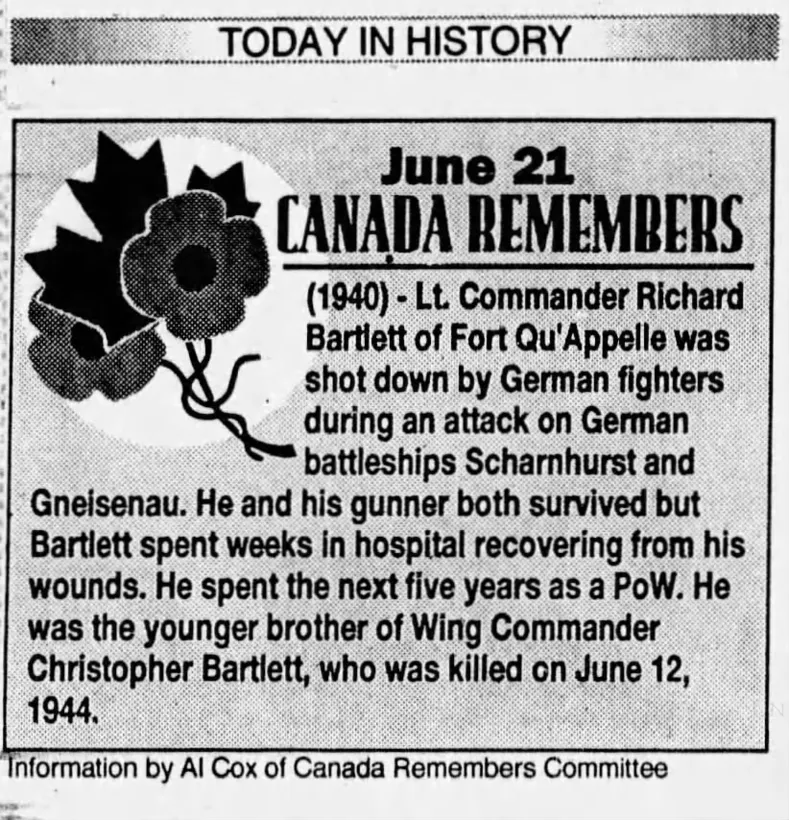
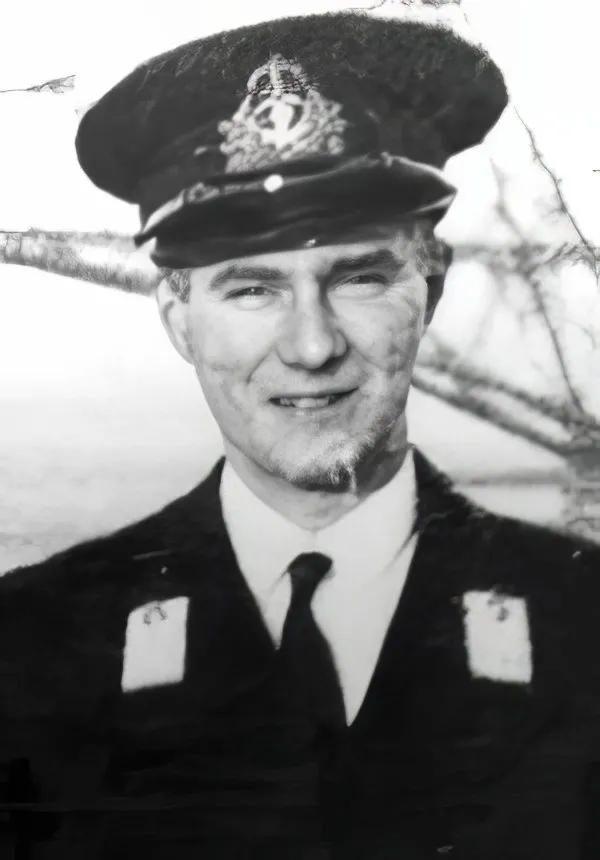
Born on Apr. 21, 1919 in Fort Qu'Appelle, Sask. After completing his senior matriculation he was accepted in 1938 by the Fleet Air Arm. After six months of general naval training aboard H.M.S. Courageous he took flying training with the Royal Air Force (R.A.F.) and was awarded his wings in 1939, at which point he became an acting sub-lieutenant. In Apr. 1940 he joined No. 803 Squadron (Skuas) in H.M.S. Ark Royal. During the Norwegian campaign air cover was provided for the retreating British army. At Trondheim harbour he was wounded and shot down while attacking the German battle cruiser Gneisenau and spent two weeks in a Norwegian hospital. He was transferred to Germany to an Air Force interrogation centre (Dulag Luft), then to Stalag Luft 1 on the Baltic coast. Describes camp conditions, low rations, first "escape committee". Enemy discovery of an escape tunnel resulted in two weeks of solitary confinement. Later, in retaliation for German prisoners held in poor conditions at Fort Henry, Kingston, Ont., they were sent to the fortress of Thorn (now Torun) in Poland and placed in dungeons. Eventually transferred to Warburg (now West Germany) where he participated in an escape.
Captured in a railyard, placed in punishment cells. Finally to Stalag Luft 3 in Silesia where the "great escape" was well under way. Not an active participant. Fifty of those who escaped were later shot as an example to others. Secret "death zones" were established by the Germans which tended to reduce the zeal for escape. In Feb. 1945, to avoid the approaching Russian Army, the prisoners were marched to the west for days, living in the open. Some died when attacked in error by British fighter aircraft. Liberated by the British army and flown to England by the R.A.F. on May 5, 1945. Bartlett rejoined the Fleet Air Arm that year and transferred to the Royal Canadian Navy in 1946. from University of Victoria Archives (British Columbia Canada)
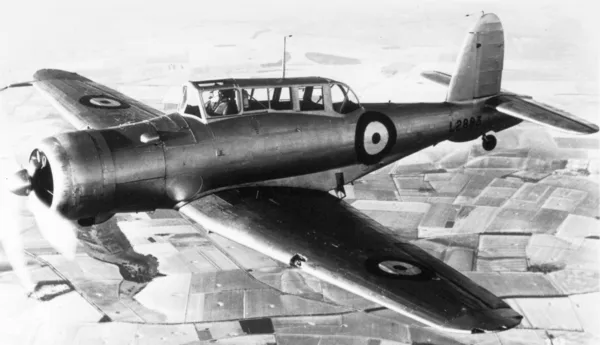
Took off in Skua #2955
Shot down after dive bombing attack on the German battleships Scharnhorst and Gneisenau
Sub Lt (A) R E Bartlett (RNFAA) and TAG L G Richards (RNFAA) force landed in Trondheimsfjord, Norway 13 June 1940. Taken Prisoner of War by the Germans 31 August 1940
German POW at Stalag XXA underground fort at Torun, Poland 1945. Liberated May 1945
Lt(A) Bartlett was BROTHER of W/C C S Bartlett (RAFVR)(Can), killed in action 1944-06-13 on 434 Squadron Halifax LW 173 WL-K during an operation over Arras, France
Canada's Naval Aviators by John MacFarlane and Robbie Hughes pages 8-9 Black Thursday - a disasterous Fleet Air Arm raid I Naval Air History