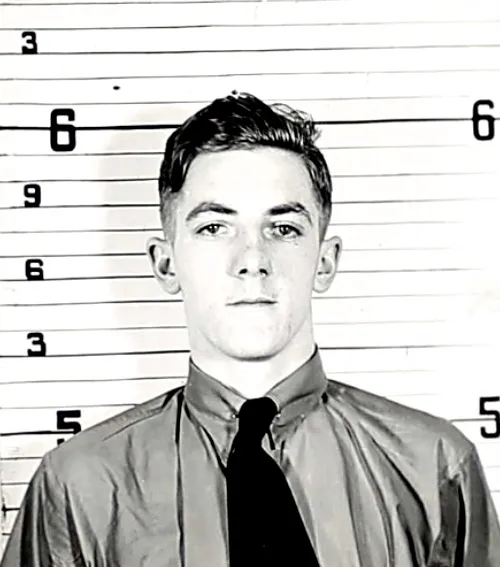
Tobin, William Benedict (Warrant Officer 2nd Class)
Killed in Action 1944-January-21
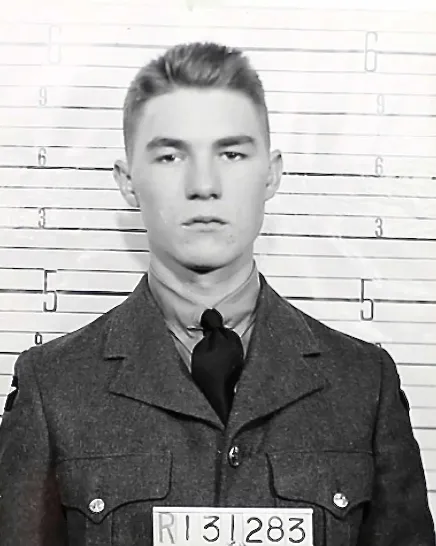

Birth Date: 1923-April-24
Born:
Parents:
Spouse:
Home: Thorold, Ontario
Enlistment:
Enlistment Date: unkown date
Service
RCAF
Unit
419 (B) Sqn- Squadron
Moosa Aswayita Beware of Moose
Base
Middleton St George
Rank
Warrant Officer 2nd Class
Position
Bomb Aimer
Service Numbers
R/131283
Home
 Thorold, Ontario
Target
Magdeburg Germany
Temporary Burial
Borne, Germany, near crash site
Remains were later exhumed from this location and reburied
 Daily Operations 6bombergroup.ca
 Canadian Virtual War Memorial
 Commonwealth War Graves Commission
 Finadagrave.com
 Library and Archives Canada Service Files (may not exist)
Crew or Other Personnel
Halifax JD466




Mission
Halifax B/GR.Mk.II JD466
Bombing Magdeburg Germany 1944-January-21 to 1944-January-21
419 (B) Sqn (RCAF) Middleton St. George
Battle of Berlin
648 aircraft- 42 I Lancasters, 224 Halifaxes, 3 Mosquitoes - on the first major raid to this target. The German controller again followed the progress of the bomber stream across the North Sea and many night fighters were in the stream before it crossed the German coast. The controller was very slow to identify Magdeburg as the target but this did not matter too much because most of the night fighters were able to stay in the bomber stream, a good example of the way the Tame Boar tactics were developing. 57 aircraft - 35 Halifaxes, 22 Lancasters - were lost, 8·8 per cent of the force; it is probable that three quarters of the losses were caused by German night fighters. The Halifax loss rate was 15·6 per cent.
·The heavy bomber casualties were not rewarded with a successful attack. Some of the Main Force aircraft now had H2S and winds which were stronger than forecast brought some of these into the target area before the Pathfinders' Zero Hour. The crews of 27 Main Force aircraft were anxious to bomb and did so before Zero Hour. The Pathfinders blamed the fires started by this early bombing, together with some very effective German decoy markers, for their failure to concentrate the marking. No details are available from Magdeburg but it is believed that most of the bombing fell outside the city. An R.A.F. man who was in hospital at Magdeburg at the time reports only, 'bangs far away'.
source: The Bomber Command War Diaries, Martin Middlebrook and Chris Everitt
419 Moose Squadron (Moosa Aswayita) RAF Middleton St George. Halifax BII aircraft JD 466 VR-E was hit by flak from the schwere Flak-Abteilung 539 and crashed at 1 km northwest of Borne, Sachsen-Anhalt, Germany during a raid against Magdeburg, Germany
There were no survivors among this crew
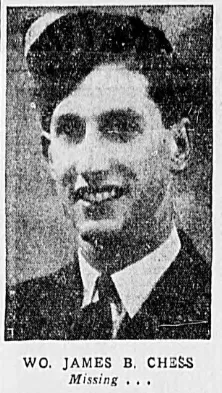
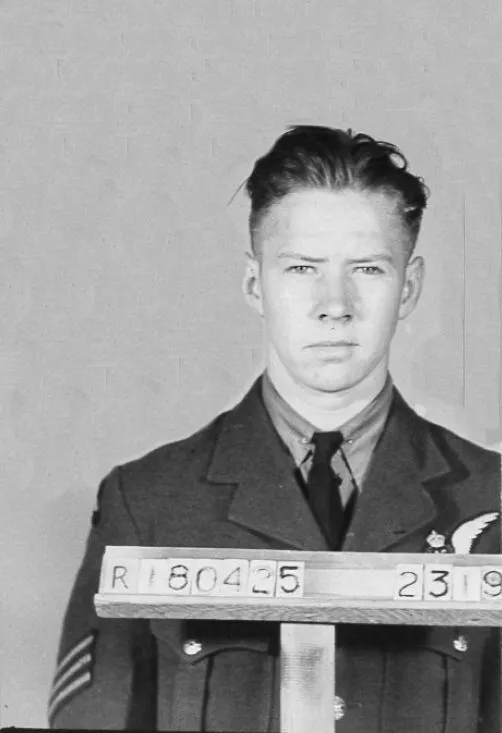
Warrant Officer Class 2 TB Tobin (RCAF), Flight Lieutenant AG Hermitage (RCAF), Warrant Officer Class 2 RH Walton (RCAF), Pilot Officer JB Chess (RCAF), Sergeant JA Wilson (RCAF), Sergeant RW Edwards (RCAF), and Sergeant R Shields (RAFVR) were all killed in action
This aircrew were initially buried in Borne, Germany, near the crash site, but later exhumed and all were re-buried in the 1939-1945 Berlin War Cemetery
There were two 419 Squadron Halifax II aircraft lost on this operation. See Fletcher, WJ for information on Halifax JD 420 VR-D
Halifax serial: JD466
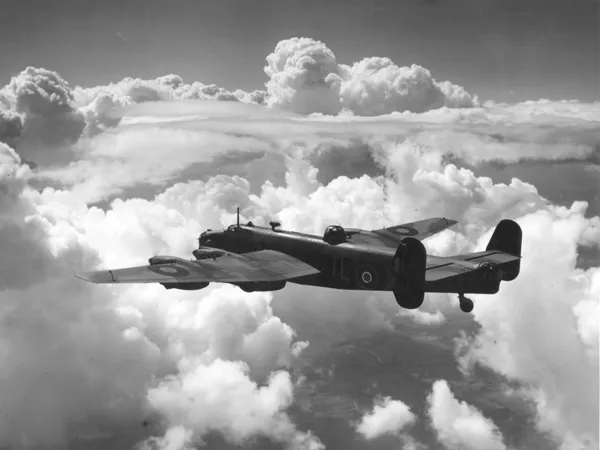
(RAF Photo, 1942)(Source Harold A Skaarup Web Page)
A Royal Air Force Handley Page Halifax Mk. II Series I (Serial No. W7676), coded TL-P, of No. 35 Squadron, RAF, based at Linton-on-Ouse, Yorkshire in the UK, being piloted by Flight Lieutenant Reginald Lane, (later Lieutenant-General, RCAF), over the English countryside. Flt Lt Lane and his crew flew twelve operations in W7676, which failed to return from a raid on Nuremberg on the night of 28/29 August 1942, when it was being flown by Flt Sgt D. John and crew.
The Handley Page Halifax is a British Royal Air Force (RAF) four-engined heavy bomber of the Second World War. It was developed by Handley Page to the same specification as the contemporary twin-engine Avro Manchester.
The Halifax has its origins in the twin-engine HP56 proposal of the late 1930s, produced in response to the British Air Ministry's Specification P.13/36 for a capable medium bomber for "world-wide use." The HP56 was ordered as a backup to the Avro 679, both aircraft being designed to use the underperforming Rolls-Royce Vulture engine. The Handley Page design was altered at the Ministry to a four-engine arrangement powered by the Rolls-Royce Merlin engine; the rival Avro 679 was produced as the twin-engine Avro Manchester which, while regarded as unsuccessful mainly due to the Vulture engine, was a direct predecessor of the famed Avro Lancaster. Both the Lancaster and the Halifax would emerge as capable four-engined strategic bombers, thousands of which would be built and operated by the RAF and several other services during the War.
On 25 October 1939, the Halifax performed its maiden flight, and it entered service with the RAF on 13 November 1940. It quickly became a major component of Bomber Command, performing routine strategic bombing missions against the Axis Powers, many of them at night. Arthur Harris, the Air Officer Commanding-in-Chief of Bomber Command, described the Halifax as inferior to the rival Lancaster (in part due to its smaller payload) though this opinion was not shared by many of the crews that flew it, particularly for the MkIII variant. Nevertheless, production of the Halifax continued until April 1945. The operational statistics from the Bomber Command War Room Manual, state 82,773 operational sorties 2,232 aircraft lost of which 1,833 were missing, in addition there were 365 anti submarine patrols with 4 aircraft lost. Halifax laid 9,572 mines according to the war manual, daily reports total 9,550 being 851x1000, 6,450x1500 and 2,248x1850 pound mines.. The Halifax was also flown in large numbers by other Allied and Commonwealth nations, such as the Royal Canadian Air Force (RCAF), Royal Australian Air Force (RAAF), Free French Air Force and Polish forces. Wikipedia
 Halifax Heavy Bomber WWII
 Wikipedia Halifax Bomber
Unit Desciption
419 (B) Sqn Moosa Aswayita ("Moose")
History of the Squadron during World War II (Aircraft: Wellington IC, III, Halifax II, Lancaster X)
419 (Bomber) Squadron formed at RAF Mildenhall, Suffolk, UK in 1941 as part of No 3 Group of Bomber Command. It got its name from its first commanding officer, Wing Commander John "Moose" Fulton, DSO, DFC, AFC. The squadron operated Vickers Wellington, then Handley Page Halifax and finally Avro Lancaster bombers through the course of WWII, with the squadron code letters VR. It was the third RCAF bomber unit to be formed in England. It started operations in January 1942, converting almost immediately from Wellington Mk ICs to Wellington Mk IIIs and then moving north to Leeming, Yorkshire, as part of 4 Group Bomber Command in August 1942. After short stays at Topcliffe and Croft , it moved to Middleton St. George, County Durham in November 1942, from which it flew until the end of hostilities. Here in November 1942 it was re-equipped with Halifax Mk IIs, which it flew for the next 18 months on the night offensive against Germany. In January 1943 it joined the newly formed 6 (RCAF) Group of Bomber Command.
In April 1944 the squadron began to convert to the Avro Lancaster Mk X, which was produced in Canada and flown across the Atlantic. The squadron remained continuously on the offensive until 25 April 1945, when it flew its last sortie. Squadron personnel flew a total of 4,325 operational sorties during the war from Mannheim to Nuremberg, Milan to Berlin and Munich to Hanover, inflicting heavy damage on the enemy. On completion of the war in Germany, the squadron was earmarked to become part of the proposed "Tiger Force" to continue the war against Japan. However, the Japanese surrender in August 1945 led to the disbandment of the squadron in at Yarmouth, Nova Scotia September 1945.
As a result of its wartime record, 419 Squadron became one of the most decorated units under the RCAF during the war. Over a span of roughly three-and-a-quarter years it logged 400 operational missions (342 bombing missions, 53 mining excursions, 3 leaflet raids and 1 "spoof") involving 4,325 sorties. A total of one hundred and twenty nine aircraft were lost on these operations. Members of the squadron accumulated 1 VC, 4 DSO's, 1 MC, 150 DFC's, 3 bars to DFC, 1 CGM, 35 DFM's: the VC was awarded posthumously to Flight Sergeant Andrew Mynarski for his attempts to help a fellow crew member escape from their burning aircraft. Battle Honours were: English Channel and North Sea 1942-44, Baltic 1942-44, Fortress Europe 1942-44, France and Germany 1944-45, Biscay Ports 1942-44, Ruhr 1942-45, Berlin 1943-44, German Ports 1942-45, Normandy 1944, Rhine, Biscay 1942; 1944. Wikipedia, Kostenuk and Griffin
 Squadron History (Bomber Command Museum)
Maps for Movements of 419 Squadron 1941-45
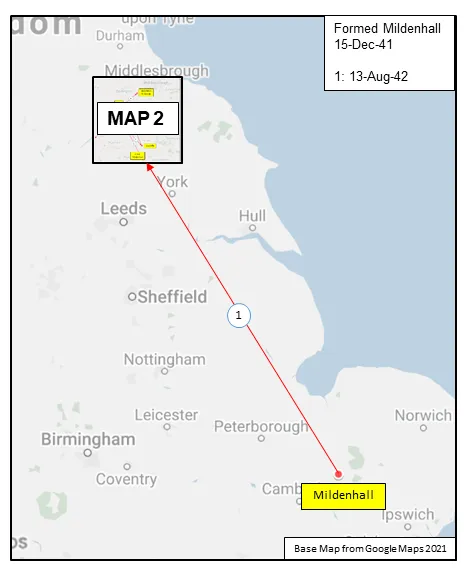
MAP 1: 419 Squadron Movements Dec 1941-Aug-42 (right-click on image to display enlarged new tab)
|
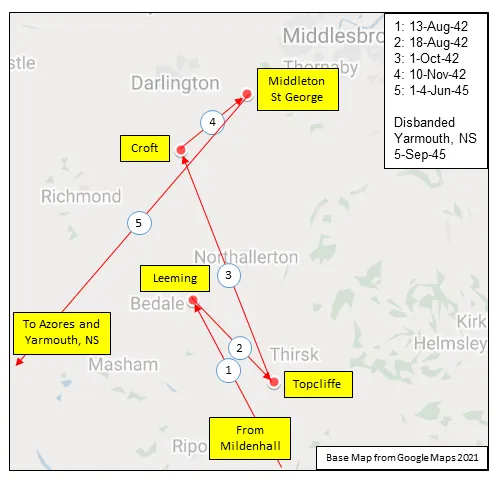
MAP 2: 419 Squadron Movements Aug 1942-Jun 1945
|
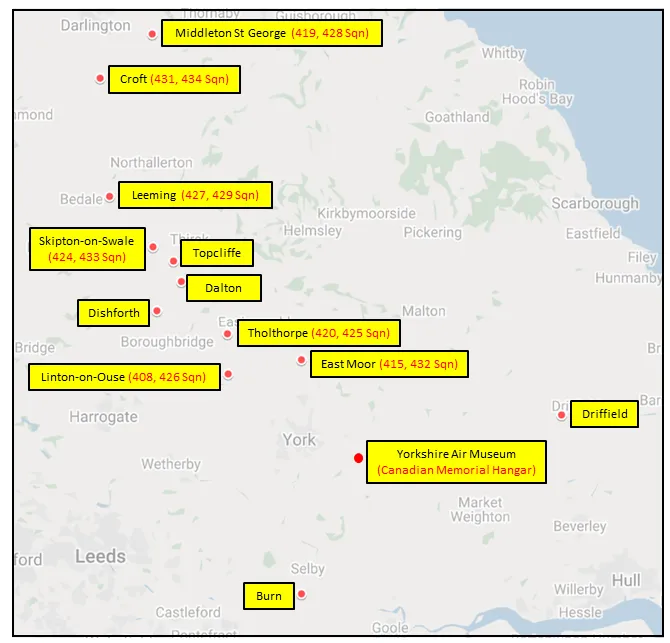
MAP 3: 6 Group Bomber Bases 1943-1945
|
419 Squadron History Summary 1941-45
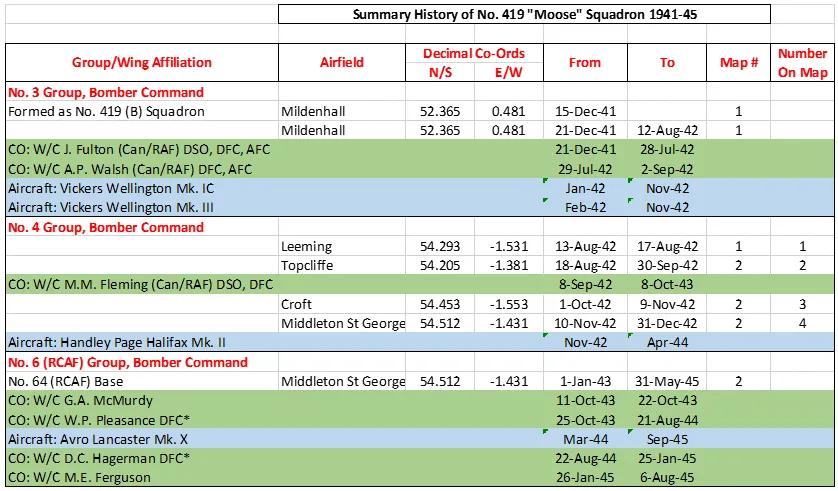
419 Squadron History Summary 1941-45 Page 2

History of the Squadron Post-WWII (Aircraft: Canuck, Silver Star, Freedom Fighter, Hornet)
The squadron was reactivated on 15 March 1954 at North Bay, Ontario , as an all-weather fighter squadron flying the CF-100 Canuck. It moved to the NATO Air Division base at Baden-Soellingen, Germany shortly after being formed. The squadron remained there until its disbandment in December 1962.
The squadron was again re-formed in December 1970, when it relocated to Cold Lake, Alberta as No. 1 Canadian Forces Flight Training School. It initially flew the T-33 Silver Star but then transitioned to the Canadair CF-5 Freedom Fighter. The squadron was on full active duty in November 1975 but disbanded again 20 years later when the CF-5’s were retired in June 1995.
The squadron was again reactivated as 419 Tactical Fighter (Training) Squadron on 23 July 2000. The squadron has since conducted Phase IV of the NATO Flying Training Canada (NFTC) program for the air forces of Canada, Austria, Denmark, Italy, Hungary, Saudi Arabia, Singapore, the United Arab Emirates and the United Kingdom. This program trains basic jet pilots to become fighter pilots and prepares them for training on CF-188 class aircraft through instruction in Air-to-Air and Air-to-Ground combat tactics over a six month period.
Halifax JD466 B/GR.Mk.II - Bombing Magdeburg Germany - 1944-01-21 to 1944-01-21
Squadron: 419 (B) Sqn (RCAF)
Start Date: 1944-01-21
Completion Date: 1944-01-21
Mission: Bombing
Operation: Battle of Berlin
Target City: Magdeburg Germany
Target Specific:
Base: Middleton St. George
Take Off Time: 19.41
Squadron Code: VR E
Radio Code:
Return Base:
Return Time:
Crash City: 1 km northwest of Borne, Sachsen-Anhalt, Germany
Crash Specifics:
Crash Latitude: 0.00000000
Crash Longitude: 0.00000000
Crash Reason: flak
Flak Battery:
Enemy Claim:
War Diary Unavailable
6 Group Unavailable
648 aircraft- 42 I Lancasters, 224 Halifaxes, 3 Mosquitoes - on the first major raid to this target. The German controller again followed the progress of the bomber stream across the North Sea and many night fighters were in the stream before it crossed the German coast. The controller was very slow to identify Magdeburg as the target but this did not matter too much because most of the night fighters were able to stay in the bomber stream, a good example of the way the Tame Boar tactics were developing. 57 aircraft - 35 Halifaxes, 22 Lancasters - were lost, 8·8 per cent of the force; it is probable that three quarters of the losses were caused by German night fighters. The Halifax loss rate was 15·6 per cent.
·The heavy bomber casualties were not rewarded with a successful attack. Some of the Main Force aircraft now had H2S and winds which were stronger than forecast brought some of these into the target area before the Pathfinders' Zero Hour. The crews of 27 Main Force aircraft were anxious to bomb and did so before Zero Hour. The Pathfinders blamed the fires started by this early bombing, together with some very effective German decoy markers, for their failure to concentrate the marking. No details are available from Magdeburg but it is believed that most of the bombing fell outside the city. An R.A.F. man who was in hospital at Magdeburg at the time reports only, 'bangs far away'.
source: The Bomber Command War Diaries, Martin Middlebrook and Chris Everitt
419 Moose Squadron (Moosa Aswayita) RAF Middleton St George. Halifax BII aircraft JD 466 VR-E was hit by flak from the schwere Flak-Abteilung 539 and crashed at 1 km northwest of Borne, Sachsen-Anhalt, Germany during a raid against Magdeburg, Germany
There were no survivors among this crew
Warrant Officer Class 2 TB Tobin (RCAF), Flight Lieutenant AG Hermitage (RCAF), Warrant Officer Class 2 RH Walton (RCAF), Pilot Officer JB Chess (RCAF), Sergeant JA Wilson (RCAF), Sergeant RW Edwards (RCAF), and Sergeant R Shields (RAFVR) were all killed in action
This aircrew were initially buried in Borne, Germany, near the crash site, but later exhumed and all were re-buried in the 1939-1945 Berlin War Cemetery
There were two 419 Squadron Halifax II aircraft lost on this operation. See Fletcher, WJ for information on Halifax JD 420 VR-D
