Multiple RCAF fatalities associated with this accident.No burial information available.
Smith, John Michael (Captain)
Killed in Flying Accident 1982-November-16


Birth Date: 1953
Born:
Parents: Son of Raymond Smith of Armdale, Nova Scotia.
Spouse: Husband of Carol Audrey (nee King) Smith and father of David, Jennifer and Bradley Smith of Trenton, Ontario.
Home:
Enlistment:
Enlistment Date: unkown date
Service
RCAF
Unit
436 Sqn- Squadron
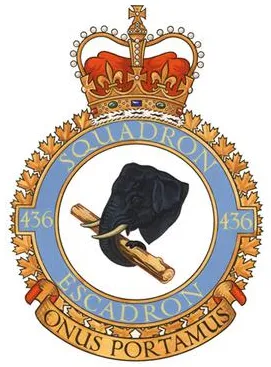
Onus Portamus We carry the load
Base
Rank
Captain
Position
Pilot
Service Numbers
 Canadian Virtual War Memorial
Crew or Other Personnel
Hercules 130329





Hercules serial: 130329

CC-130H Hercules
(Source RCAF Web Page)
(Source RCAF Web Page)
 Hercules
 Wikipedia Hercules
 Harold A Skaarup Web Page
 CC-130 Hercules - Kestrel Publications
Hercules CC-130H 130329
USAF serial 73-1589 issued for book keeping, no record of it actually being marked externally (does appear on serial plate). Delivered to 435 Squadron on 26 September 1974. Later served with 436 (T) Squadron. Flew this squadron's first operational LAPES mission on 8 April 1982, when it delivered 64 drums of fuel near Eureka, NWT. Crashed and destroyed during LAPES demonstration at CFB Namao, Alberta on 16 November 1982. Crashed when load jammed in aircraft, with chute deployed. 7 fatalities, including Sgt. D.G. Buchan, Sgt. J.R. Gionet, Capt. T.C. Harper, and Capt. R.F. Lovell of 435 Squadron, and Capt. J.M. Smith; and Master Corporal L.D. Smith of 436 Squadron.{{link,general,https://aviation-safety.net/database/record.php?id=19821116-1,Aviation Safety.net}}
1974-10-16 Taken on Strength 2019-08-20
1983-06-28 Struck off Strength Struck off after crash, see comments. 2019-08-20


Unit Desciption
436 Sqn Onus Portamus ("Elephant")
History of the Squadron during World War II (Aircraft: Dakota III, IV)
No 436 was the 33rd RCAF squadron formed overseas in WWII. It was the 2nd transport squadron and the first formed in India. It was inaugurated on August 20, 1944 at Gujrat, Punjab, India  . It flew Dakota aircraft in support of the British 14th Army in northern Burma, and was known as “Canucks Unlimited”. After cessation of hostilities in the Far East, the squadron relocated to Down Ampney, Gloucstershire, England , where it provided transport services in Britain and Europe for Canadian units. It was finally disbanded at Odiham, Hampshire on June 22, 1946.
Overall, in Burma the squadron flew 1906 sorties, airlifted 29,000 tons of freight and supplies, 15,000 troops, passengers and casualties. Casualties were 3 aircraft, 4 aircrew killed. An additional 6983 operational hours were flown in England. Awards gained by the squadron were 1 DSO, 26 DFCs, 1 AFM, 3 BEMs and 11 MiD. Battle Honours: Burma 1945.Wikipedia, Kostenuk and Griffin
Maps for Movements of 436 Squadron 1944-46
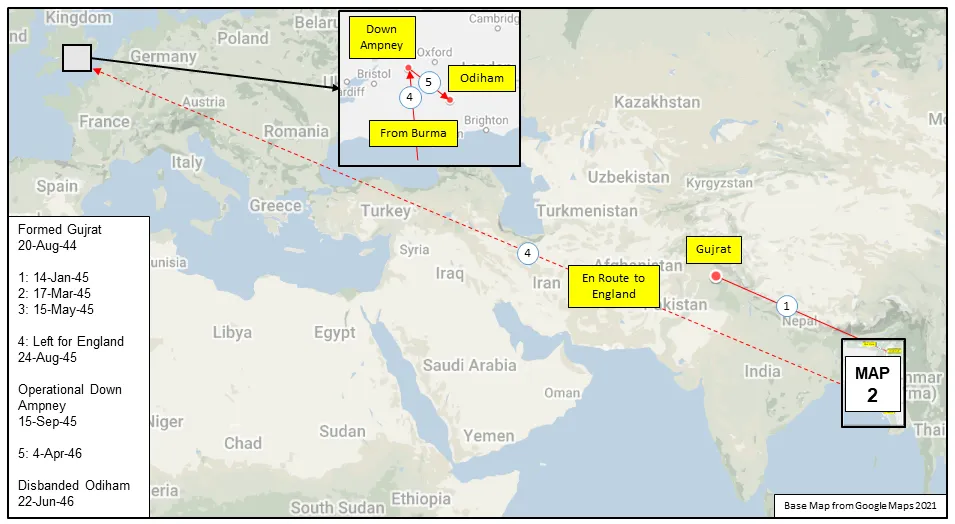
MAP 1: 436 Squadron Movements 1944-46 (right-click on image to display enlarged in new tab)
|
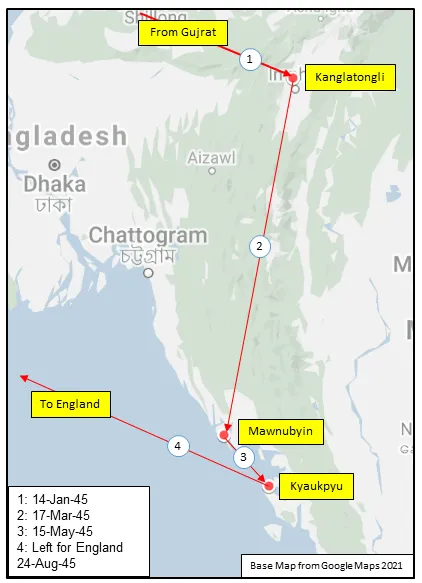
MAP 2: 436 Squadron Movements in India and Burma 1945 (detail of Map 1)
|
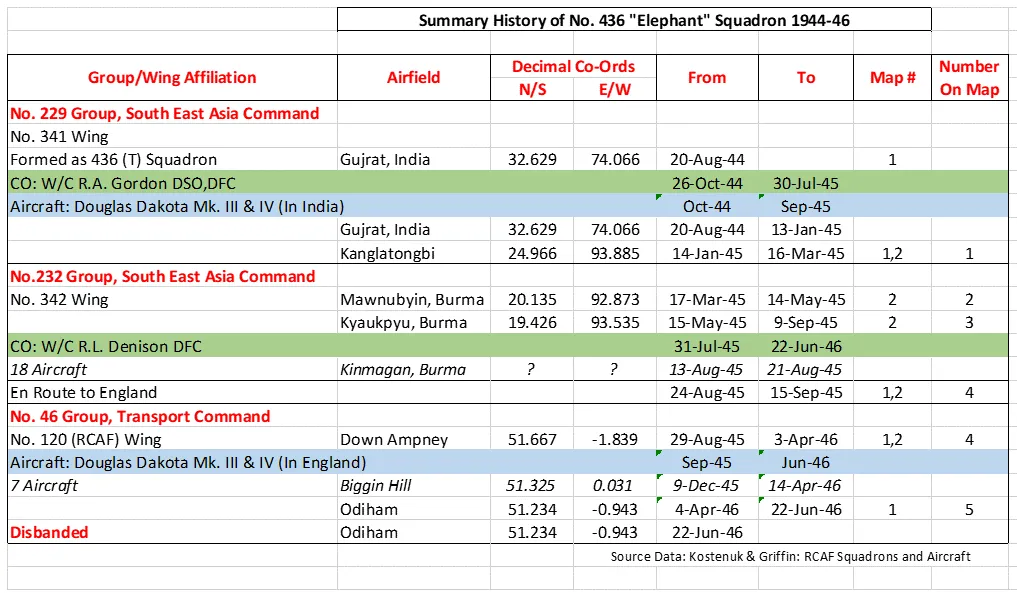
436 Squadron History Summary 1944-46
 Voices from the Past: Burma Memories 25:39
History of the Squadron Post-WWII (Aircraft: Boxcar, Hercules)
The squadron was re-formed at RCAF Station Dorval on 1 April 1949, flying Fairchild C-119 Flying Boxcar transport aircraft. In 1955 it helped move No. 1 Fighter Wing from England to France, and also carried out emergency airlifts of supplies to No.1 Air Division in Europe. It moved to RCAF Station Downsview on 1 July 1956, RCAF Station Uplands in August 1964. The squadron replaced its Boxcars with Lockheed C-130E Hercules in 1965: these were later replaced by CC-130J Super Hercules aircraft which are currently operated by the squadron. Its final move was to CFB Trenton on 11 August 1971.
436 Transport Squadron now provides tactical and strategic airlift capabilities for the Canadian Armed Forces. The unit has operated aircraft from Afghanistan, sent aircraft and personnel to support Operation MOBILE during the 2011 military intervention in Libya and deployed its Hercules assets in support of Operation IMPACT.