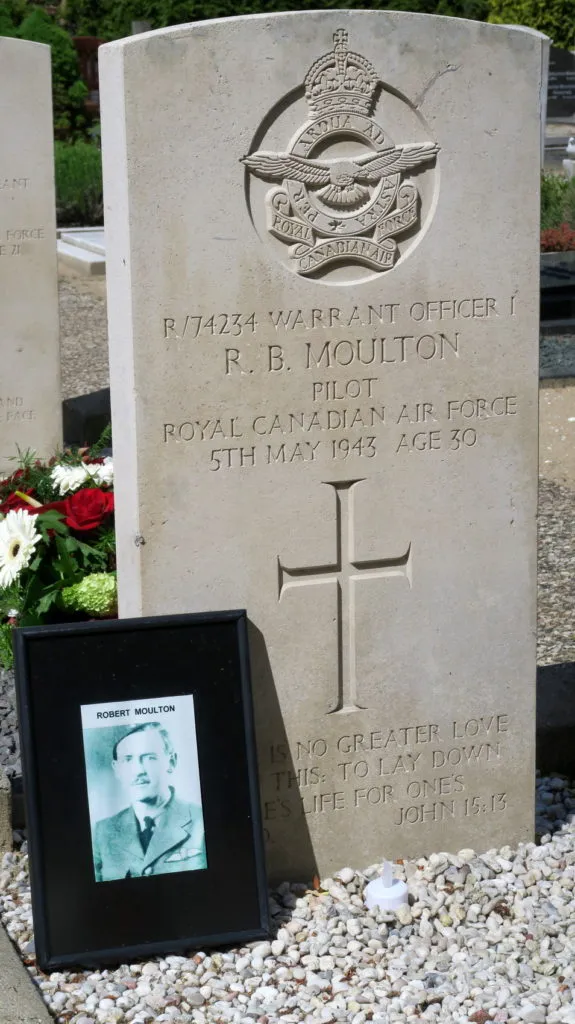
Grave marker for Warrant Officer 1 Robert Moulton Photo Henk Butink
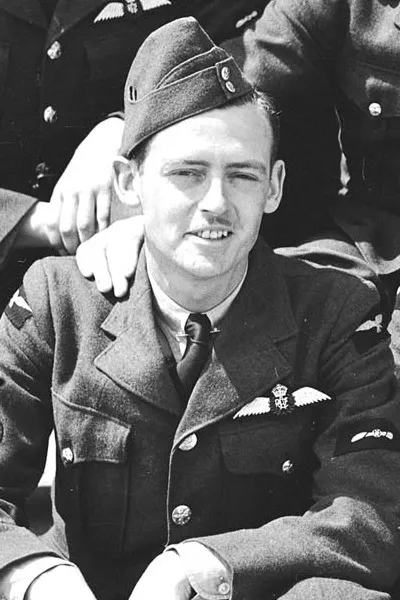

Birth Date: 1912-November-21
Born: Brockville, Ontario
Parents: Son of Benjamin Moulton and Sophrona Moulton, (nee McNamara). He had one sibling, a younger brother named Thomas Adrian Moulton, who served four months in The Netherlands with the Cameron Highlanders.
Spouse:
Home: Brockville, Ontario
Enlistment: Ottawa, Ontario
Enlistment Date: 1940-October-11
Service
RCAF
Unit
428 (B) Sqn- Squadron
Usque Ad Finem To the Very End
Base
RAF Dalton
Rank
Warrant Officer 1st Class
Position
Pilot
Service Numbers
R/74234
 Brockville, Ontario
Dortmund Germany
Brockville, Ontario
Dortmund Germany
On May 5, 1943, the Vickers Wellington NA-K HE 727 bomber crashed in Wilnis (now part of De Ronde Venen) in a field near what is now the roundabout at Mijdrechtse Dwarsweg-Ir. Enschedeweg. The Vickers Wellington was part of the 428 Ghost Squadron of the Royal Canadian Air Force and had taken off the day before with five crew members from Dalton Airfield in Graafschap Yorkshire, England.
The target was Dortmund. The attack on Dortmund was, at that time, the largest Allied air raid on a German city during World War II. A total of 596 bombers participated, 31 of which "failed to return." Of these, 31 bombers crashed in the Netherlands.
From a military perspective, the attack was successful. Reports indicate that the bombing caused severe damage to the city. More than 1,200 buildings were destroyed, and nearly 2,000 others were damaged, including factories of Hoesch and the Dortmund Union Steelworks. The bombing resulted in nearly 700 deaths, with around 200 prisoners of war who had been forced to work in the war industry among them. Almost 1,100 people were injured.
The Vickers Wellington was attacked on its return flight by a Messerschmitt Me-110, piloted by Hauptmann Hans-Dieter Frank. The bomber caught fire and lost altitude.
The pilot, Warrant Officer Class I Robert Moulton, ordered the crew to bail out. Navigator Flight Sergeant Gordon Carter and wireless operator/gunner Flight Sergeant Howard Hoddinott managed to parachute out and were taken as prisoners of war. They survived the war. It appears that pilot Robert Moulton attempted an emergency landing to prevent the burning aircraft from crashing into the village of Wilnis. About one kilometer north of the village, the aircraft hit the ground and quickly disappeared almost entirely into the soft peat soil. Although Flight Sergeant Hoddinott was handed a parachute, pilot Robert Moulton did not survive the crash. Bomb aimer/gunner Flight Sergeant Joseph White and rear gunner Flight Sergeant Adrien Thibaudeau also lost their lives and were declared missing.
During a recovery operation in September 2002, the Royal Netherlands Air Force and the Army Identification Service found the mortal remains of the three missing crew members. They were identified, and a military burial followed, with three individual graves at the Dutch Reformed Cemetery in Wilnis.
The recovery of the three crew members was initiated by the Vickers Wellington 1943 Recovery Foundation in Mijdrecht. The process took seven years, including legal procedures and research.
2019 / Mr. Jan C.K. van Loo
Chairman of the Vickers Wellington 1943 Recovery Foundation
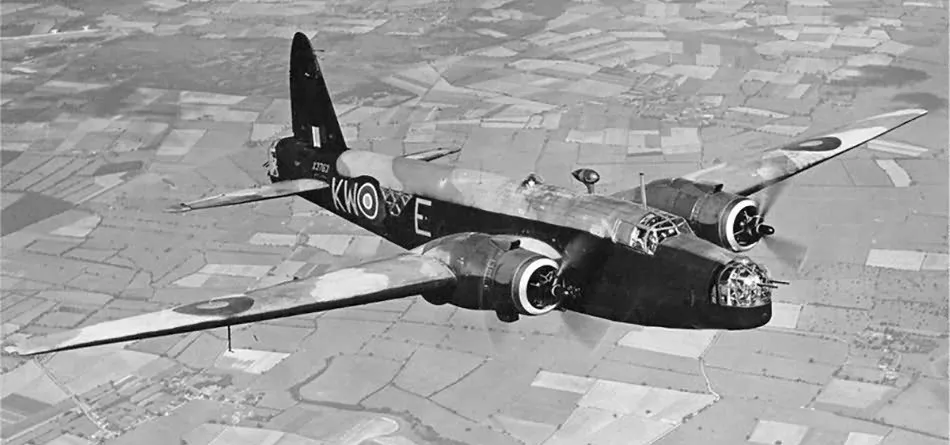
The Vickers Wellington was a British twin-engined, long-range medium bomber. It was designed during the mid-1930s at Brooklands in Weybridge, Surrey. Led by Vickers-Armstrongs' chief designer Rex Pierson, a key feature of the aircraft is its geodetic airframe fuselage structure, which was principally designed by Barnes Wallis. Development had been started in response to Air Ministry Specification B.9/32, issued in the middle of 1932, for a bomber for the Royal Air Force. This specification called for a twin-engined day bomber capable of delivering higher performance than any previous design.
The Wellington was used as a night bomber in the early years of the Second World War, performing as one of the principal bombers used by Bomber Command. During 1943, it started to be superseded as a bomber by the larger four-engined "heavies" such as the Avro Lancaster. The Wellington continued to serve throughout the war in other duties, particularly as an anti-submarine aircraft.
It holds the distinction of having been the only British bomber that was produced for the duration of the war, and of having been produced in a greater quantity than any other British-built bomber. The Wellington remained as first-line equipment when the war ended, although it had been increasingly relegated to secondary roles. The Wellington was one of two bombers named after Arthur Wellesley, 1st Duke of Wellington, the other being the Vickers Wellesley.
In August 1936, an initial order for 180 Wellington Mk I aircraft, powered by a pair of 1,050 hp (780 kW) Bristol Pegasus radial engines, was received by Vickers; it had been placed so rapidly that the order occurred prior to the first meeting intended to decide the details of the production aircraft. In October 1937, another order for a further 100 Wellington Mk Is, produced by the Gloster Aircraft Company, was issued; it was followed by an order for 100 Wellington Mk II aircraft with Rolls-Royce Merlin X V12 engines. Yet another order was placed for 64 Wellingtons produced by Armstrong Whitworth Aircraft. With this flurry of order and production having been assured by the end of 1937, Vickers set about simplifying the manufacturing process of the aircraft and announced a target of building one Wellington per day.
A total of 180 Wellington Mk I aircraft were built; 150 for the RAF and 30 for the Royal New Zealand Air Force (RNZAF) (which were transferred to the RAF on the outbreak of war and used by 75 Squadron). In October 1938, the Mk I entered service with 9 Squadron. The Wellington was initially outnumbered by the Handley Page Hampden (also ordered by the Ministry to B.9/32) and the Armstrong Whitworth Whitley (to B.34/3 for a 'night' bomber) but outlasted both rival aircraft in service. The Wellington went on to be built in 16 separate variants, in addition to two training conversions after the war. The number of Wellingtons built totalled 11,462 of all versions, a greater quantity produced than any other British bomber. On 13 October 1945, the last Wellington to be produced rolled out. Wikipedia
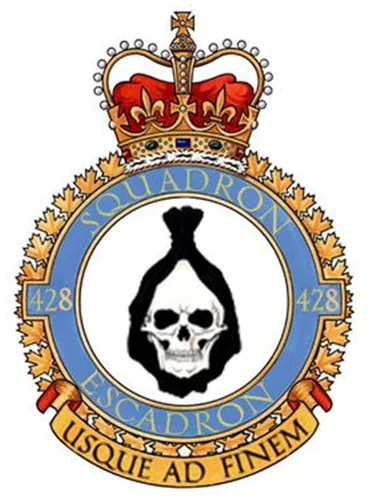
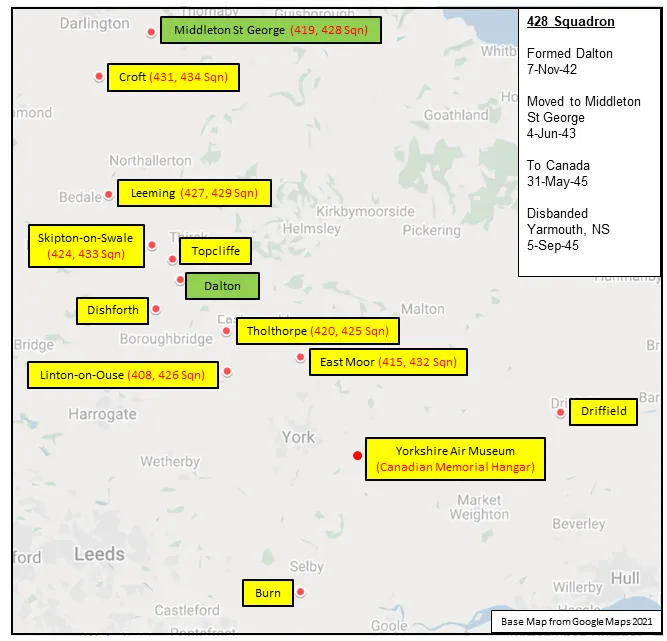
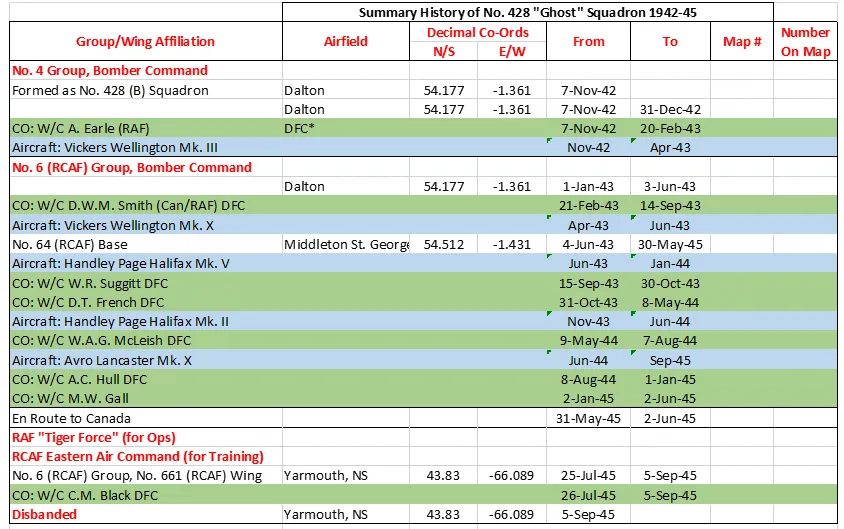
No 428 Squadron was the ninth long-range heavy bomber squadron and the 26th RCAF squadron formed overseas during the Second World War. It was formed at RAF Dalton in Yorkshire, England on November 7, 1942. The squadron was initially assigned to No. 4 Group RAF Bomber Command. With the creation of No. 6 Group RCAF, the squadron was reallocated on January 1, 1943 operating with it until April 25, 1945.
The squadron was originally equipped with Vickers Wellington Mk III and X, and its first operational mission was on January 26–27, 1943, when five Wellingtons bombed the U-Boat base at Lorient in Brittany, on the Bay of Biscay. In the early part of June 1943, the squadron moved to RAF Middleton St. George, Durham where it remained for the remainder of the war. Around this time the squadron was converted to Handley Page Halifaxes (Mk Vs, and later supplemented by Mk II Series IIA). In January 1944, Halifax bombers from No. 428 Squadron participated in the first high-level mining raid "Gardening", when mines were dropped by parachute from 15,000 feet (4,570 m) over Brest on 4/5 Jan and Saint-Nazaire on 6/7 Jan 1944. The squadron flew its last sortie with the Halifax on June 12, 1944 then converted to the Canadian-built Avro Lancaster Mk X, the first sortie taking place on June 14, 1944.
For the final phase of the air campaign against Germany, the squadron took part in day and night raids, with its last operational sortie taking place on April 25, 1945, when 15 Lancasters bombed anti-aircraft gun batteries defending the mouth of the Weser, on the Frisian Island of Wangerooge. The squadron remained in service in the United Kingdom until the end of May 1945, then flew to Yarmouth, Nova Scotia . The squadron was intended to be part of the "Tiger Force" to carry on the war against Japan, but the Japanese surrender led to the disbandment of the force. The squadron was therefore disbanded at Yarmouth in September 1945.
In the course of WWII operations, the squadron flew 283 missions involving 3467 individual sorties. 84 aircraft were lost and a total of 9378 tons of bombs were dropped. the aircrew earned 2 DSO's, 71 DFC's, 2 CGM's and 6 DFM's. Battle Honours were: English Channel and North Sea 1943-44, Baltic 1944, Fortress Europe 1943-44, France and Germany 1944-45, Biscay Ports 1943-44, Ruhr 1943-45, Berlin 1943-44, German Ports 1943-45, Normandy 1944, Rhine, Biscay 1943-44. Wikipedia, Kostenuk and Griffin
Squadron History (Bomber Command Museum PDF)
The squadron was re-activated as the fifth Avro Canada CF-100 Canuck equipped squadron, on June 21, 1954, at RCAF Station Uplands as 428 All-Weather (Fighter) Squadron. It was re-activated, as one of nine Canadian based RCAF squadrons, to be operating under the new RCAF Air Defence Command, protecting North American airspace from Soviet intruders and long range bombers. The squadron was finally disbanded on 1 June 1961.
War Diary Unavailable
3 Wellingtons from 426 and 429 Squadrons were ordered out on a sea search. All crews returned safely, but unsuccessful. Richard Koval (6bombergroup.ca)
On May 5, 1943, the Vickers Wellington NA-K HE 727 bomber crashed in Wilnis (now part of De Ronde Venen) in a field near what is now the roundabout at Mijdrechtse Dwarsweg-Ir. Enschedeweg. The Vickers Wellington was part of the 428 Ghost Squadron of the Royal Canadian Air Force and had taken off the day before with five crew members from Dalton Airfield in Graafschap Yorkshire, England.
The target was Dortmund. The attack on Dortmund was, at that time, the largest Allied air raid on a German city during World War II. A total of 596 bombers participated, 31 of which "failed to return." Of these, 31 bombers crashed in the Netherlands.
From a military perspective, the attack was successful. Reports indicate that the bombing caused severe damage to the city. More than 1,200 buildings were destroyed, and nearly 2,000 others were damaged, including factories of Hoesch and the Dortmund Union Steelworks. The bombing resulted in nearly 700 deaths, with around 200 prisoners of war who had been forced to work in the war industry among them. Almost 1,100 people were injured.
The Vickers Wellington was attacked on its return flight by a Messerschmitt Me-110, piloted by Hauptmann Hans-Dieter Frank. The bomber caught fire and lost altitude.
The pilot, Warrant Officer Class I Robert Moulton, ordered the crew to bail out. Navigator Flight Sergeant Gordon Carter and wireless operator/gunner Flight Sergeant Howard Hoddinott managed to parachute out and were taken as prisoners of war. They survived the war. It appears that pilot Robert Moulton attempted an emergency landing to prevent the burning aircraft from crashing into the village of Wilnis. About one kilometer north of the village, the aircraft hit the ground and quickly disappeared almost entirely into the soft peat soil. Although Flight Sergeant Hoddinott was handed a parachute, pilot Robert Moulton did not survive the crash. Bomb aimer/gunner Flight Sergeant Joseph White and rear gunner Flight Sergeant Adrien Thibaudeau also lost their lives and were declared missing.
During a recovery operation in September 2002, the Royal Netherlands Air Force and the Army Identification Service found the mortal remains of the three missing crew members. They were identified, and a military burial followed, with three individual graves at the Dutch Reformed Cemetery in Wilnis.
The recovery of the three crew members was initiated by the Vickers Wellington 1943 Recovery Foundation in Mijdrecht. The process took seven years, including legal procedures and research.
2019 / Mr. Jan C.K. van Loo
Chairman of the Vickers Wellington 1943 Recovery Foundation
 Canadian Virtual War Memorial
 Library and Archives Canada Service Files (may not exist)

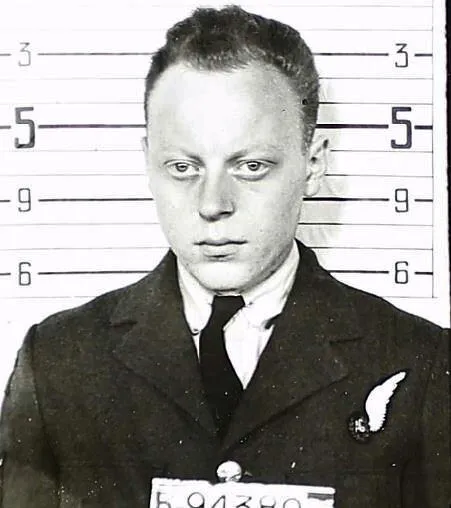
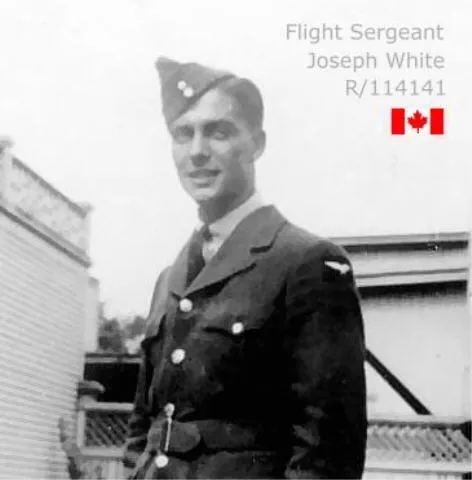
 About the crew of the Vickers Wellington HE727
 Wikipedia Vickers Wellington
 YouTube Vickers Wellington documentary