McFarlane, Cyril Robert Hudson (Leading Aircraftman)
Killed in Flying Accident 1942-April-07


Birth Date: 1911-September-22
Born:
Parents: Son of Jessie McFarlane, of Hamilton, Auckland, New Zealand
Spouse: husband of L. M. McFarlane, of Wellington City, New Zealand
Home:
Enlistment:
Enlistment Date: unkown date
Service
RNZAF
Unit
10 AOS- Air Observer School
Base
RCAF Stn. Chatham, New Brunswick
Rank
Leading Aircraftman
Position
Service Numbers
413946
 Ottawa War Memorial
 Find a Grave Memorial - Second Find a grave memorial
 Commonwealth War Graves Commission
 Finadagrave.com
Crew or Other Personnel
Anson 6631

Anson serial: 6631
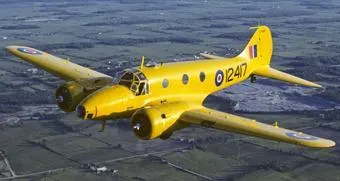
Canadian Warplane Heritage Museum
The Museum's Anson Mk. V was built by MacDonald Brothers in Winnipeg in 1944. It flew with No. 7 Photographic Wing and No. 414 Squadron in Ottawa on photo survey work until the late 1940s. In 1956, it was purchased by INCO and used for mineral surveying until 1980, when it was donated to the Museum. The exterior is painted in the yellow colour common to all BCATP trainers and is in its same wartime RCAF markings.
The Avro Anson was known by a number of nicknames including "Faithful Annie" or "Flying Greenhouse". It was the first aircraft to be flown by the Royal Canadian Air Force to have a retractable undercarriage, which was a comparative novelty in 1936. In 1940, a Canadian government owned company, Federal Aircraft Limited, was created in Montreal to manufacture the Anson for Canadian use. Nearly 3,000 Anson aircraft were produced and, in the early days of the British Commonwealth Air Training Plan (BCATP), the Anson was the standard trainer for many pilots, observers (navigators), wireless operators and bomb aimers. More than 20,000 aircrew received training on the Anson. In Canadian service, the aircraft was substantially re-designed with the substitution of North American engines and many other airframe and equipment changes. Harold Skaarup web pages
 Avro Anson History
Anson Mk. I 6631
Ex RAF W2421. To No. 3 Training Command on 8 July 1941, for use by No. 10 Air Observer School at Chatham, NB. Category D damage at Chatham on 13 December 1941, when an ambulance collided with this parked aircraft. Missing out of Chatham on 7 April 1942 on a night navigation exercise. Later declared Category A. The aircraft was never located, but body of one of the three crew washed up on the beach near Shediac, NB several months later. Ownership to Eastern Air Command on 10 September 1942 for write off.1941-06-17 Taken on Strength de Havilland Canada 2019-08-20
1942-April-06 Accident: 10 Air Observer School Loc: Names: Berriman | Macfarlane | Mckinnon
1943-04-05 Struck off Strength 2019-08-20
Unit Desciption
10 AOS (10 Air Observer School)
Air Observers were later called "navigators". For recruits in this stream, the training path after ITS was 8 weeks at an Air Observer School (AOS), 1 month at a Bombing & Gunnery School, and finally 1 month at a Navigation School. The Air Observer schools were operated by civilians under contract to the RCAF. For example, Nos. 7, 8, and 9 were run by CP Airlines. However, the instructors were RCAF. The basic navigation techniques throughout the war years were dead reckoning and visual pilotage, and the tools were the aeronautical chart, magnetic compass, watch, trip log, pencil, Douglas protractor, and Dalton Navigational Computer. They trained in the Avro Anson.
 RCAF.info - RCAF Station Chatham NB
 New Brunswick Aviation Museum