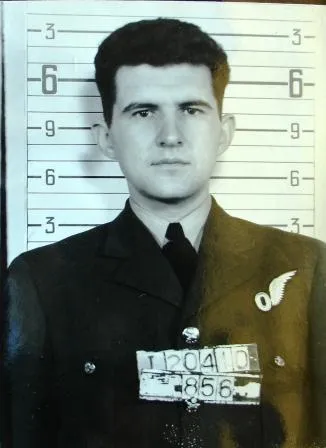
Flight Lieutenant Kennedy was BROTHER of Flying Officer W E Kennedy (RCAF) who was killed in a flying accident 1944-02-24 when 6 BGS (Bombing & Gunnery School, Mountain View, Ontario) Bolingbroke IV.T 10241 crashed near Melville, Ontario returning from a gunnery exercise
Flight Lieutenant Kennedy had previously been employed by the Royal Bank of Canada at the Tillsonburg, Ontario branch in 1938 and later at the Chippawa, Ontario branch from where he enlisted in the RCAF in January, 1942
406 Lynx Squadron (We Kill By Night) RAF Mansten. Mosquito NF30 aircraft NT 495 HU-C failed to return from a night intruder operation over Altenburg, Germany, cause of loss unknown
Pilot, Flight Lieutenant T W Trewin (RCAF) and Navigator, Flight Lieutenant JB Kennedy (RCAF) were missing, presumed killed in action
The missing have no known grave and are both commemorated on the Runnymede War Memorial
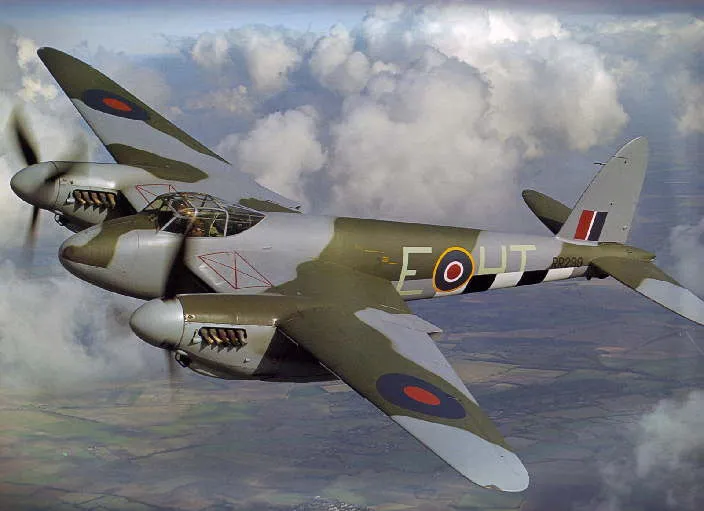
(British Aerospace photo) (Source Bomber Command Museum of Canada)
The de Havilland DH.98 Mosquito was a British twin-engine shoulder-winged multi-role combat aircraft, introduced during the Second World War. It was one of few operational front-line aircraft of the era whose frame was constructed almost entirely of wood. Nicknamed The Wooden Wonder, it was affectionately as the "Mossie" to its crews. The total number of DH98 Mosquito aircraft built was 7,781, the type serving with the main Allied air forces, including both the United States and Russia.
When Mosquito production began in 1941 it was the fastest propeller driven operational aircraft in the world. The first variant was an unarmed, high-speed, high-altitude photo-reconnaissance aircraft. Originally conceived as an unarmed fast bomber, the Mosquito's use evolved during the war into many roles including low to medium-altitude daytime tactical bomber, high-altitude night bomber, pathfinder, day or night fighter, fighter-bomber, intruder, and maritime strike aircraft. It was also used by the British Overseas Airways Corporation (BOAC) as a fast transport to carry small high-value cargoes to, and from, neutral countries, through enemy-controlled airspace. The crew of two, pilot and navigator, sat side by side, but a single passenger could ride in the aircraft's bomb bay when necessary.
The Mosquito FB Mk. VI was often flown in special raids, such as Operation Jericho, an attack on Amiens Prison in early 1944, and precision attacks against military intelligence, security and police facilities (such as Gestapo headquarters). On the 10th anniversary of the Nazi' seizure of power in 1943, a morning Mosquito attack knocked out the main Berlin broadcasting station while Hermann Goering was speaking, putting his speech off the air. Goering later said: "It makes me furious when I see the Mosquito. I turn green and yellow with envy. There is nothing the British do not have. They have the geniuses and we have the nincompoops."
The Mosquito flew with the RCAF and other air forces in the European, Mediterranean and Italian theatres. After the end of the Second World War Spartan Air Services flew 10 ex-RAF Mosquitoes, mostly B.35's plus one of only six PR.35's built, for high-altitude photographic survey work in Canada. There are approximately 30 non-flying Mosquitos around the world with five airworthy examples, four in the United States, and one in Canada.
Harold Skaarup web page and Wikipedia
History of the Squadron during World War II (Aircraft: Blenheim I & IV, Beaufighter IIF & VIF, Mosquito XII & XXX)
The Squadron was formed at Acklington, Northumberland, UK on May 10, 1941 as the RCAF's 5th squadron formed overseas, as a night-fighter unit. It flew Blenheim, Beaufighter and Mosquito aircraft in the night air defence of Great Britain role, before being re-designated as an Intruder squadron in November 1944. It was listed as the top scoring RAF/RCAF Intruder unit for the period November 27 1944 until the end of WWII. The squadron was disbanded at Predannack, Cornwall, UK on Sep 1, 1945.
Overall, the squadron claimed 64 enemy aircraft destroyed, 7 probables and 47 damaged. Also claimed were 88 locomotives and many other vehicles. Squadron operational losses were 11 aircraft, 20 aircrew killed or missing and 2 POWs. The squadron personnel were awarded 3 DSOs, 1 second Bar to DFC, 1 Bar to DFC, 14 DFCs, 2 DFMs and 4 Mentioned in Dispatches. Battle Honours were: Defence of Britain 1941-45, English Channel and North Sea 1944, Fortress Europe 1943-44, France and Germany 1944-45: Biscay Ports 1944, Normandy 1944, Rhine: Biscay 1944.Wikipedia, Kostenuk and Griffin
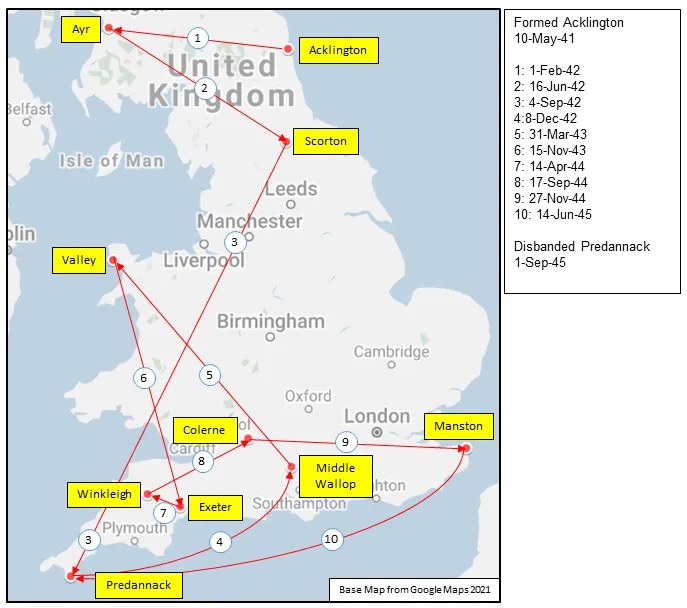
Maps for Movements of 406 Squadron 1941-45
MAP 1: 406 Squadron Movements in UK 1941-45 (right-click on image to display enlarged new tab)
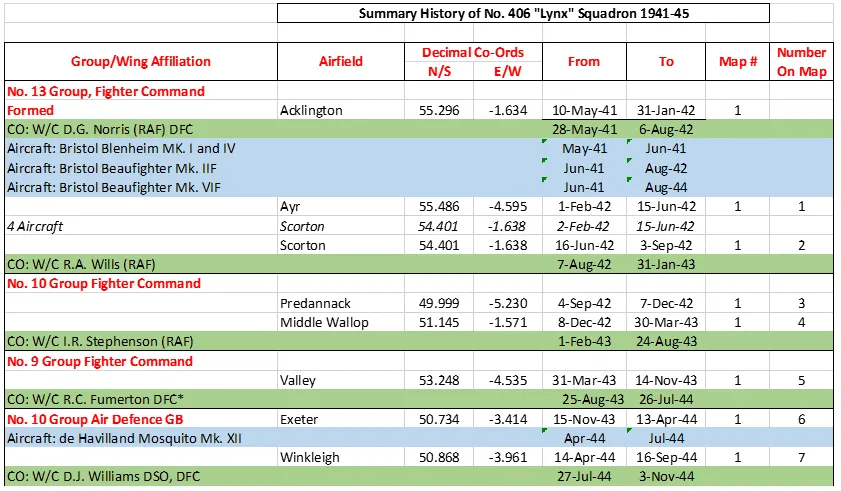
406 Sqn History Summary 1941-45
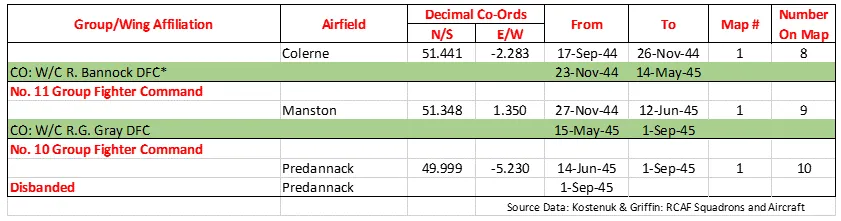
406 Sqn History Summary 1941-45 Page 2
History of the Squadron Post-WWII (Aircraft: Harvard II, Mitchell III, Silver Star, Expeditor, Otter, Sea King, Tracker, Cyclone)
The unit was re-formed as a reserve unit, 406 Tactical Bomber Squadron (Auxiliary) on 1 April 1947 at RCAF Station Saskatoon . It flew B-25 Mitchell III light bombers, and also Harvard and T-33 Silver Star aircraft for army co-operation duties. It was re-designated 406 (Light Bomber) Squadron on 1 April 1949 and adopted the title City of Saskatoon in September 1952. In March 1958 under the name 406 Squadron, it was re-equipped with C-45 Expeditor and later CSR-123 Otter aircraft, and assigned to a light transport and emergency rescue role. The squadron was disbanded again on 1 April 1964 as a result of the reduction of the Auxiliary Force.
The squadron was re-formed for a third time at CFB Shearwater, Nova Scotia
on 12 July 1972 as the 406 Maritime Operational Training Squadron, operating the CH-124 Sea King helicopter and the CP-121 Tracker ASW aircraft. In mid-1981, the operational Tracker squadron, 880 Maritime Reconnaissance Squadron, was transferred CFB Summerside, which left 406 Squadron only responsible for Sea King training. At the present time, the squadron trains pilots, Air Combat Systems Officers (ACSOs), and Airborne Electronic Sensor Operators (AES Ops) on the CH-148 Cyclone aircraft and flight operations relevant to the Maritime Helicopter (MH) role. In addition, the Squadron’s Technical Training Flight conducts a wide range of avionics and aviation courses for Cyclone technicians, as well as specialty maintenance courses. On an annual basis, between 200 and 300 students graduate from 406 Squadron. The squadron’s partner squadrons 423 Squadron in Shearwater, N.S., and 443 Squadron in Patricia Bay, B.C., employ 406 Squadron Cyclone graduates as integral members of helicopter air detachments aboard Her Majesty’s Canadian ships.
Mosquito NT495 NF.Mk. 30 - Combat - 1945-04-04 to 1945-04-05
Squadron: 406 (I) Sqn (RCAF)
Start Date: 1945-04-04
Completion Date: 1945-04-05
Mission: Combat
Operation: unspecified
Target City:
Target Specific:
Base: RAF Mansten
Take Off Time:
Squadron Code: HC-U
Radio Code:
Return Base:
Return Time:
Crash City: Germany
Crash Specifics: near Altenburg
Crash Latitude: 0.00000000
Crash Longitude: 0.00000000
Crash Reason:
Flak Battery:
Enemy Claim:
War Diary Unavailable
6 Bomber Group April 4/5, 1945
90 Halifaxes from 408, 415, 420, 425, 426, and 432 Squadrons were ordered on an attack on the Rhenania oil facilities at Harburg. The crews were over the target at between 16,500 and 19,000 feet, releasing 712,000 lbs of high explosives. According to reports, bombing was accurate and severe damage was caused.
While the Halifaxes went to Harburg, 93 Lancasters from 419, 424, 427,428, 429, 431, 433, and 434 Squadrons were ordered to attack the Leuna synthetic oil plant at Merseburg. The crews were over the target at between16,000 and 20,500 feet, releasing 568,000 lbs of high explosives. According to reports, the target was cloud covered and the attack was scattered.
15 Lancasters from 424, 427, 429, and 433 Squadrons were ordered a mining operation to Oslo. The crews were over the garden at 10,000 feet, sowing 84@1500 lb mines. Richard Koval (6bombergroup.ca)
406 Lynx Squadron (We Kill By Night) RAF Mansten. Mosquito NF30 aircraft NT 495 HU-C failed to return from a night intruder operation over Altenburg, Germany, cause of loss unknown
Pilot, Flight Lieutenant T W Trewin (RCAF) and Navigator, Flight Lieutenant JB Kennedy (RCAF) were missing, presumed killed in action
The missing have no known grave and are both commemorated on the Runnymede War Memorial

 Southampton, Ontario
 Enlisted Staff - RBC
 Canadian Virtual War Memorial
 Commonwealth War Graves Commission
 Finadagrave.com
 Library and Archives Canada Service Files (may not exist)
 Mosquito
 BAE Systems (formerly De Havilland)
 Wikipedia Mosquito
 USAAF F-8 Mosquito Serial Numbers
 Mosquitos shipped to Taiwanese Airforce
 Mosquito B35 Maintenance Manual