Source: Harold A Skaarup Web Page
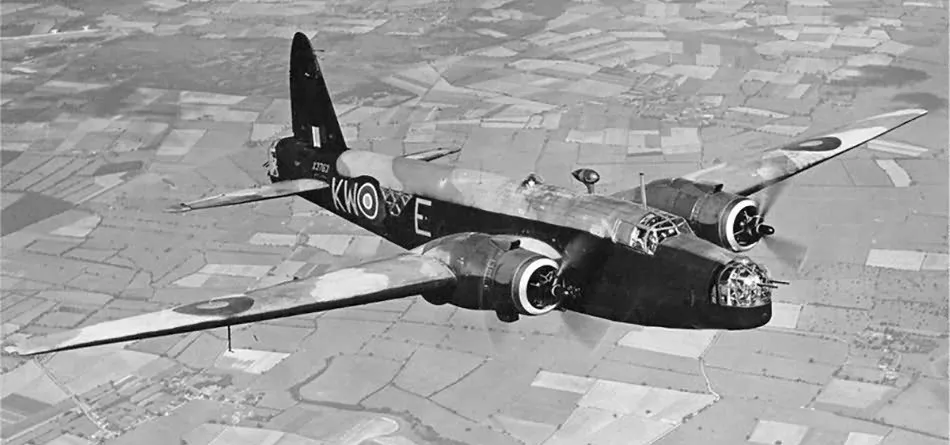
Vickers Wellington B. Mk. III (Serial No. X3763), coded KW-E, No. 425 'Alouette' (B) Squadron, RCAF, late summer of 1942
The Vickers Wellington was a British twin-engined, long-range medium bomber. It was designed during the mid-1930s at Brooklands in Weybridge, Surrey. Led by Vickers-Armstrongs' chief designer Rex Pierson, a key feature of the aircraft is its geodetic airframe fuselage structure, which was principally designed by Barnes Wallis. Development had been started in response to Air Ministry Specification B.9/32, issued in the middle of 1932, for a bomber for the Royal Air Force. This specification called for a twin-engined day bomber capable of delivering higher performance than any previous design.
The Wellington was used as a night bomber in the early years of the Second World War, performing as one of the principal bombers used by Bomber Command. During 1943, it started to be superseded as a bomber by the larger four-engined "heavies" such as the Avro Lancaster. The Wellington continued to serve throughout the war in other duties, particularly as an anti-submarine aircraft.
It holds the distinction of having been the only British bomber that was produced for the duration of the war, and of having been produced in a greater quantity than any other British-built bomber. The Wellington remained as first-line equipment when the war ended, although it had been increasingly relegated to secondary roles. The Wellington was one of two bombers named after Arthur Wellesley, 1st Duke of Wellington, the other being the Vickers Wellesley.
In August 1936, an initial order for 180 Wellington Mk I aircraft, powered by a pair of 1,050 hp (780 kW) Bristol Pegasus radial engines, was received by Vickers; it had been placed so rapidly that the order occurred prior to the first meeting intended to decide the details of the production aircraft. In October 1937, another order for a further 100 Wellington Mk Is, produced by the Gloster Aircraft Company, was issued; it was followed by an order for 100 Wellington Mk II aircraft with Rolls-Royce Merlin X V12 engines. Yet another order was placed for 64 Wellingtons produced by Armstrong Whitworth Aircraft. With this flurry of order and production having been assured by the end of 1937, Vickers set about simplifying the manufacturing process of the aircraft and announced a target of building one Wellington per day.
A total of 180 Wellington Mk I aircraft were built; 150 for the RAF and 30 for the Royal New Zealand Air Force (RNZAF) (which were transferred to the RAF on the outbreak of war and used by 75 Squadron). In October 1938, the Mk I entered service with 9 Squadron. The Wellington was initially outnumbered by the Handley Page Hampden (also ordered by the Ministry to B.9/32) and the Armstrong Whitworth Whitley (to B.34/3 for a 'night' bomber) but outlasted both rival aircraft in service. The Wellington went on to be built in 16 separate variants, in addition to two training conversions after the war. The number of Wellingtons built totalled 11,462 of all versions, a greater quantity produced than any other British bomber. On 13 October 1945, the last Wellington to be produced rolled out.
Wikipedia
 Wikipedia Vickers Wellington
 RCAF - Vickers Wellington
 YouTube Vickers Wellington documentary
Harold A Skaarup Web Page
115 (B) Sqn Despite The Elements ()
No. 115 Sqn was originally formed on Dec 1, 1917 as a heavy bomber squadron and joined the Independent Air Force of the RAF in August 1918. It was disbanded in 1919, then re-formed in June 1937. It formed part of RAF Bomber Command No. 3 Group in WWII. Starting with Handley Page Harrow aircraft, it transferred to Vickers Wellingtons in 1939, which it flew until March 1943, when it transferred to Avro Lancaster B. Mk. II and later B. Mks I and III. Between April 1940 and September 1942 the squadron was seconded to Coastal Command and based at Kinloss, Scotland. It rejoined Bomber Command and flew from Mildenhall, East Wretham and Little Snoring in 1942 and 1943 before settling at Witchford, Cambridgeshire from November 1943 until the end of hostilities.
In April 1940 the squadron made the RAF's first bombing attack on the mainland of Europe, at Stavanger in Norway. In August of 1941 it participated in the service trials of the new navigational aid, GEE, and as a result of its report the device was put into mass production. Overall, in WWII the squadron flew 5392 sorties and dropped about 23,000 tons of bombs. This was the second-highest tonnage of bombs in Bomber Command. The squadron was 3rd in the number of raids in the course of the war. Since it was active over the whole span of WWI, it lost the greatest number of aircraft of any squadron in Bomber Command: it was the only squadron to lose more than 200 aircraft.
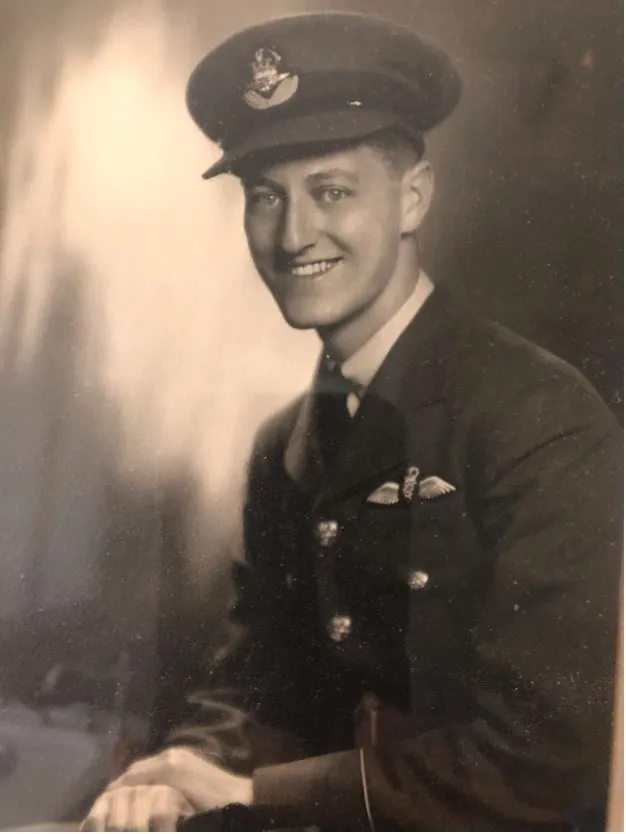

 Toronto, Ontario
 Canadian Virtual War Memorial
 Library and Archives Canada Service Files (may not exist)