 Toronto, Ontario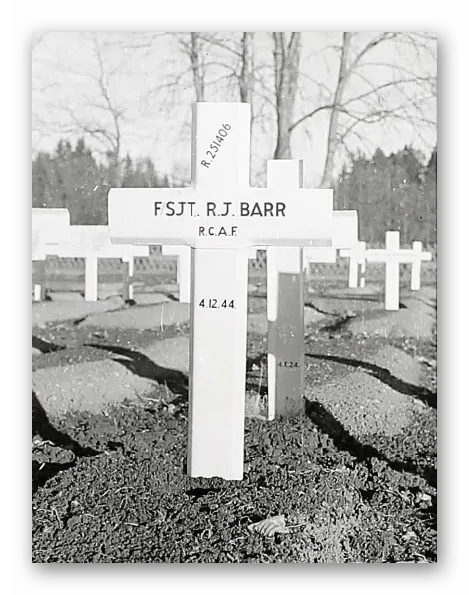
Grave Marker for Flt Sergeant Barr
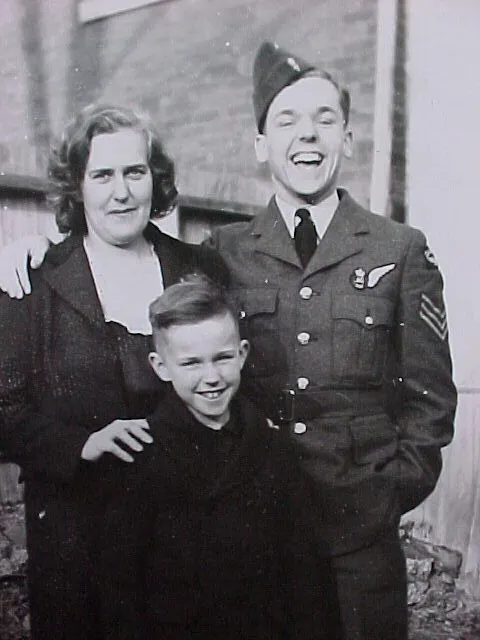

Birth Date: 1925-August-09
Born:
Parents: Son of James Reid Barr and Edith Barr, of Toronto, Ontario, Canada.
Spouse:
Home: Toronto, Ontario
Enlistment:
Enlistment Date: unkown date
Service
RCAF
Unit
166 (B) Sqn- Squadron (RAF)
Tenacity
Base
RAF Kirmington
Rank
Flight Sergeant
Position
Air Gunner
Service Numbers
R/251406
Took off from Kirmington at 16:15 in Lancaster Mark I (Sqn code: AS-E Bomber Command) on an operation to Karlsruhe Germany.
Shot down by a night fighter and crashed near target at Worth-Hagenbach Germany.
Claim by Hptm Friedrich Karl Muller Stab I/NJG11 - Worth-Hagenbach: 2,000-3,000m at 19:35. (Nachtjagd Combat Archive 1944 Part 5 - Theo Boiten). The aircraft crashed approx 1.5miles south east of Bissingen.
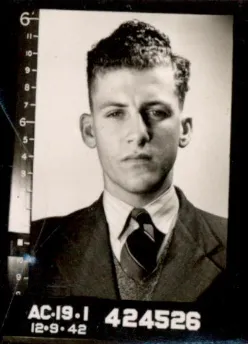
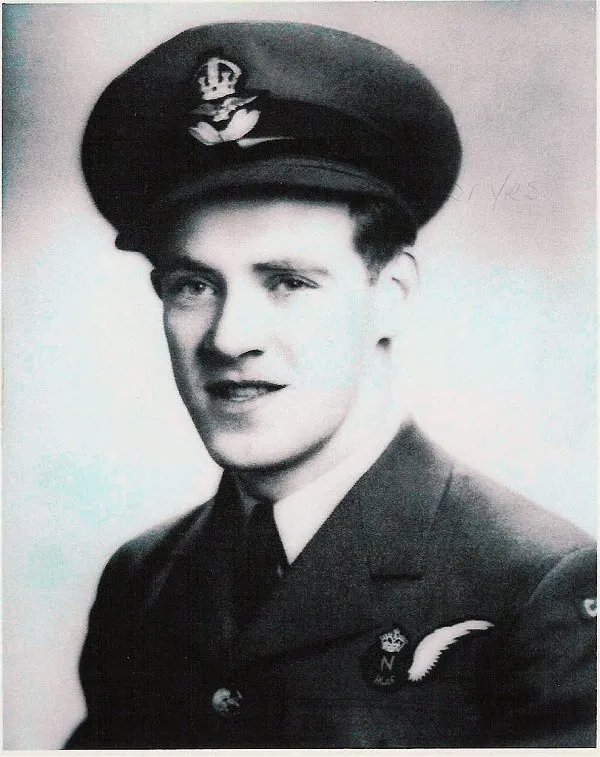
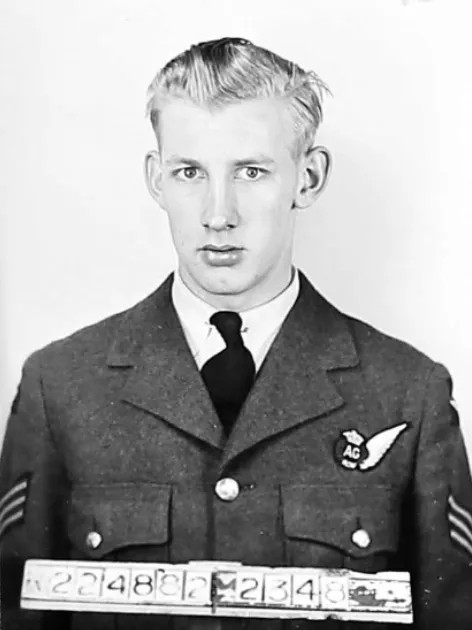
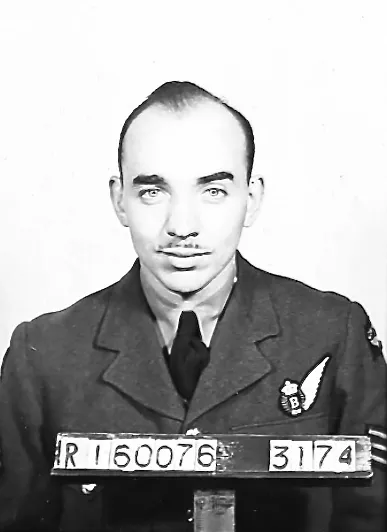
Killed: Flight Sergeant Robert James Barr RCAF R/251406 KIA Durnbach War Cemetery grave 4. F. 24. Flying Officer Allen James Reid RCAF J/36936 KIA Durnbach War Cemetery grave 4. F. 20. Flight Sergeant Harry Ray Thyret RCAF R/224882 KIA Durnbach War Cemetery grave 4. F. 21. Flight Sergeant Jack Anthony Joyce RAF KIA Durnbach War Cemetery grave 4. F. 25. Sergeant Alexander John Taylor RAF KIA Durnbach War Cemetery grave 4. F. 23.
POW: Pilot Officer George Christopher Clewley RCAF J/87350 POW cPoW/Stalag 9C Bad Zulza/Stalag Luft 3 Sagan & Belaria /PoW Number 53693.
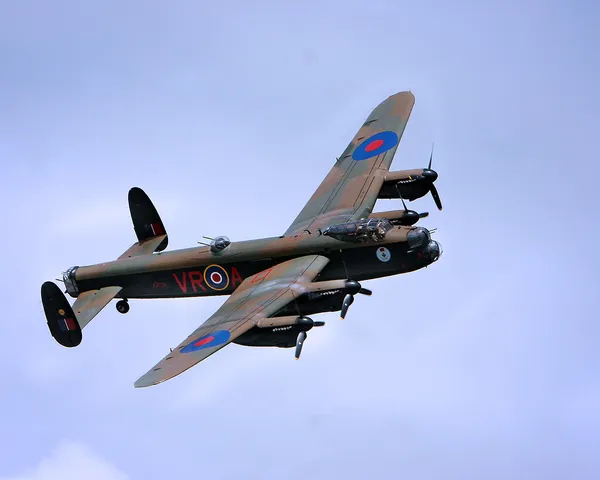
The Avro Lancaster is a British Second World War heavy bomber. It was designed and manufactured by Avro as a contemporary of the Handley Page Halifax, both bombers having been developed to the same specification, as well as the Short Stirling, all three aircraft being four-engined heavy bombers adopted by the Royal Air Force (RAF) during the same wartime era.
The Lancaster has its origins in the twin-engine Avro Manchester which had been developed during the late 1930s in response to the Air Ministry Specification P.13/36 for a capable medium bomber for "world-wide use". Originally developed as an evolution of the Manchester (which had proved troublesome in service and was retired in 1942), the Lancaster was designed by Roy Chadwick and powered by four Rolls-Royce Merlins and in one version, Bristol Hercules engines. It first saw service with RAF Bomber Command in 1942 and as the strategic bombing offensive over Europe gathered momentum, it was the main aircraft for the night-time bombing campaigns that followed. As increasing numbers of the type were produced, it became the principal heavy bomber used by the RAF, the Royal Canadian Air Force (RCAF) and squadrons from other Commonwealth and European countries serving within the RAF, overshadowing the Halifax and Stirling. Wikipedia
No 166 Squadron RAF was originally formed at Bircham Newton, Norfolk on June 13, 1918, designed as a heavy bomber unit, to fly the Handley Page V/1500 aircraft. The squadron was never fully mobilized because the Armistice intervened. The squadron was re-formed in November 1936 as a heavy bomber unit, flying Handley Page Heyfords, later equipping with Armstrong Whitworth Whitleys. It was based at Boscombe Down, Wiltshire from November 1936 to January 1937, when it moved to Leconfield, Yorkshire. The squadron became part of an air observer's school on June 7, 1938, and then became a 1 Group pool squadron in May 1939. From September 1939 it was based at Abingdon, Berkshire until April 1940. In that month the squadron merged with no. 97 Squadron to form No. 10 OTU.
In January 1943 the squadron was re-formed at Kirmington, Yorkshire (53.578,-0.344, now Humberside Airport), from flights of Nos. 150 and 170 squadrons, when parts of these squadrons were posted to the Middle East. It was again bomber squadron, flying Vickers Wellingtons in No. 1 Group of Bomber Command. It remained at Kirmington until the end of WWII, later re-equipping with Avro Lancasters. In the period 27/28 January 1943 and 25 April 1945, it dropped 27,287 tons of bombs and laid 333 tons of mines. The squadron won "at least" 2 DSOs, 2 CGMs, 117 DFCs and 108 DFMs in the course of WWII. The squadron was disbanded on November 18, 1945.
War Diary Unavailable
6 Group Unavailable
Took off from Kirmington at 16:15 in Lancaster Mark I (Sqn code: AS-E Bomber Command) on an operation to Karlsruhe Germany.
Shot down by a night fighter and crashed near target at Worth-Hagenbach Germany.
Claim by Hptm Friedrich Karl Muller Stab I/NJG11 - Worth-Hagenbach: 2,000-3,000m at 19:35. (Nachtjagd Combat Archive 1944 Part 5 - Theo Boiten). The aircraft crashed approx 1.5miles south east of Bissingen.
Killed: Flight Sergeant Robert James Barr RCAF R/251406 KIA Durnbach War Cemetery grave 4. F. 24. Flying Officer Allen James Reid RCAF J/36936 KIA Durnbach War Cemetery grave 4. F. 20. Flight Sergeant Harry Ray Thyret RCAF R/224882 KIA Durnbach War Cemetery grave 4. F. 21. Flight Sergeant Jack Anthony Joyce RAF KIA Durnbach War Cemetery grave 4. F. 25. Sergeant Alexander John Taylor RAF KIA Durnbach War Cemetery grave 4. F. 23.
POW: Pilot Officer George Christopher Clewley RCAF J/87350 POW cPoW/Stalag 9C Bad Zulza/Stalag Luft 3 Sagan & Belaria /PoW Number 53693.
 Canadian Virtual War Memorial
 Commonwealth War Graves Commission
 Finadagrave.com
 Library and Archives Canada Service Files (may not exist)



 Lancaster Bomber
 Wikipedia
 Harold A Skaarup Web Page