Pilot Officer Percy Barlow (RCAF) had previously been employed by the Royal Bank of Canada, entering service at the Souris, Manitoba branch on 1926-11-09 and serving at various branches before enlisting in the RCAF from the St Catherine and Bleury branch in Montreal, Quebec 1942-10-03
Barlow, Percy (Pilot Officer)
Killed in Action 1944-December-17


Birth Date: 1909
Born: England, United Kingdom
Parents: Son of Thomas James Barlow and Mary Annetta Barlow, of Souris, Manitoba, Canada.
Spouse:
Home: Souris, Manitoba
Enlistment: Montreal, Quebec
Enlistment Date: 1942-October-03
Service
RCAF
Unit
61 (B) Sqn- Squadron (RAF)
Per Purum Tonantes Thundering through the clear air
Base
RAF Skellingthorpe
Rank
Pilot Officer
Position
Navigator
Service Numbers
J/39368
Home
 Souris, Manitoba
Target
Munich Germany
Temporary Burial
Degerndorf Civil Cemetery, near crash site
Remains were later exhumed from this location and reburied
 Enlisted Staff - RBC
 Canadian Virtual War Memorial
 Commonwealth War Graves Commission
 Finadagrave.com
 Library and Archives Canada Service Files (may not exist)
Crew or Other Personnel
Lancaster LM729



Mission
Lancaster Mk.I/III LM729
Bombing Munich Germany 1944-December-17 to 1944-December-17
61 (B) Sqn (RAF) RAF Skellingthorpe
61 Squadron RAF (Per Puram Tunantes), RAF Skellingthorpe. Lancaster III aircraft LM 729 QR-V was shot down by flak thirty five-miles south-east of the targets in Munich, Germany near Degendorf, Germany with only the rear air-gunner surviving the aircraft loss
Flying Officer Percy Barlow (RCAF), Flying Officer Edward Roy Newland (RCAF), Warrant Officer Hilton Alfred Hales (RAAF), Sergeant Ronald William Bennett (RAFVR), Sergeant David Thomson Muir (RAFVR) and Sergeant Herbert Alfred Tuck (RAFVR) were all killed in action
Although claimed as shot down by flak, Rear Gunner Chester Samuel Joce (RAFVR) later reported that a photo-flash bomb, used by aircrew to illuminate the target area in order to photograph bomb damage exploded inside the fuselage after the bomb load was released, killing most of the crew. The tail plane and rear turret separated from the fuselage and Joce survived to fall free and became a Prisoner of War
Nachtjagd Combat Archrive, 1944 Part 5 16 October - 31 December by Theo Boiten, page 64
Lancaster serial: LM729
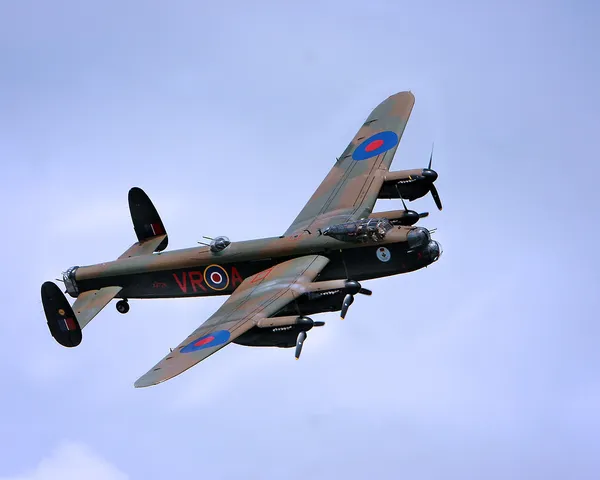
Avro Lancaster Mk. X RCAF Serial FM 213
Canadian Warplane Heritage Museum
Canadian Warplane Heritage Museum
The Avro Lancaster is a British Second World War heavy bomber. It was designed and manufactured by Avro as a contemporary of the Handley Page Halifax, both bombers having been developed to the same specification, as well as the Short Stirling, all three aircraft being four-engined heavy bombers adopted by the Royal Air Force (RAF) during the same wartime era.
The Lancaster has its origins in the twin-engine Avro Manchester which had been developed during the late 1930s in response to the Air Ministry Specification P.13/36 for a capable medium bomber for "world-wide use". Originally developed as an evolution of the Manchester (which had proved troublesome in service and was retired in 1942), the Lancaster was designed by Roy Chadwick and powered by four Rolls-Royce Merlins and in one version, Bristol Hercules engines. It first saw service with RAF Bomber Command in 1942 and as the strategic bombing offensive over Europe gathered momentum, it was the main aircraft for the night-time bombing campaigns that followed. As increasing numbers of the type were produced, it became the principal heavy bomber used by the RAF, the Royal Canadian Air Force (RCAF) and squadrons from other Commonwealth and European countries serving within the RAF, overshadowing the Halifax and Stirling. Wikipedia
 Lancaster Bomber
 Wikipedia
Lancaster LM729 Mk.I/III - Bombing Munich Germany - 1944-12-17 to 1944-12-17
Squadron: 61 (B) Sqn (RAF)
Start Date: 1944-12-17
Completion Date: 1944-12-17
Mission: Bombing
Operation: unspecified
Target City: Munich Germany
Target Specific: rail yards
Base: RAF Skellingthorpe
Take Off Time: 16:40:00
Squadron Code: QR-V
Radio Code:
Return Base:
Return Time:
Crash City: Germany
Crash Specifics: thirty five-miles south-east of Munich near Degendorf, Germany
Crash Latitude: 0.00000000
Crash Longitude: 0.00000000
Crash Reason: flak
Flak Battery: unspecified
Enemy Claim:
War Diary Unavailable
6 Group Unavailable
61 Squadron RAF (Per Puram Tunantes), RAF Skellingthorpe. Lancaster III aircraft LM 729 QR-V was shot down by flak thirty five-miles south-east of the targets in Munich, Germany near Degendorf, Germany with only the rear air-gunner surviving the aircraft loss
Flying Officer Percy Barlow (RCAF), Flying Officer Edward Roy Newland (RCAF), Warrant Officer Hilton Alfred Hales (RAAF), Sergeant Ronald William Bennett (RAFVR), Sergeant David Thomson Muir (RAFVR) and Sergeant Herbert Alfred Tuck (RAFVR) were all killed in action
Although claimed as shot down by flak, Rear Gunner Chester Samuel Joce (RAFVR) later reported that a photo-flash bomb, used by aircrew to illuminate the target area in order to photograph bomb damage exploded inside the fuselage after the bomb load was released, killing most of the crew. The tail plane and rear turret separated from the fuselage and Joce survived to fall free and became a Prisoner of War
Nachtjagd Combat Archrive, 1944 Part 5 16 October - 31 December by Theo Boiten, page 64
