103 Squadron (Noli Me Tangere). Lancaster aircraft W 4827 lost during operations. Five of the crew, not Canadians, missing presumed killed. Pilot Officer Addison had run the quarter mile in the 1936 British Empire Games.
Addison, Joseph Horace (Pilot Officer)
Killed in Action 1943-June-26


Birth Date: 1914-April-13
Born: Sidney, British Columbia
Parents: Son of Horace Howell Addison and Clare Addison.
Spouse: Husband of Irene Addison, of Victoria, British Columbia.
Home: Sidney, British Columbia
Enlistment: London, United Kingdom
Enlistment Date: 1942-January-30
Service
RCAF
Unit
103 Sqn- Squadron (RAF)
Noli Me Tangere Touch me not
Base
Elsham Wolds
Rank
Pilot Officer
Position
Air Gunner
Service Numbers
C/16683
Target
 Gelsenkirchen Germany
 Canadian Virtual War Memorial
 Library and Archives Canada Service Files (may not exist)
Crew or Other Personnel
Lancaster W4827



Mission
Lancaster Mk.I W4827
Bombing Gelsenkirchen Germany 1943-June-26 to 1943-June-26
103 (B) Sqn (RAF) Elsham Wolds
GELSENKIRCHEN
473 aircraft - 214 Lancasters, 134 Halifaxes, 73 Stirlings, 40 Wellingtons, 12 Mos?quitoes. This was the first raid to Gelsenkirchen since 1941, when it had been one of Bomber Command's regular 'oil targets', although, being in the middle of the Ruhr, this town had often been hit when other targets were attacked. 30 aircraft - 13 Lancasters, 7 Halifaxes, 6 Stirlings, 4 Wellingtons - were lost, 6?3 per cent of the force.
The target was obscured by cloud and the Oboe Mosquitoes, for once, failed to produce regular and accurate marking since 5 of the 12 Oboe aircraft found that their equipment was unserviceable. The raid was not a success. Diisseldorf reports 24 buildings destroyed and 3,285 damaged but 2,937 of these suffered only superficial blast damage. 20 industrial premises were hit and 4 of them suffered total production loss but no large fires were involved and the loss in production lasted for no longer than 2 weeks. 16 people were killed.
Bombs probably fell on many other Ruhr towns. Solingen, nearly 30 miles from Gelsenkirchen, recorded 21 people killed and 58 injured on this night.source: The Bomber Command War Diaries, Martin Middlebrook and Chris Everitt
Lancaster W4827 was shot down by night fighter pilot Oberfeldwebel Karl-Heinz Scherfling of the 10./NJG 1, flying a Bf 110 G-4 from Bergen airfield.source: Aviation Safety Network
Lancaster serial: W4827
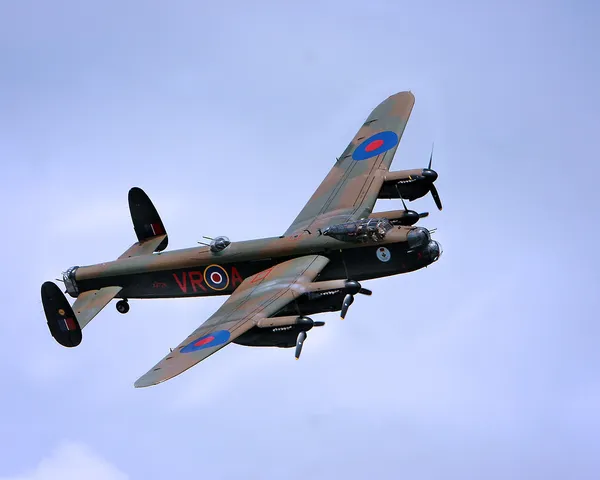
Avro Lancaster Mk. X RCAF Serial FM 213
Canadian Warplane Heritage Museum
Canadian Warplane Heritage Museum
The Avro Lancaster is a British Second World War heavy bomber. It was designed and manufactured by Avro as a contemporary of the Handley Page Halifax, both bombers having been developed to the same specification, as well as the Short Stirling, all three aircraft being four-engined heavy bombers adopted by the Royal Air Force (RAF) during the same wartime era.
The Lancaster has its origins in the twin-engine Avro Manchester which had been developed during the late 1930s in response to the Air Ministry Specification P.13/36 for a capable medium bomber for "world-wide use". Originally developed as an evolution of the Manchester (which had proved troublesome in service and was retired in 1942), the Lancaster was designed by Roy Chadwick and powered by four Rolls-Royce Merlins and in one version, Bristol Hercules engines. It first saw service with RAF Bomber Command in 1942 and as the strategic bombing offensive over Europe gathered momentum, it was the main aircraft for the night-time bombing campaigns that followed. As increasing numbers of the type were produced, it became the principal heavy bomber used by the RAF, the Royal Canadian Air Force (RCAF) and squadrons from other Commonwealth and European countries serving within the RAF, overshadowing the Halifax and Stirling. Wikipedia
 Lancaster Bomber
 Wikipedia
 Harold A Skaarup Web Page
Lancaster W4827 Mk.I - Bombing Gelsenkirchen Germany - 1943-06-26 to 1943-06-26
Squadron: 103 (B) Sqn (RAF)
Start Date: 1943-06-26
Completion Date: 1943-06-26
Mission: Bombing
Operation: unspecified
Target City: Gelsenkirchen Germany
Target Specific:
Base: Elsham Wolds
Take Off Time: 23:19:00
Squadron Code: MP-W
Radio Code:
Return Base:
Return Time:
Crash City:
Crash Specifics:
Crash Latitude: 0.00000000
Crash Longitude: 0.00000000
Crash Reason: fighter
Flak Battery:
Enemy Claim:
War Diary Unavailable
6 Group Unavailable
GELSENKIRCHEN
473 aircraft - 214 Lancasters, 134 Halifaxes, 73 Stirlings, 40 Wellingtons, 12 Mos?quitoes. This was the first raid to Gelsenkirchen since 1941, when it had been one of Bomber Command's regular 'oil targets', although, being in the middle of the Ruhr, this town had often been hit when other targets were attacked. 30 aircraft - 13 Lancasters, 7 Halifaxes, 6 Stirlings, 4 Wellingtons - were lost, 6?3 per cent of the force.
The target was obscured by cloud and the Oboe Mosquitoes, for once, failed to produce regular and accurate marking since 5 of the 12 Oboe aircraft found that their equipment was unserviceable. The raid was not a success. Diisseldorf reports 24 buildings destroyed and 3,285 damaged but 2,937 of these suffered only superficial blast damage. 20 industrial premises were hit and 4 of them suffered total production loss but no large fires were involved and the loss in production lasted for no longer than 2 weeks. 16 people were killed.
Bombs probably fell on many other Ruhr towns. Solingen, nearly 30 miles from Gelsenkirchen, recorded 21 people killed and 58 injured on this night.source: The Bomber Command War Diaries, Martin Middlebrook and Chris Everitt
Lancaster W4827 was shot down by night fighter pilot Oberfeldwebel Karl-Heinz Scherfling of the 10./NJG 1, flying a Bf 110 G-4 from Bergen airfield.source: Aviation Safety Network
