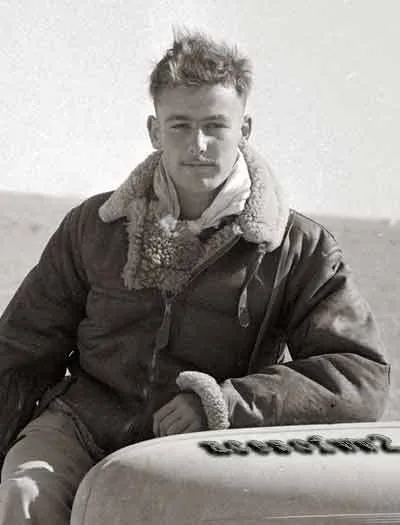
Jowsey, Milton Eardley (Squadron Leader)
Evader 1945-February-22

Birth Date: 1922-May-21
Born: Ottawa, Ottawa Municipality, Ontario, Canada
Parents:
Spouse:
Home:
Enlistment: Ottawa Ontario
Enlistment Date: 1940-October-21
Service
RCAF
Unit
442 (F) Sqn- Squadron
Un Dieu, Une Reine, Un Coeur One God, one queen, one heart
Base
B.88 Heesch, Netherlands
Rank
Squadron Leader
Position
Pilot
Service Numbers
J/6366
Mission
Spitfire LF Mk IX PT725
Sweep 1945-February-22 to 1945-February-22
442 (F) Sqn (RCAF) B.88 Heesch, Netherlands
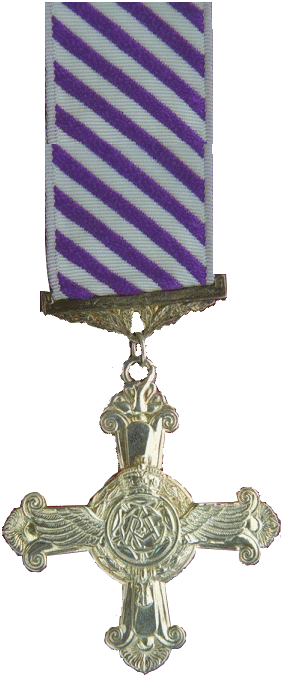
442 Squadron (Un dieu, une reine, un coeur) Landing Ground B.88, Heesch, Netherlands. Squadron Leader Milton Eardley Jowsey DFC (RCAF) was flying a ground attack role from Eindhoven, Netherlands in Spitfire LF Mk IX PT 725 Y2-E and was strafing a German staff car when his engine was struck by his own bullets that had ricocheted from the target . The Spitfire crashed near the Dutch/German border. Squadron Leader Jowsey managed to bale from his stricken aircraft and avoided capture as an Evader, aided and sheltered by locals and Dutch Resistance Fighters until liberated by advancing British Troops 1945-04-01 and returned safe to the UK 1945-04-05
Squadron Leader Jowsey also flew with 234 Squadron in the Western Desert in Africa and with 92 Squadron in SicilyRAF Evaders, The Comprehensive Story of Thousands of Escapers and Their Escape Lines, Western Europe, 1940-1945 by Oliver Clutton-Brock, page 377
Invasion Without Tears, The Story of Canada's Top-Scoring Spitfire Wing in Europe During the Second World War by Monty Berger and Brian Jeffrey Street, pages 121-123, 144-145, 179-180, 190
Aces High, A Tribute to the Most Notable Fighter Pilots of the British and Commonwealth Forces of WWII by Christopher Shores and Clive Williams, page 365
 Royal Air Force Serial and Image Database
Spitfire pilots and aircraft database - Flying Officer Milton Jowsey RCAF
Spitfire serial: PT725
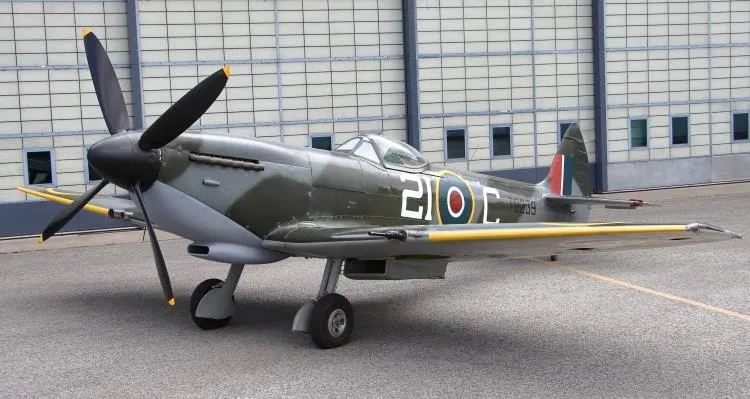
Supermarine Spitfire LF Mk. XVIe, Canadian Warplane Heritage Museum
The Supermarine Spitfire is a British single-seat fighter aircraft that was used by the Royal Air Force and other Allied countries before, during, and after World War II. Many variants of the Spitfire were built, using several wing configurations, and it was produced in greater numbers than any other British aircraft. It was also the only British fighter produced continuously throughout the war. The Spitfire continues to be popular among enthusiasts; around 70 remain airworthy, and many more are static exhibits in aviation museums throughout the world.
The Spitfire was designed as a short-range, high-performance interceptor aircraft by R. J. Mitchell, chief designer at Supermarine Aviation Works, which operated as a subsidiary of Vickers-Armstrong from 1928. Mitchell pushed the Spitfire's distinctive elliptical wing with cutting-edge sunken rivets (designed by Beverley Shenstone) to have the thinnest possible cross-section, helping give the aircraft a higher top speed than several contemporary fighters, including the Hawker Hurricane.
The Spitfire had detachable wing tips which were secured by two mounting points at the end of each main wing assembly. When the Spitfire took on a role as a high-altitude fighter (Marks VI and VII and some early Mk VIIIs), the standard wing tips were replaced by extended, "pointed" tips which increased the wingspan from 36 ft 10 in (11.23 m) to 40 ft 2 in (12.24 m). The other wing-tip variation, used by several Spitfire variants, was the "clipped" wing; the standard wing tips were replaced by wooden fairings which reduced the span by 3 ft 6 in (1.07 m). The wing tips used spruce formers for most of the internal structure with a light alloy skin attached using brass screws.
Due to a shortage of Brownings, which had been selected as the new standard rifle calibre machine gun for the RAF in 1934, early Spitfires were fitted with only four guns, with the other four fitted later. Early tests showed that, while the guns worked perfectly on the ground and at low altitudes, they tended to freeze at high altitude, especially the outer wing guns, because the RAF's Brownings had been modified to fire from an open bolt. While this prevented overheating of the cordite used in British ammunition, it allowed cold air to flow through the barrel unhindered. Supermarine did not fix the problem until October 1938, when they added hot air ducts from the rear of the wing-mounted radiators to the guns, and bulkheads around the gunbays to trap the hot air in the wing. Red fabric patches were doped over the gun ports to protect the guns from cold, dirt, and moisture until they were fired.
The first Rolls-Royce Griffon-engined Mk XII flew in August 1942, and first flew operationally with 41 Squadron in April 1943. This mark could nudge 400 mph (640 km/h) in level flight and climb to an altitude of 33,000 ft (10,000 m) in under nine minutes. As American fighters took over the long-range escorting of USAAF daylight bombing raids, the Griffon-engined Spitfires progressively took up the tactical air superiority role, and played a major role in intercepting V-1 flying bombs, while the Merlin-engined variants (mainly the Mk IX and the Packard-engined Mk XVI) were adapted to the fighter-bomber role. Although the later Griffon-engined marks lost some of the favourable handling characteristics of their Merlin-powered predecessors, they could still outmanoeuvre their main German foes and other, later American and British-designed fighters.Wikipedia
 Wikipedia Supermarine Spitfire
 YouTube How the Spitfire Became an Aviation Masterpiece
 RCAF Supermarine Spitfire Serials - Kestrel Publications
Unit Desciption
442 (F) Sqn Un Dieu, Une Reine, Un Coeur ("Caribou")
History of the Squadron before and during World War II (Aircraft: Spitfire VB, IXB, IXE, Mustang III)
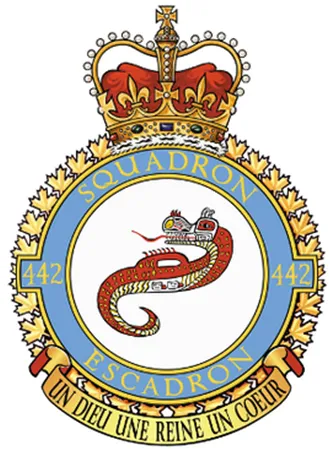
[ Note that during WWII the squadron did not have a badge nor a motto. These were awarded later.]
No 442 (F) Squadron was formed in Rockcliffe, ON  as No. 14 (F) Squadron RCAF on January 2, 1942. It originally flew Curtiss Kittyhawks with the RCAF Western Air Command due to the threat to Canada's west coast after the Pearl Harbor attack. The squadron moved to Alaska and participated on strafing and bombing missions against then-Japanese held Kiska during the Aleutian Islands Campaign. The squadron was the fifth of six home squadrons transferred overseas without its aircraft, and was re-designated No. 442 (F) Squadron RCAF at Digby, Lincolnshire, UK. on February 8 1944. It flew Spitfire aircraft in offensive and defensive operations in the preparation for D-Day, and afterwards gave close support to the ground troops. They moved with the ground troops through France, the Low Countries, and Germany. In March 1945 the squadron was re-equipped with Mustang aircraft, to provide fighter cover for long-range bomber groups. The squadron was disbanded at Molesworth, Huntingdonshire, UK on August 7, 1945.
In the course of operations, the squadron flew 4954 sorties for the loss of16 pilots, of whom 1 was killed, 9 presumed dead and 4 POWs. They accounted for 56 enemy aircraft confirmed destroyed, 5 probables and 25 damaged. In ground attacks they were credited with 909 motor vehicles, 125 locomotives and 194 trains. The squadron had 1 ace: Flight Lieutenant D.C. Gordon, DFC. The squadron amassed 1 DSO, 3 Bars to DFC, 10 DFCs, 1 Croix de Guerre (France). Battle Honours were: Fortress Europe 1944, France and Germany 1944-45, Normandy 1944, Arnhem, Rhine, Aleutians 1943. Wikipedia, Kostenuk and Griffin
Maps for Movements of 442 Squadron 1944-45
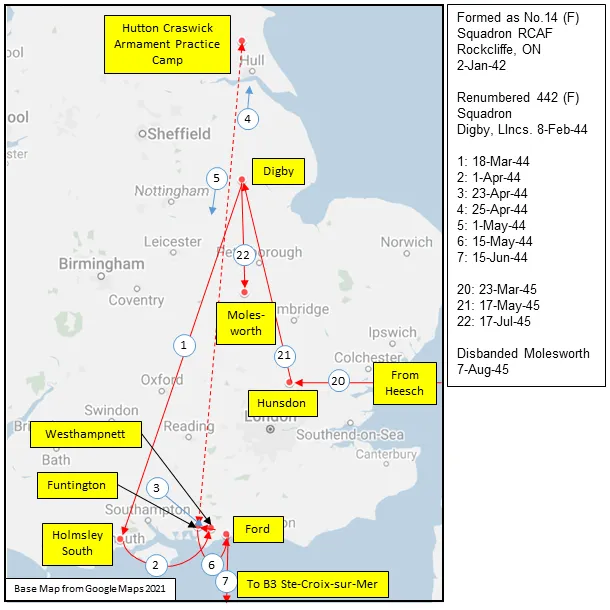
MAP 1: 442 Squadron Movements 1944-45 (right-click on image to display enlarged in new tab)
|
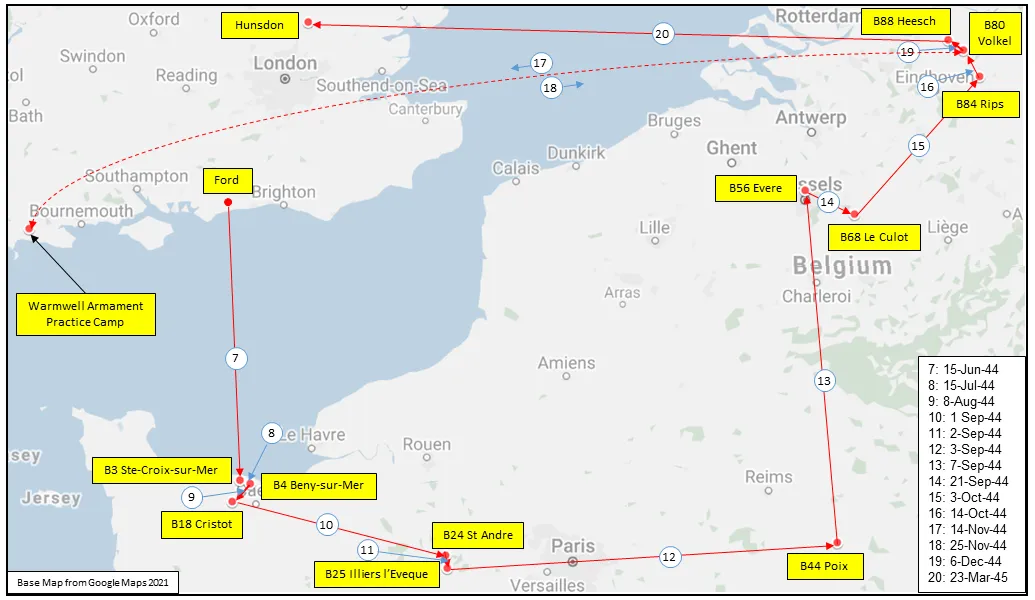
MAP 2: 442 Squadron Movements 1944-45
|
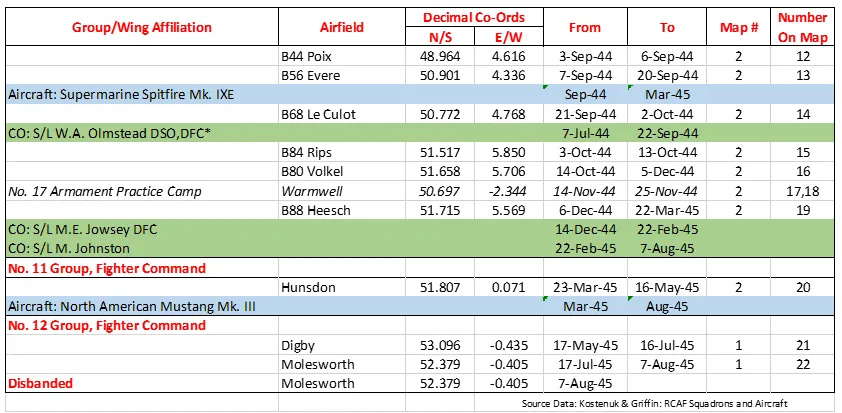
442 Squadron History Summary 1944-45
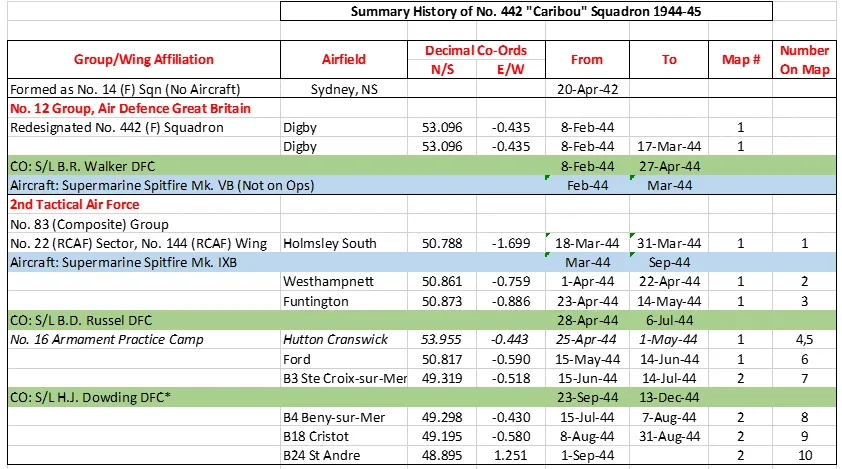
442 Squadron History Summary 1944-45 Page 2
History of the Squadron Post-WWII (Aircraft: Harvard, Vampire III, Mustang IV, Sabre 5, Expeditor, Otter, Cormorant)
The squadron was re-formed at Vancouver, British Columbia on 15 April 1946. It was redesignated 442 "City of Vancouver" (F) Squadron on 3 September 1952. It flew de Havilland Vampire, North American Mustang and Canadair Sabre aircraft in a fighter role until October 1958 when it was reassigned to a light transport and emergency rescue role and re-equipped with Beech Expeditor and de Havilland Otter aircraft. It was redesignated 442 Squadron. A reduction of the Auxiliary Force resulted in the squadron being disbanded on 1 April 1964.
The squadron was re-formed as '442 Communications and Rescue Squadron' on 8 July 1968, from '121 Composite Unit' (authorized 1 January 1959). The squadron is based at Comox, British Columbia , flying the CH-149 Cormorant Helicopters. The primary role of 442 Transport and Rescue Squadron is the provision of aviation resources in support of the Joint Rescue Coordination Center (JRCC) Victoria. This region consists of approximately 920,000 square kilometers of mainly mountainous terrain of Yukon and British Columbia and 560,000 square kilometers of the Pacific Ocean extending to approximately 600 nautical miles offshore, including over 27,000 kilometers of rugged British Columbia coastline. The rugged and often inaccessible terrain, severe weather, and large expanses of sparsely populated areas make the Victoria SRR the most demanding region in the country.
While approximately 80 of the Squadron's personnel strength of 200 are aircrew trades, including pilots, navigators, flight engineers, and Search and Rescue Technicians (SAR Techs), the majority are maintenance personnel, charged with keeping the aircraft at peak operational readiness. On occasions when major search operations dictate the establishment of a forward operating base somewhere else in the province, 442's maintenance personnel will deploy with the aircrew, providing servicing and repairs to aircraft on site.
Spitfire PT725 LF Mk IX - Sweep - 1945-02-22 to 1945-02-22
Squadron: 442 (F) Sqn (RCAF)
Start Date: 1945-02-22
Completion Date: 1945-02-22
Mission: Sweep
Operation: unspecified
Target City:
Target Specific:
Base: B.88 Heesch, Netherlands
Take Off Time: 13:10:00
Squadron Code: Y2-E
Radio Code:
Return Base:
Return Time:
Crash City: Netherlands
Crash Specifics: near Limburg
Crash Latitude: 0.00000000
Crash Longitude: 0.00000000
Crash Reason:
Flak Battery:
Enemy Claim:
War Diary Unavailable
6 Group Unavailable
442 Squadron (Un dieu, une reine, un coeur) Landing Ground B.88, Heesch, Netherlands. Squadron Leader Milton Eardley Jowsey DFC (RCAF) was flying a ground attack role from Eindhoven, Netherlands in Spitfire LF Mk IX PT 725 Y2-E and was strafing a German staff car when his engine was struck by his own bullets that had ricocheted from the target . The Spitfire crashed near the Dutch/German border. Squadron Leader Jowsey managed to bale from his stricken aircraft and avoided capture as an Evader, aided and sheltered by locals and Dutch Resistance Fighters until liberated by advancing British Troops 1945-04-01 and returned safe to the UK 1945-04-05
Squadron Leader Jowsey also flew with 234 Squadron in the Western Desert in Africa and with 92 Squadron in SicilyRAF Evaders, The Comprehensive Story of Thousands of Escapers and Their Escape Lines, Western Europe, 1940-1945 by Oliver Clutton-Brock, page 377
Invasion Without Tears, The Story of Canada's Top-Scoring Spitfire Wing in Europe During the Second World War by Monty Berger and Brian Jeffrey Street, pages 121-123, 144-145, 179-180, 190
Aces High, A Tribute to the Most Notable Fighter Pilots of the British and Commonwealth Forces of WWII by Christopher Shores and Clive Williams, page 365
Royal Air Force Serial and Image Database
Spitfire pilots and aircraft database - Flying Officer Milton Jowsey RCAF
