Flight Lieutenant William Cook died January 4th, 2006 and is buried in Clinton Public Cemetery, Clinton, On.
Mission
Spitfire Mk IX BS532
Ramrod 1943-October-03 to 1943-October-03
(F) Sqn (RCAF) Headcorn
ORB 421 Squadron Ramrod 259 1943-10-03
Fighter Sweep. In HARDELOT, swept under Appledore control, BETHUNE-AMIENS-ROYE-area, at 20,000 to 22,000 ft. 421 bounced 25+ a/c passing beneath wing. Full wing engaged combats intermingled all in the vicinity of ROYE/AMY a/d between 7,000 and 15,000 ft. 9 pilots of wing fired on at least 15 a/c. Seven aircraft were seen to crash and two parachutes to open. several other aircraft were going down and are believed to have crashed. Enemy casualties inflicted by 421 squadron - Pilot Officer Hicks, 1 FW 190 destroyed - Pilot Officer Packard 1 FW 190 destroyed - Pilot Officer Linton and Flying Officer Cook 1 FW 190 destroyed (shared). Our casualties - Flying Officer Cook missing - heard over R/T to say "baling out"
HERE FOLLOWS THE FIRST TWO CHAPTERS OF Flight Lieutenant COOK'S ACCOUNT OF THIS MISSION
"I don't remember much of the dogfight only that it was a good one. Never underestimate the fighting ability of the German fighter boys, they were good. I was flying number two to my good friend Karl Linton when we engaged a good number of FW 190's. Karl and I shared one. I remember we were jumped by two coming in at five o'clock and a little above us. I saw the number one firing but the tracers were going behind us and he was a little out of range. I waited until he was within a good range then called a break to starboard which meant we would tum into them and perhaps get on their tails. We swung around and I put old AUV through the gate; this was called pushing the "tit". All of a sudden I had very little power. I quickly scanned the instrument panel and noticed my oil pressure dropping. I tried to keep up with Karl but found it impossible.
Soon I was streaming glycol and going nowhere but down. I called up my CO who was Squadron Leader Buck McNair and told him of my predicament. I said that I was going to try for the Channel and bale out. He asked if I needed an escort and I said that I thought that I could make it on my own. I checked the outside of the aircraft and could see that there was a great deal of oil on the cowling on the port side of the engine. I was also making quite a trail of white glycol smoke. I was awakened suddenly from my inspection by black puffs of smoke around me. Flak. I looked down and noticed aerodromes. I also noticed that I was lower than I thought I should be. I figured that I was between Poix and Couty. If that were the case then I had better forget the Channel
THE FULL ACCOUNT OF Flight Lieutenant COOK'S EVASION STORY CAN BE FOUND IN HIS SERVICE RECORD BELOW
Spitfire serial: BS532
Supermarine Spitfire LF Mk. XVIe, Canadian Warplane Heritage Museum
The Supermarine Spitfire is a British single-seat fighter aircraft that was used by the Royal Air Force and other Allied countries before, during, and after World War II. Many variants of the Spitfire were built, using several wing configurations, and it was produced in greater numbers than any other British aircraft. It was also the only British fighter produced continuously throughout the war. The Spitfire continues to be popular among enthusiasts; around 70 remain airworthy, and many more are static exhibits in aviation museums throughout the world.
The Spitfire was designed as a short-range, high-performance interceptor aircraft by R. J. Mitchell, chief designer at Supermarine Aviation Works, which operated as a subsidiary of Vickers-Armstrong from 1928. Mitchell pushed the Spitfire's distinctive elliptical wing with cutting-edge sunken rivets (designed by Beverley Shenstone) to have the thinnest possible cross-section, helping give the aircraft a higher top speed than several contemporary fighters, including the Hawker Hurricane.
The Spitfire had detachable wing tips which were secured by two mounting points at the end of each main wing assembly. When the Spitfire took on a role as a high-altitude fighter (Marks VI and VII and some early Mk VIIIs), the standard wing tips were replaced by extended, "pointed" tips which increased the wingspan from 36 ft 10 in (11.23 m) to 40 ft 2 in (12.24 m). The other wing-tip variation, used by several Spitfire variants, was the "clipped" wing; the standard wing tips were replaced by wooden fairings which reduced the span by 3 ft 6 in (1.07 m). The wing tips used spruce formers for most of the internal structure with a light alloy skin attached using brass screws.
Due to a shortage of Brownings, which had been selected as the new standard rifle calibre machine gun for the RAF in 1934, early Spitfires were fitted with only four guns, with the other four fitted later. Early tests showed that, while the guns worked perfectly on the ground and at low altitudes, they tended to freeze at high altitude, especially the outer wing guns, because the RAF's Brownings had been modified to fire from an open bolt. While this prevented overheating of the cordite used in British ammunition, it allowed cold air to flow through the barrel unhindered. Supermarine did not fix the problem until October 1938, when they added hot air ducts from the rear of the wing-mounted radiators to the guns, and bulkheads around the gunbays to trap the hot air in the wing. Red fabric patches were doped over the gun ports to protect the guns from cold, dirt, and moisture until they were fired.
The first Rolls-Royce Griffon-engined Mk XII flew in August 1942, and first flew operationally with 41 Squadron in April 1943. This mark could nudge 400 mph (640 km/h) in level flight and climb to an altitude of 33,000 ft (10,000 m) in under nine minutes. As American fighters took over the long-range escorting of USAAF daylight bombing raids, the Griffon-engined Spitfires progressively took up the tactical air superiority role, and played a major role in intercepting V-1 flying bombs, while the Merlin-engined variants (mainly the Mk IX and the Packard-engined Mk XVI) were adapted to the fighter-bomber role. Although the later Griffon-engined marks lost some of the favourable handling characteristics of their Merlin-powered predecessors, they could still outmanoeuvre their main German foes and other, later American and British-designed fighters.Wikipedia
History of the Squadron during World War II (Aircraft: Spitfire VA, VB, IX, IXB, XVI)
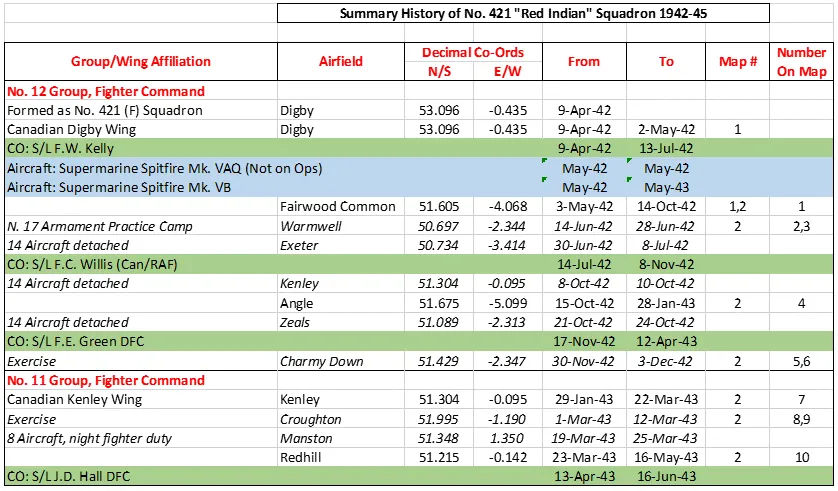
The squadron was the 20th squadron and the last of the eight Fighter squadrons formed overseas by the RCAF in WWII. It was initiated at Digby, Lincolnshire, England on April 9, 1942, It flew on defensive operations over Britain, as well as offensive operations over Europe, before D-Day. After the invasion, the squadron moved to France on 16 June 1944 and thereafter provided air and ground support to the Allied ground forces as they moved through France, the Low Countries and Germany. The squadron was disbanded at Utersen, Germany on July 10, 1945.
In the course of its operations, the squadron flew some 10,900 sorties and claimed 79 enemy aircraft destroyed, 2 probables and 27 damaged, for the loss of 34 aircraft and 33 pilots, of whom 4 were killed, 25 missing and 4 injured. The squadron had 2 aces, Squadron Leader R.W McNair, DFC and 2 Bars, and Flight Lieutenant P.G. Johnson. The squadron members were awarded 1 second Bar to DFC, 2 Bars to DFC and 5 DFCs. Battle Honours were: Defence of Britain 1942-43, Fortress Europe 1942-44, France and Germany 1944-45, Normandy 1944, Arnhem, RhineWikipedia, Kostenuk and Griffin
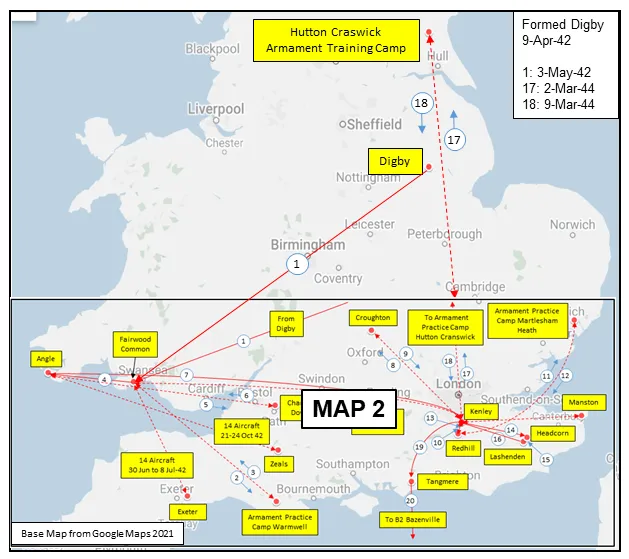
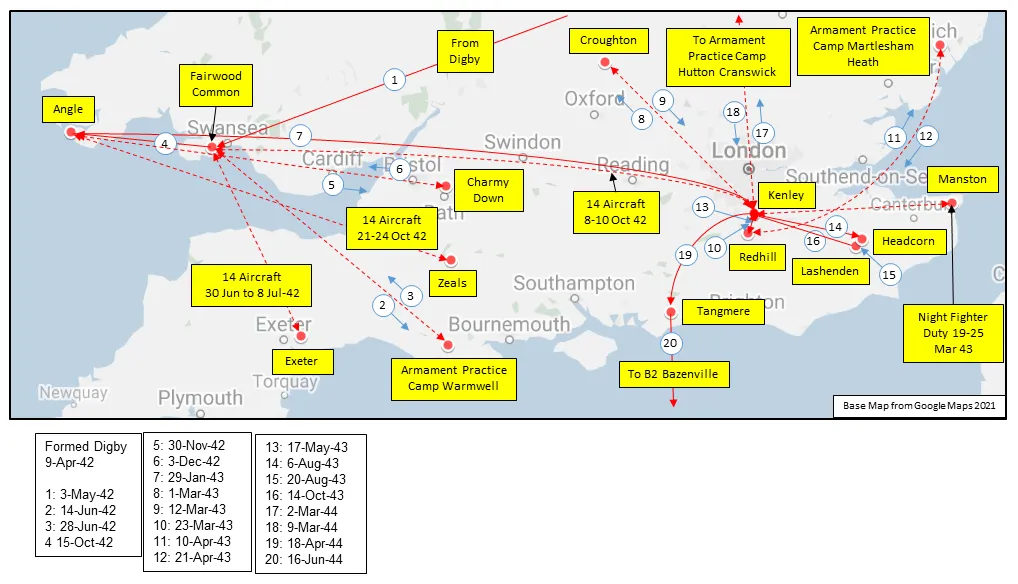
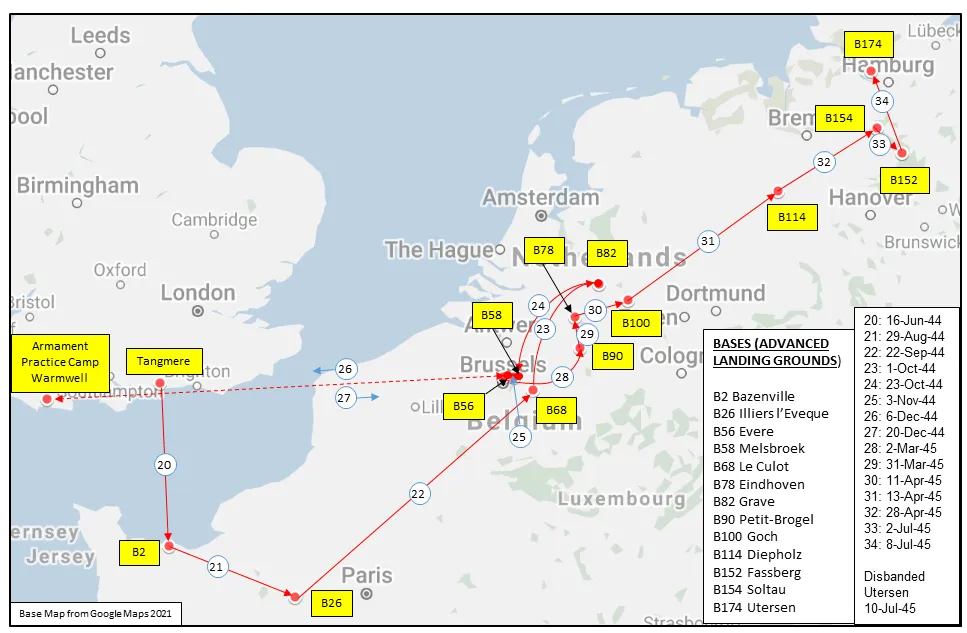
Maps for Movements of 421 Squadron 1942-45
MAP 1: 421 Squadron Movements in England 1942-44 (right-click on image to display enlarged in new tab)
MAP 2: 421 Squadron Movements, detail of Map 1
MAP 3: 421 Squadron Movements in Europe 1944-45
421 Squadron History Summary 1942-45
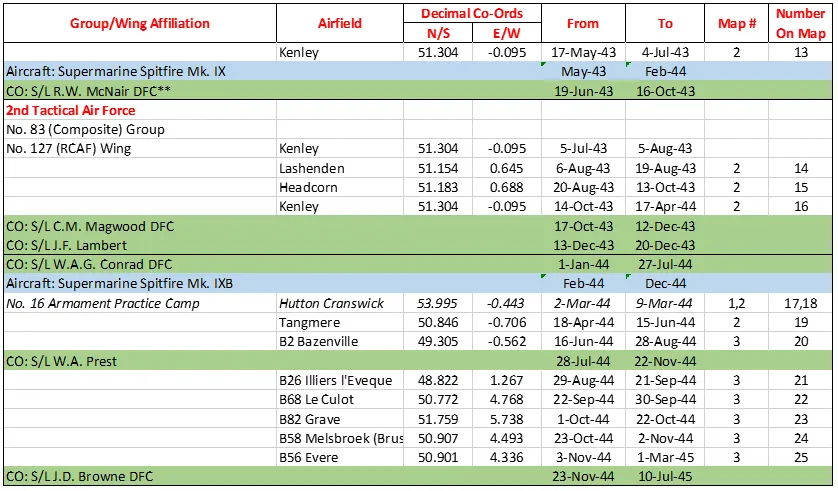
421Squadron History Summary 1942-45 Page 2
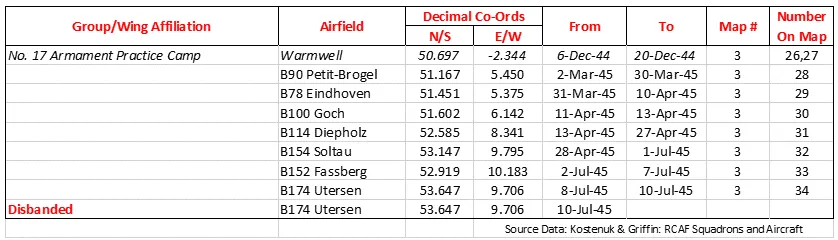
421 Squadron History Summary 1942-45 Page 3
History of the Squadron Post-WWII (Aircraft: Vampire III, 5, Meteor T7, Sabre 2, 5, 6, Starfighter)
The squadron was re-formed as a Fighter unit at Chatham, New Brunswick on 15 September 1949, flying de Havilland Vampire III aircraft and, during 1951, was stationed in the United Kingdom for operational training with the Royal Air Force, flying Gloster Meteor T Mk. 7 training aircraft. In December 1951 it was re-equipped with Sabre aircraft and in October 1952 joined No. 2 (Fighter) Wing at Grostenquin, France . Selected as one of eight Sabre squadrons in No. 1 Air Division Europe to be re-equipped with CF-104 Starfighter aircraft for a nuclear strike role, the squadron was deactivated on 1 August 1963 and was reactivated as Strike Attack on 21 December. When No. 2 Wing was disbanded in February 1964, the squadron joined No. 4 Wing at Baden-Soellingen, Germany . On 1 February 1968 the squadron was integrated into the Canadian Armed Forces. It was redesignated '421 Tactical Fighter Squadron' on 1 January 1972. The squadron was finally disbanded 31 August 1992, as a result of the ending of the Cold War.
Spitfire BS532 Mk IX - Ramrod - 1943-10-03 to 1943-10-03
Squadron: (F) Sqn (RCAF)
Start Date: 1943-10-03
Completion Date: 1943-10-03
Mission: Ramrod
Operation: unspecified
Target City:
Target Specific:
Base: Headcorn
Take Off Time:
Squadron Code: AU V
Radio Code:
Return Base:
Return Time:
Crash City:
Crash Specifics:
Crash Latitude: 0.00000000
Crash Longitude: 0.00000000
Crash Reason: fighter
Flak Battery:
Enemy Claim:
War Diary Unavailable
6 Group Unavailable
ORB 421 Squadron Ramrod 259 1943-10-03
Fighter Sweep. In HARDELOT, swept under Appledore control, BETHUNE-AMIENS-ROYE-area, at 20,000 to 22,000 ft. 421 bounced 25+ a/c passing beneath wing. Full wing engaged combats intermingled all in the vicinity of ROYE/AMY a/d between 7,000 and 15,000 ft. 9 pilots of wing fired on at least 15 a/c. Seven aircraft were seen to crash and two parachutes to open. several other aircraft were going down and are believed to have crashed. Enemy casualties inflicted by 421 squadron - Pilot Officer Hicks, 1 FW 190 destroyed - Pilot Officer Packard 1 FW 190 destroyed - Pilot Officer Linton and Flying Officer Cook 1 FW 190 destroyed (shared). Our casualties - Flying Officer Cook missing - heard over R/T to say "baling out"
HERE FOLLOWS THE FIRST TWO CHAPTERS OF Flight Lieutenant COOK'S ACCOUNT OF THIS MISSION
"I don't remember much of the dogfight only that it was a good one. Never underestimate the fighting ability of the German fighter boys, they were good. I was flying number two to my good friend Karl Linton when we engaged a good number of FW 190's. Karl and I shared one. I remember we were jumped by two coming in at five o'clock and a little above us. I saw the number one firing but the tracers were going behind us and he was a little out of range. I waited until he was within a good range then called a break to starboard which meant we would tum into them and perhaps get on their tails. We swung around and I put old AUV through the gate; this was called pushing the "tit". All of a sudden I had very little power. I quickly scanned the instrument panel and noticed my oil pressure dropping. I tried to keep up with Karl but found it impossible.
Soon I was streaming glycol and going nowhere but down. I called up my CO who was Squadron Leader Buck McNair and told him of my predicament. I said that I was going to try for the Channel and bale out. He asked if I needed an escort and I said that I thought that I could make it on my own. I checked the outside of the aircraft and could see that there was a great deal of oil on the cowling on the port side of the engine. I was also making quite a trail of white glycol smoke. I was awakened suddenly from my inspection by black puffs of smoke around me. Flak. I looked down and noticed aerodromes. I also noticed that I was lower than I thought I should be. I figured that I was between Poix and Couty. If that were the case then I had better forget the Channel
THE FULL ACCOUNT OF Flight Lieutenant COOK'S EVASION STORY CAN BE FOUND IN HIS SERVICE RECORD BELOW
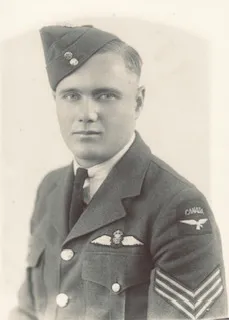

 Clinton, Ontario
 Service Record for Flight Lieutenant William Francis Cook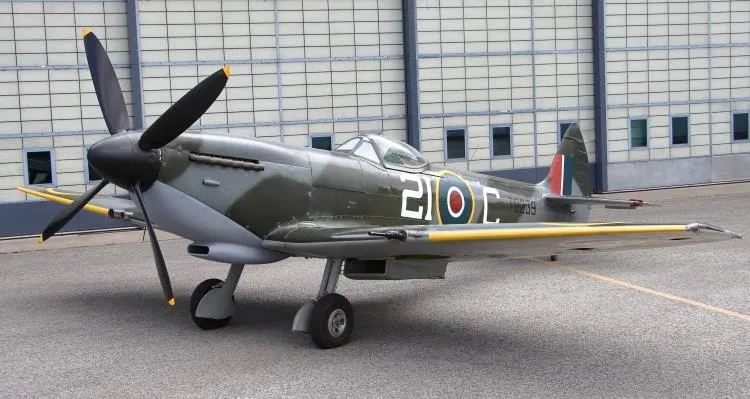
 Wikipedia Supermarine Spitfire
 Harold A Skaarup Web Page
 YouTube How the Spitfire Became an Aviation Masterpiece
 RCAF Supermarine Spitfire Serials - Kestrel Publications