 Prescott, Ontario
Sharpe earned his pilot certificate at the Glenn Curtiss School in California in 1914, before the war. He was gazetted a Lieutenant in the RFC in the 3 RS. He died in a crash at Shoreham on 1915-02-04, when his Farman nose-dived to the ground off a climbing turn near the Sussex Pad Public House at Lancing. Sharpe was the first Canadian in the flying service casualty of WWI.
pg.77, Canadian Aeronautics -1915
Sharpe, William Frederick Nelson (Lieutenant)
Killed in Flying Accident 1915-February-04
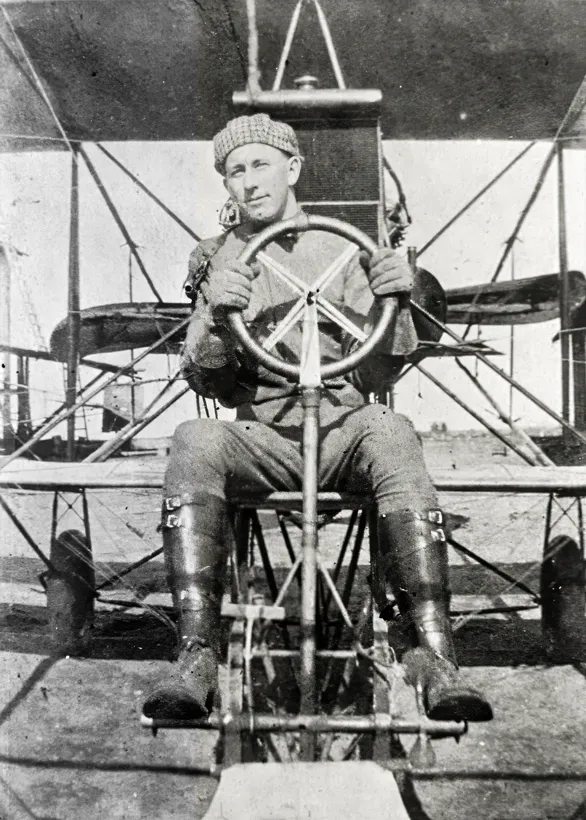

Birth Date: 1892-December
Born: Prescott, Ontario
Parents: Frederick Charles Sharpe & Ida Bell Sharpe
Spouse: Alma K. Sharpe
Home: Prescott, Ontario
Enlistment:
Enlistment Date: unkown date
Service
RFC
Unit
(RFC)
Base
Rank
Lieutenant
Position
pilot
Service Numbers
30124
 Canadian Virtual War Memorial
 Commonwealth War Graves Commission
 Finadagrave.com
S.7 Longhorn serial: 731
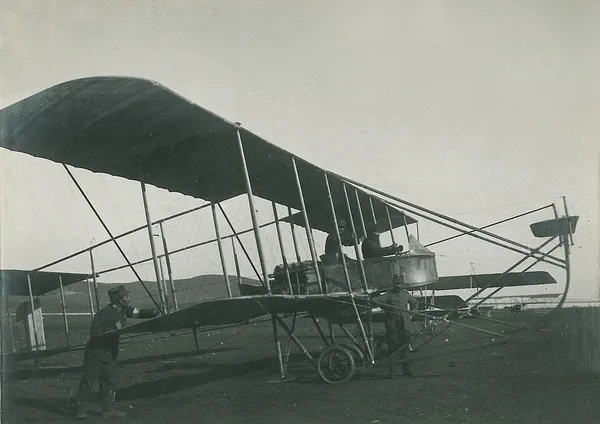
Farman 7 Longhorn Biplane at Nicopolis airfield, Preveza, Greece Jan 1913
Source Actia Nicopolis Foundation, Preveza, Greece
The Maurice Farman MF.7 Longhorn is a French biplane developed before World War I which was used for reconnaissance by both the French and British air services in the early stages of the war before being relegated to service as a trainer.
The "Longhorn" is a three bay biplane with a forward elevator mounted on upcurved extensions of the landing skids and an empennage carried on four booms consisting of biplane horizontal stabilizers with an elevator attached to the trailing edge of the upper surface and twin rudders. The airframe was constructed using a combination of ash and silver spruce, and many of the members including the outer interplane struts and the outrigger booms carrying the tail surfaces are hollow. It is powered by a Renault air-cooled V8 engine driving a pusher propeller mounted at the back of a fabric-covered nacelle. The propeller is mounted on the engine's camshaft, and therefore revolves at half the engine speed. Its name was derived from the distinctive front-mounted elevator and elongated skids.
Other users of the MF.7 included the Australian Flying Corps (AFC), provided with the MF.7 by the British Indian Army, operated it during the Mesopotamian campaign of 1915–16.
Some Maurice Farman 7s were sold to Spain and served with the Servicio de Aeronáutica Military since 1913.
Four MF.7s were sold to Norway and served with the Norwegian Army Air Service.
MF.7s were used by the Imperial Japanese forces in the World War I Battle of Tsingtao, with one downed by the German force's sole working aircraft. This was the first documented downing of an airplane in battle.
A Greek example was converted to a hydroplane flown by Michael Moutoussis with Aristeidis Moraitinis as observer and carried out the world's first air-naval co-operation mission during the First Balkan War. Wikipedia
 MF.7 Longhorn