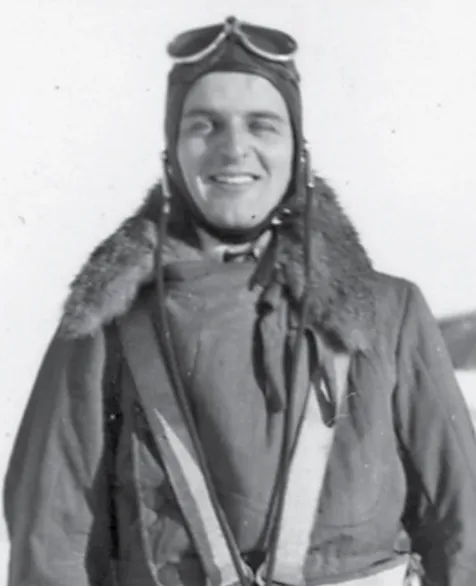
Flying Officer Weir shipped out in August, 1940, arriving on the
south coast of England, in the middle of the Blitz, and at the apogee of German invasion fears. He was posted to RCAF 401 Squadron, which had sustained heavy losses in the Battle of Britain, and had been re-assigned to Thurso, Scotland, to regroup while protecting the skies over Scapa Flow, the main British naval base.
By October, 1941, 401 Squadron had been posted to Lancashire and re-equipped with Spitfires. Flying Officer Weir, who had accumulated 1,000 hours of operational flight time, had far exceeded the life expectancy for new fighter pilots. His luck was about to expire.
Flying sweeps with a rookie tail man over Abbeville, one
of the main Luftwaffe bases in Normandy, he was shot down by a coven of Messerschmitts. In the melee, the cockpit and fuel tank burst into flame. Flying Officer Weir bailed out at 26,000 feet, a dangerously high altitude without an oxygen mask, and landed - burned, battered and bootless - about 30 km southwest of Caen.
His eyes were almost fused shut and the skin on his hands, face and neck was seared. A French farmer led him, nearly blind and in shock, to a tree stump and told him to wait for the Germans. That's how he began his nearly four years as a POW, first in a German hospital, then in Stalag Luft I on the Baltic.
"It was a nightmare," said Mrs. Weir about the three dreadful weeks that her fiancé was missing in action. She was working at Simpsons (now the Bay) as a personal shopper when she received an urgent message to go to the office. Thinking she was about to be fired, she was overjoyed to learn the real news - Flying Officer Weir was alive, albeit in a POW camp. Her relief was so palpable that she quit her job and began working for a research facility in the war effort.
Overseas, hatching escape plots was the primary conversational currency - tunnelling, sneaking under the wire, or jumping from trains when being transported from one camp to another. And escape is what Flying Officer Weir did a couple of days later when hundreds of Allied airmen were marched to the local train sta-
tion, bound for Stalag Luft III, the "escape-proof" POW camp deep in Poland. But freedom lasted only a couple of days before he was rounded up in the local whorehouse, marched to Gestapo headquarters, brutally beaten, and loaded aboard another train.
With 300 other prisoners, he arrived at Stalag Luft III, near Sagan (about 160 km southeast of Berlin) in mid-April, 1942, and immediately joined the "˜X' or escape committee, even though the camp had been deliberately designed to thwart tunnelling. The barracks in the four compounds were raised several inches off the ground so guards could observe covert digging; the sandy subsoil, which was structurally fragile, was bright yellow and easily detected against the grey surface soil; finally, the Germans had embedded seismograph microphones around the perimeter of the camp to amplify digging sounds.
But they weren't counting on the determination and organizing skills of RAF squadron leader Roger Bushell. He was shot down in March, 1940, and had survived at least four POW camps and several escape attempts before arriving in Stalag Luft III in October, 1943. He immediately developed an ambitious master plan for three tunnels - Tom, Dick and Harry - and an escape strategy to spring more than 200 men, equipped with civilian clothes or uniforms, identity papers and travel documents.
Supermarine Spitfire LF Mk. XVIe, Canadian Warplane Heritage Museum
The Supermarine Spitfire is a British single-seat fighter aircraft that was used by the Royal Air Force and other Allied countries before, during, and after World War II. Many variants of the Spitfire were built, using several wing configurations, and it was produced in greater numbers than any other British aircraft. It was also the only British fighter produced continuously throughout the war. The Spitfire continues to be popular among enthusiasts; around 70 remain airworthy, and many more are static exhibits in aviation museums throughout the world.
The Spitfire was designed as a short-range, high-performance interceptor aircraft by R. J. Mitchell, chief designer at Supermarine Aviation Works, which operated as a subsidiary of Vickers-Armstrong from 1928. Mitchell pushed the Spitfire's distinctive elliptical wing with cutting-edge sunken rivets (designed by Beverley Shenstone) to have the thinnest possible cross-section, helping give the aircraft a higher top speed than several contemporary fighters, including the Hawker Hurricane.
The Spitfire had detachable wing tips which were secured by two mounting points at the end of each main wing assembly. When the Spitfire took on a role as a high-altitude fighter (Marks VI and VII and some early Mk VIIIs), the standard wing tips were replaced by extended, "pointed" tips which increased the wingspan from 36 ft 10 in (11.23 m) to 40 ft 2 in (12.24 m). The other wing-tip variation, used by several Spitfire variants, was the "clipped" wing; the standard wing tips were replaced by wooden fairings which reduced the span by 3 ft 6 in (1.07 m). The wing tips used spruce formers for most of the internal structure with a light alloy skin attached using brass screws.
Due to a shortage of Brownings, which had been selected as the new standard rifle calibre machine gun for the RAF in 1934, early Spitfires were fitted with only four guns, with the other four fitted later. Early tests showed that, while the guns worked perfectly on the ground and at low altitudes, they tended to freeze at high altitude, especially the outer wing guns, because the RAF's Brownings had been modified to fire from an open bolt. While this prevented overheating of the cordite used in British ammunition, it allowed cold air to flow through the barrel unhindered. Supermarine did not fix the problem until October 1938, when they added hot air ducts from the rear of the wing-mounted radiators to the guns, and bulkheads around the gunbays to trap the hot air in the wing. Red fabric patches were doped over the gun ports to protect the guns from cold, dirt, and moisture until they were fired.
The first Rolls-Royce Griffon-engined Mk XII flew in August 1942, and first flew operationally with 41 Squadron in April 1943. This mark could nudge 400 mph (640 km/h) in level flight and climb to an altitude of 33,000 ft (10,000 m) in under nine minutes. As American fighters took over the long-range escorting of USAAF daylight bombing raids, the Griffon-engined Spitfires progressively took up the tactical air superiority role, and played a major role in intercepting V-1 flying bombs, while the Merlin-engined variants (mainly the Mk IX and the Packard-engined Mk XVI) were adapted to the fighter-bomber role. Although the later Griffon-engined marks lost some of the favourable handling characteristics of their Merlin-powered predecessors, they could still outmanoeuvre their main German foes and other, later American and British-designed fighters.Wikipedia
History of the Squadron before and during World War II (Aircraft: Siskin III, Hurricane I, II, Spitfire Vb, IX, IXb)
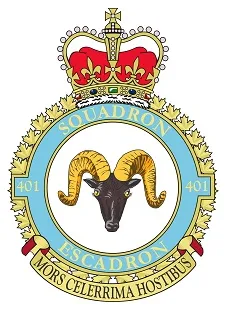
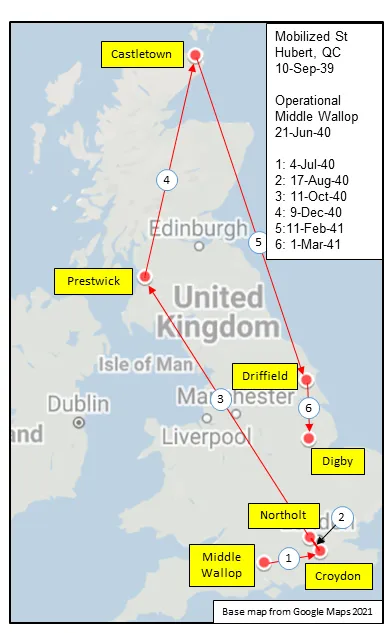
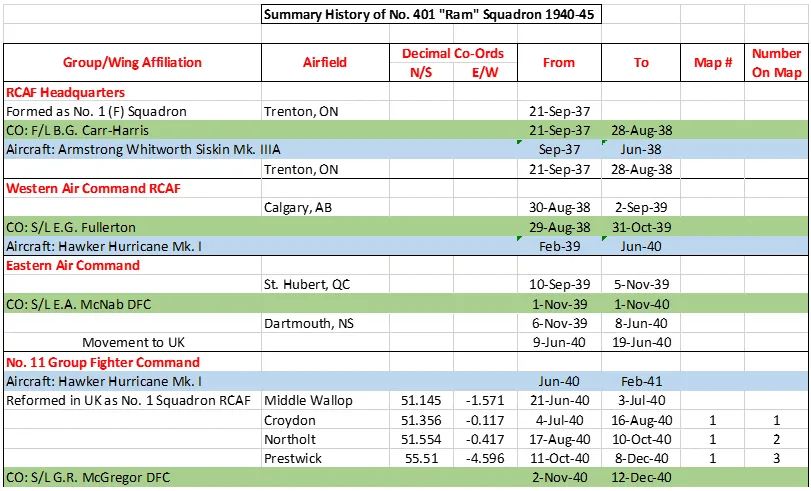
The roots of the squadron go back to No 81 (Canadian) Squadron RAF in 1918. This squadron was authorized as No 1 Squadron CAF around November 20 of that year, and was disbanded on January 28, 1920. It was re-formed at Jericho Beach (Vancouver), BC on 1 April 1925, and flew forestry and fishery patrols with Curtiss HS-2L flying boats, until it was transferred to the non-military Directorate of Civil Government Air Operationson 1 July 1927, and its service designation lapsed. The squadron was re-created at Trenton, ON in 1937 as No 1 (Fighter) Squadron RCAF. At the time it was equipped with Armstrong Whitworth Siskin III biplane fighters. It moved to Calgary in August 1938 and was re-equipped with Hawker Hurricane Mk 1 fighter aircraft in February 1939. On the outbreak of WWII in September 1939 the squadron was mobilized at St Hubert, QC, before moving to Dartmouth, NS in November. It absorbed No 115 (Fighter) Squadron of the Auxiliary in Montreal before moving to Britain in May 1940. After its aircraft had been modified to make them battle-fit at Middle Wallop, Hampshire and Croydon, Surrey, the squadron joined No 11 Group of RAF Fighter Command at Northolt, Middlesex, in August 1940, and saw action in the Battle of Britain, claiming 30 aircraft destroyed, 8 probably destroyed and 34 damaged. In October 1940 the squadron moved to bases in Scotland before moving briefly to No 12 Group Fighter Command in Driffield, Yorkshire. On March 1st, 1941 it was renumbered No 401 (Fighter) Squadron RCAF, at Digby, Lincolnshire, UK as part of the Canadian Digby Wing of 12 Group. The Squadron code letters were YO.
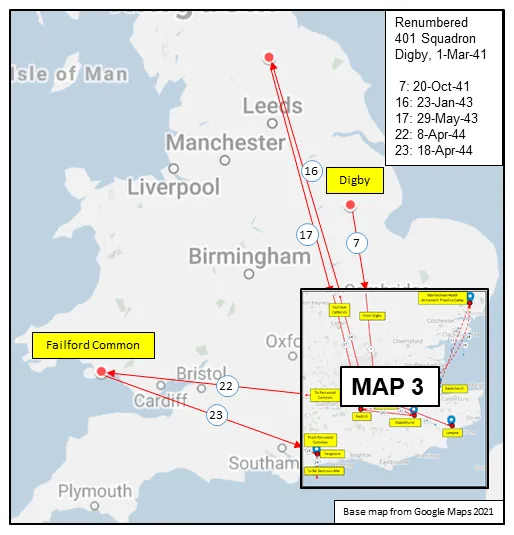
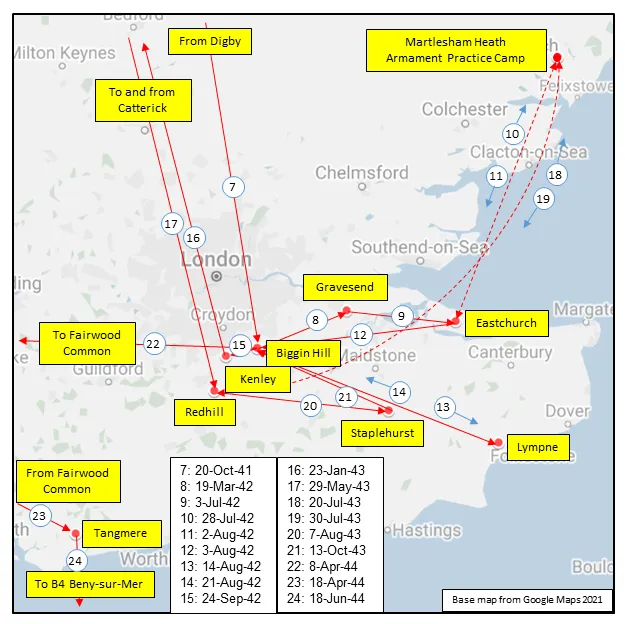
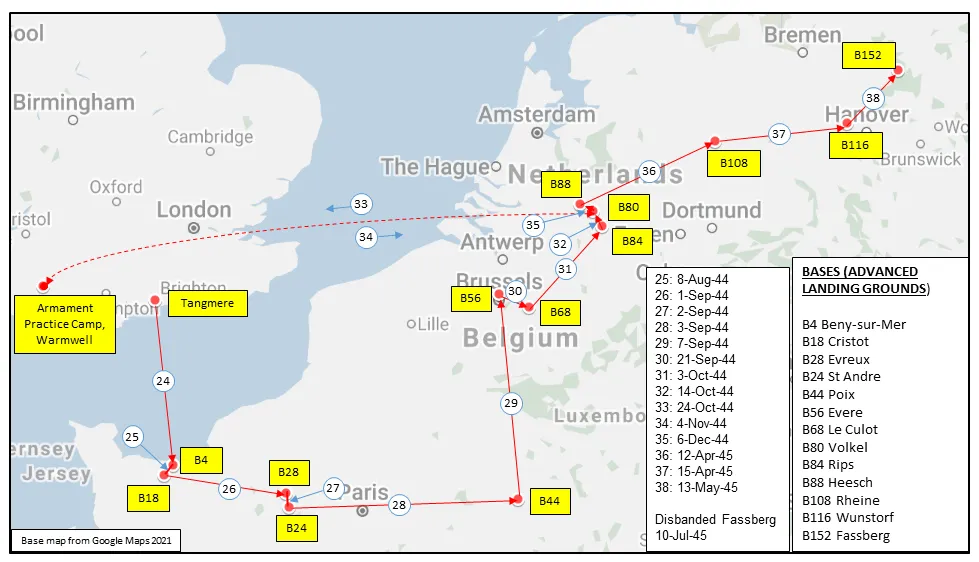
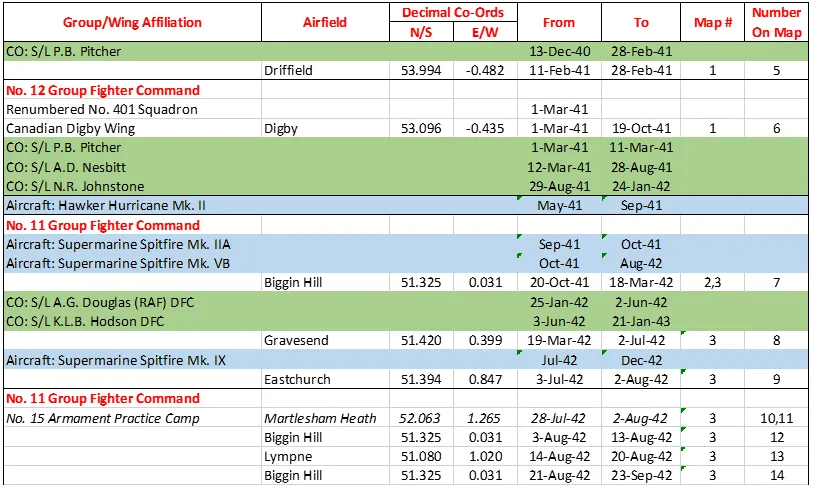
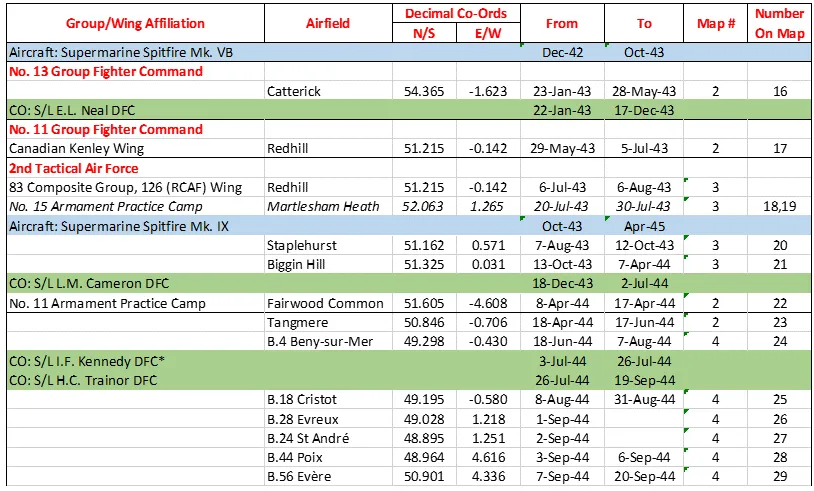
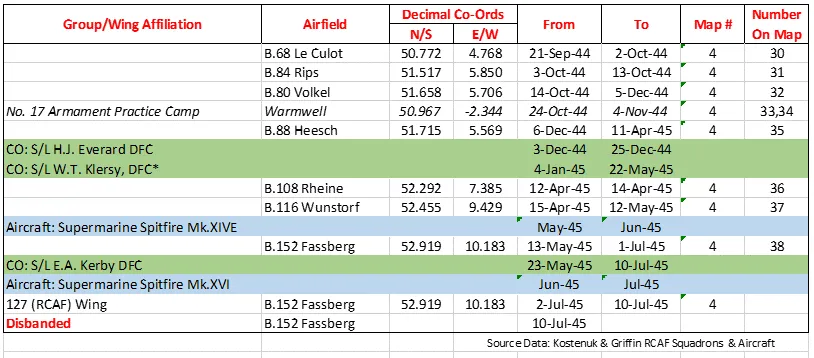
In October 1941 the squadron became again part of 11 Group, flying from several bases in Kent, ending up in September 1942 as part of the Canadian Kenley Wing until January 1943. In February 1941 the squadron converted to Hawker Hurricane Mk II aircraft, then in September of 1941 to Supermarine Spitfire Mk Vb. They flew different Marks of Spitfire for the rest of the war. During the period to early 1943, the squadron participated in fighter sweeps over France, and in RAMROD and RHUBARB operations. From January to May 1943 the squadron was rested at Catterick, Yorkshire and then it rejoined the Kenley Wing. In July 1943 Fighter Command was subsumed into the 2nd Tactical Air Force (TAF), and 401 Sqn was part of the No 126 (RCAF) Wing of No 83 Composite Group. Until June 1944 the squadron flew from Redhill, the Advanced Landing Ground at Staplehurst, Kent, Biggin Hill and Tangmere, Sussex where they continued fighter sweep and RAMROD operations. On and after D-Day the squadron patrolled the beachheads, and 12 days after D-Day the squadron moved to France, to No 4 Base at Beny-sur-Mer, Normandy. Thereafter until the cessation of hostilities the squadron’s Spitfires were employed in fighter and ground attack operations, moving from base to base through France, Belgium, the Netherlands and finally into Germany, as the armies moved northwards. The squadron was finally disbanded at Fassberg, Germany
on 10 July 1945.
The squadron shot down 195 enemy aircraft, which made it the top-scoring squadron of the RCAF, and it was the leading squadron in the 2nd TAF with 112 air and 15 ground victories. It held the record for the most sorties flown (12,087). In October 1944 the unit recorded the first victory in the RAF/RCAF over a Me 262 jet fighter. Among the pilots there were 9 Aces (Squadron Leader W.T. Klersy DFC & Bar, Flight Lieutenant J. MacKay DFC & Bar, Flight Lieutenant D.R. Morrison DFC & DFM, Flying Officer G.D. Cameron DFC, Flying Officer J.P.W. Francis DFC, Flying Officer R.R. Bouskill, Flight Lieutenant G.W. Johnson DFC & Bar, Squadron Leader L.M. Cameron DFC, Flying Officer D.B. Dack). Several pilots also claimed triple victories in a single sortie. Aircrew operational losses were 61 pilots, of whom 6 were killed and 28 presumed dead. Aircrew were awarded 15 DFCs, 4 Bars to DFC and 1 DFM.
Battle Honours were:Battle of Britain 1940, Defence of Britain 1940-44, English Channel and North Sea 1942, Fortress Europe 1941-44, Dieppe, France, Germany 1944-45Wikipedia, Kostenuk and Griffin
Maps for Movements of 401 Squadron 1940-45
MAP 1: No 1 Squadron RCAF Movements 1940-41 (right-click on image to display enlarged view in new tab)
MAP 2: 401 Squadron Movements in UK 1941-44
MAP 3: 401 Enlargement Detail of Map 2
MAP 4: 401 Squadron Movements in Europe 1944-45
401 Squadron History Summary 1940-45
401 Squadron History Summary 1940-45 Page 2
401 Squadron History Summary 1940-45 Page 3
401 Squadron History Summary 1940-45 Page 4
History of the Squadron Post-WWII (Aircraft: Vampire III, Sabre V, Expeditor, Otter, Kiowa, Hornet)
The squadron was reactivated as No 401 (F) Sqn (Aux) on 15 April 1946 at RCAF Station St. Hubert, Quebec . It was retitled ‘401 "City of Westmount" (F) Sqn (Aux)’ on September 4, 1952. The squadron flew de Havilland Vampire Mk. III and Canadair Sabre Mk. 5 aircraft in a fighter role until October 1958 when it was reassigned to a light transport and emergency rescue role, was re-designated '401 Squadron "City of Westmount" Sqn (Aux)' on November 1, 1958 and re-equipped with Beechcraft Expeditor and de Havilland Otter aircraft. The squadron was awarded a Squadron Standard on 5 May 1962. It was integrated into the Canadian Armed Forces as No 401 “City of Westmount” Air Reserve Squadron in January 1969. It was again re-designated '401 Helicopter Operational Training Squadron' on October 22, 1991. Flying the CH-136 Kiowa helicopter out of St. Hubert, Quebec. 401 Squadron was disbanded on June 23, 1996, after 55 years of operation.
The unit was reactivated as 401 Tactical Fighter Squadron on June 30, 2015, incorporating personnel from No 409 Tactical Fighter Squadron, flying the CF-18 Hornet aircraft. It celebrated its 100th Anniversary in 2018. Its first deployment was to Kuwait for offensive operations during Operation Impact, which is part of the Canadian Government’s approach to the Middle East. The reformed 401 Squadron complements the duties of 409 Tac F Sqn and, assisted by 410 Tactical Fighter (Operational Training) Squadron, deploys tactical fighter forces to meet Canadian and allied defence needs. It is based at Cold Lake, Alberta as part of RCAF 4 Wing. Under the umbrella of the NORAD mission, fighter crews are on stand-by 24/7 ready to respond to any aerospace threat.

 Toronto, Ontario
 Flightlines January 2018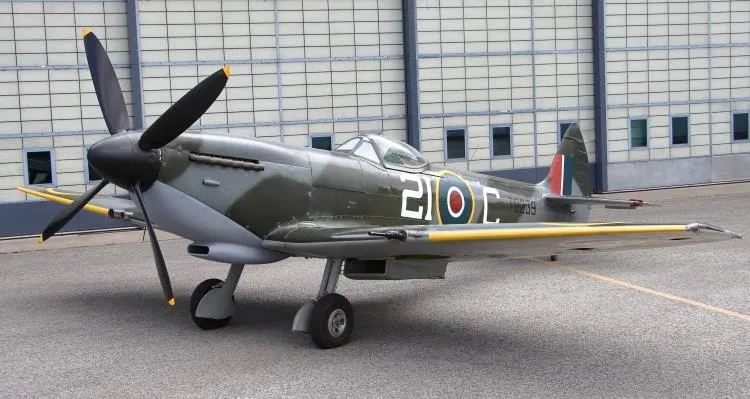
 Wikipedia Supermarine Spitfire
 YouTube How the Spitfire Became an Aviation Masterpiece
 RCAF Supermarine Spitfire Serials - Kestrel Publications