417 City of Windsor Squadron (Supporting Liberty And Justice). Warrant Officer Grant was killed when Hurricane aircraft HL 782 and HL 900 were in a mid-air collision ten miles north-east of Idfu.
Grant, William Kenneth (Warrant Officer 2nd Class)
Killed in Action 1942-November-09
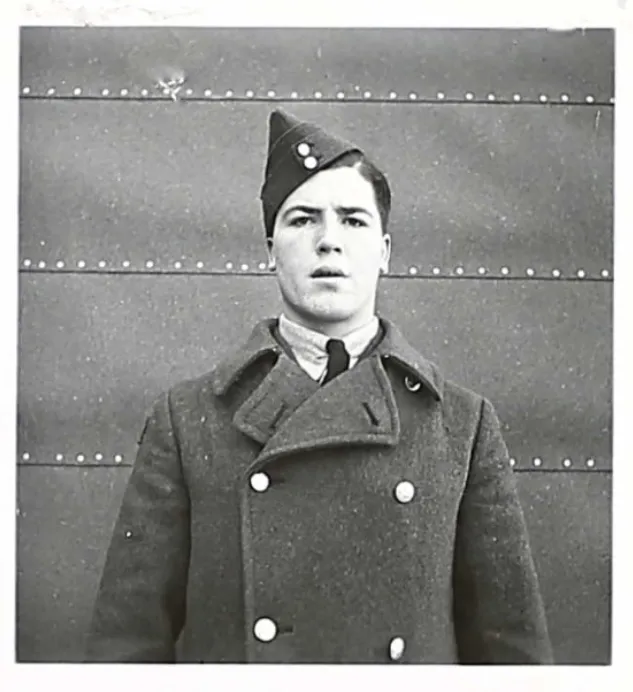

Birth Date: 1922
Born:
Parents: Son of William George and Selena M. Grant, of Colborne, Ontario, Canada.
Spouse:
Home: Colborne, Ontario
Enlistment:
Enlistment Date: unkown date
Service
RCAF
Unit
417 Sqn- Squadron
Supporting Liberty and Justice
Base
Rank
Warrant Officer 2nd Class
Position
Pilot
Service Numbers
R/67317
 Canadian Virtual War Memorial
 Commonwealth War Graves Commission
 Finadagrave.com
 Library and Archives Canada Service Files (may not exist)
Hurricane serial: HL782
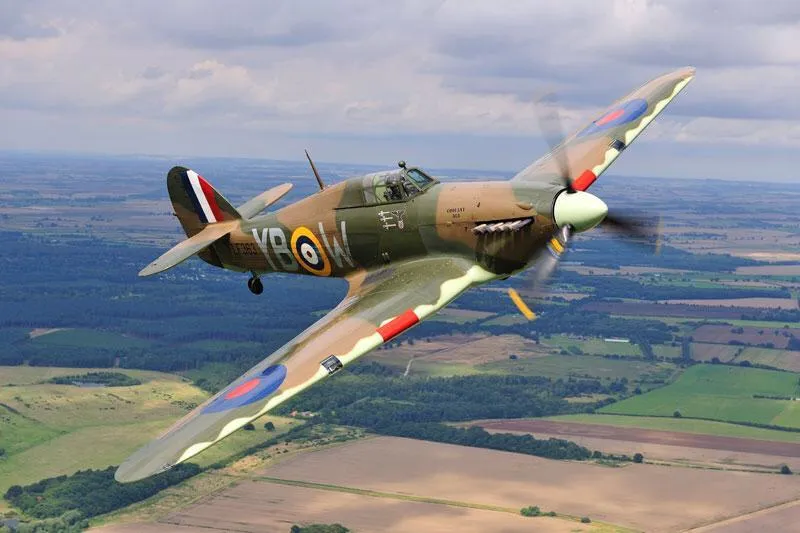
Hawker Hurricane Mk IIc.
Source BBMF
Source BBMF
The Hawker Hurricane is a single-seat fighter aircraft of the 1930s"“1940s that was designed and predominantly built by Hawker Aircraft Ltd. for service with the Royal Air Force (RAF). The Hurricane developed through several versions, as bomber-interceptors, fighter-bombers, and ground support aircraft in addition to fighters. Versions designed for the Navy were popularly known as the Sea Hurricane, with modifications enabling their operation from ships. Some were converted to be used as catapult-launched convoy escorts. By the end of production in July 1944, 14,487 Hurricanes had been completed in Britain and Canada.
A major manufacturer of the Hurricane was Canadian Car and Foundry at their factory in Fort William (now Thunder Bay), Ontario. The facility's chief engineer, Elsie MacGill, became known as the "Queen of the Hurricanes". The initiative was commercially led rather than governmentally, but was endorsed by the British government; Hawker, having recognized that a major conflict was all but inevitable after the Munich Crisis of 1938, drew up preliminary plans to expand Hurricane production via a new factory in Canada. Under this plan, samples, pattern aircraft, and a complete set of design documents stored on microfilm, were shipped to Canada; the RCAF ordered 20 Hurricanes to equip one fighter squadron and two more were supplied to Canadian Car and Foundry as pattern aircraft but one probably did not arrive. The first Hurricane built at Canadian Car and Foundry was officially produced in February 1940. As a result, Canadian-built Hurricanes were shipped to Britain to participate in events such as the Battle of Britain. Canadian Car and Foundry (CCF) was responsible for the production of 1,451 Hurricanes.
Sea Hurricane
While the Sea Hurricane never served in the Royal Canadian Navy, it was, ironically, operated by the Royal Canadian Air Force. In late 1941, the RCAF found itself without any frontline fighters, having sent its earlier Hawker Hurricanes off to the UK along with 1 (Fighter) Squadron, RCAF, and was having a hard time procuring additional fighters to meet its needs.
For reasons that are still slightly unclear, the RCAF received 50 Sea Hurricanes in 1942. It is assumed that these aircraft, built in Thunder Bay, Ontario by Canadian Car and Foundry, were to be used as part of the Fleet Air Arm (FAA) Merchant Ship Fighting Unit (MSFU) based in Canada, but were diverted to the RCAF. These Sea Hurricanes were basically a Hurricane Mk. I with a tail-hook, catapult spools, a short blunt de Havilland spinner, and an eight gun wing. Wikipedia and Harold A Skaarup Web Page
Folding Wings
The idea of adding folding wings to the Sea Hurricane was examined in 1940 but ultimately abandoned due to concerns about the aircraft's ability to accommodate the extra weight and the urgent need for next-generation aircraft. The Sea Hurricane was primarily designed as a stopgap measure for naval operations, which limited the resources available for such modifications.
Examination of the Concept
- Weight Concerns: There were significant worries about the Sea Hurricane's ability to handle the additional weight that folding wings would introduce.
- Resource Limitations: The Sea Hurricane was intended as a stopgap solution for naval operations, which meant that resources for further modifications were limited.
The Sea Hurricane was adapted from the original Hurricane design to meet the needs of naval aviation. Key modifications included:
- Strengthened Airframe: To withstand the rigors of carrier operations.
- Arrestor Hook: Essential for landing on aircraft carriers.
- Naval Equipment: Ensured functionality in maritime conditions.
While the folding wing concept was explored, the pressing demands of the war and the need for more advanced aircraft led to its dismissal. The Sea Hurricane continued to serve effectively in its modified form without the folding wings.
 Hurricane
 Wikipedia Hurricane
 Harold A Skaarup Web Page
 Hurricane - Kestrel Publications
Unit Desciption
417 Sqn Supporting Liberty and Justice ("City of Windsor")
History of the Squadron during World War II (Aircraft: Hurricane Mks. IIB, IIC, Spitfire Mks. VB, VC, VIII, IXB)
No. 417 Squadron was the 16th RCAF squadron formed overseas in WWII. It was the seventh fighter squadron, and was formed at Charmy Down, Somerset, England  in November 1941. After 4 months in England and Scotland, the squadron sailed to Egypt where it flew Hawker Hurricanes and, later, Supermarine Spitfires in the defence of the Suez Canal and the Nile Delta. It became the only Canadian squadron in the Desert Air Force, and provided air defence and ground support to the British Eighth Army as it advanced from El-Alamein to Tunisia. It was in Malta to support Operation HUSKY, the invasion of Sicily in Jun-Jul 1943, and then provided support for the army in its campaign through Italy. It was disbanded at Treviso, Italy on June 30, 1945.
Overall the squadron flew 12,116 sorties. It claimed 29 enemy aircraft destroyed, 8 probables and 22 damaged, for the loss of 32 aircraft and 28 pilots of whom 7 were killed, 11 presumed dead, 8 were POW and 2 evaded capture. The squadron also accounted for many locomotives, rail cars, tanks and other vehicles. There was one ace among the pilots, Squadron Leader A.U. Houle, DFC & Bar. Squadron personnel were awarded 1 DSO, 1 Bar to DFC, 9 DFCs and 5 MiDs. Battle Honours were: Defence of Britain 1942, Egypt and Libya 1943-43, North Africa 1943, Sicily 1943, Italy 1943-45, Salrno, Anzio and Nettuno, Gustav Line, Gothic Line.Wikipedia, Kostenuk and Griffin
Maps for Movements of 419 Squadron 1942-45
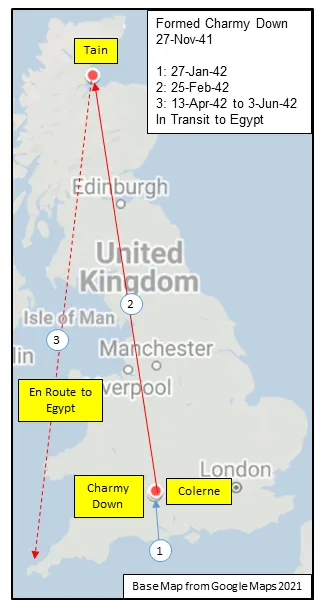
MAP 1: 417 Squadron Movements in Britain 1941-42 (right-click on image to display enlarged in new tab)
|
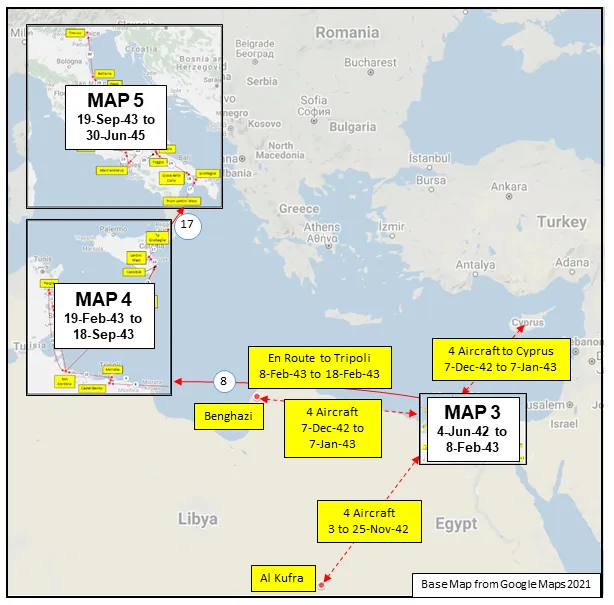
MAP 2: 417 Squadron Movements in North Africa and Mediterranean Theatre
|
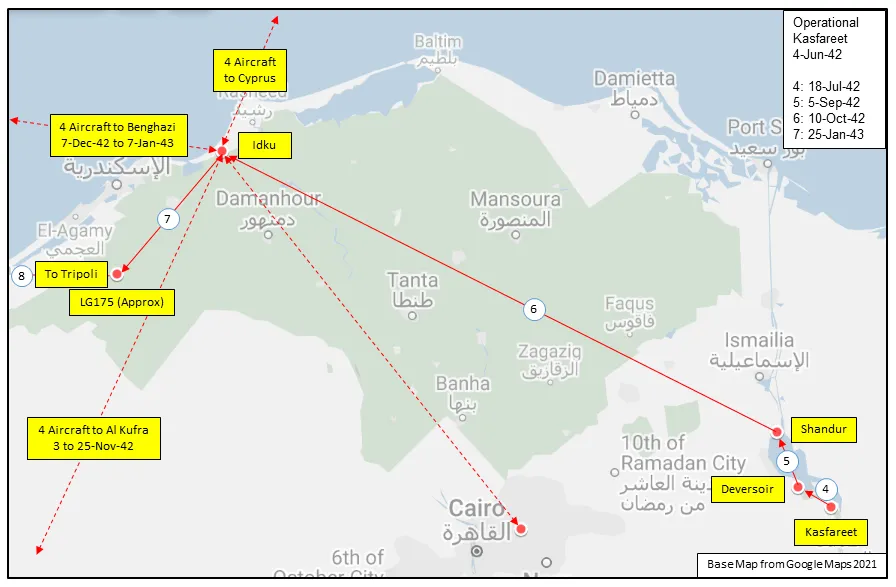
MAP 3: 417 Squadron Movements in Egypt 1942-43 (detail of Map 2)
|
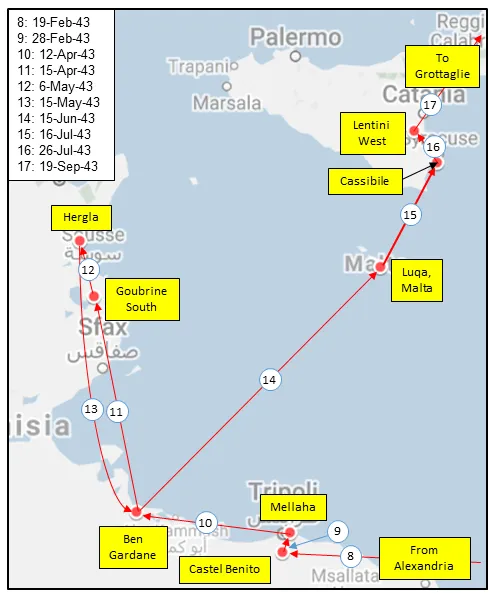
MAP 4: 417 Squadron Movements in Tunisia and Sicily 1943 (detail of Map 2)
|
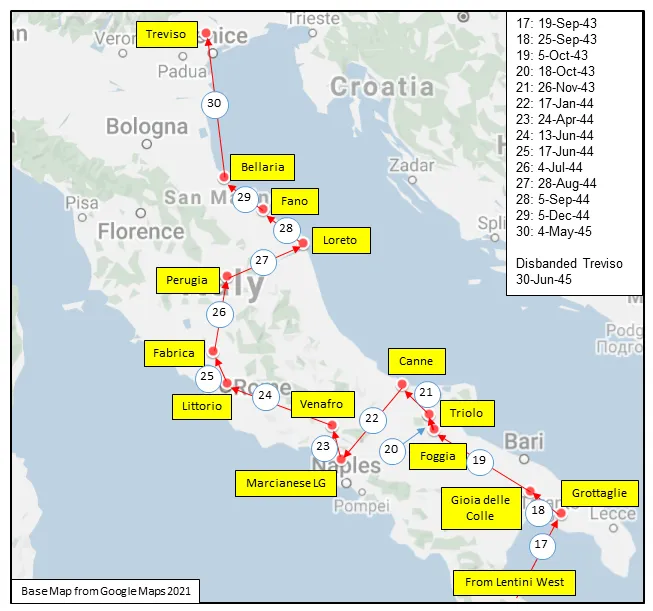
MAP 5: 417 Squadron Movements in Italy 1943-45 (detail of Map 2)
|
417 Squadron History Summary 1941-45
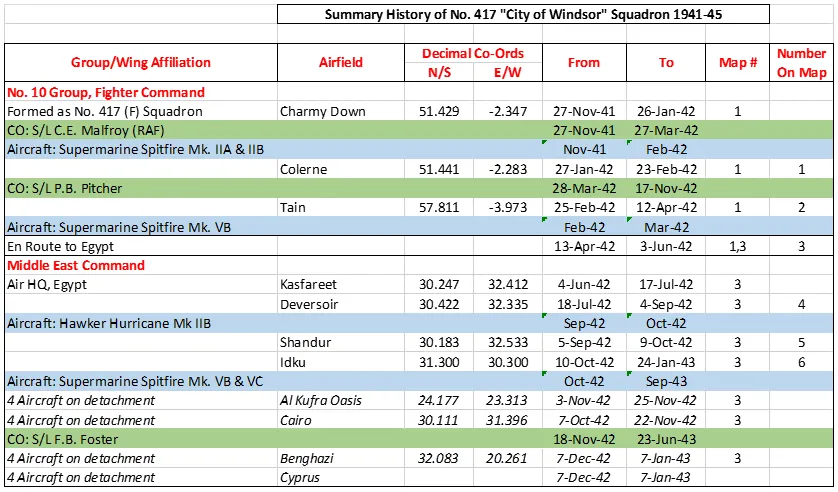
417 Squadron History Summary 1941-45 Page 2
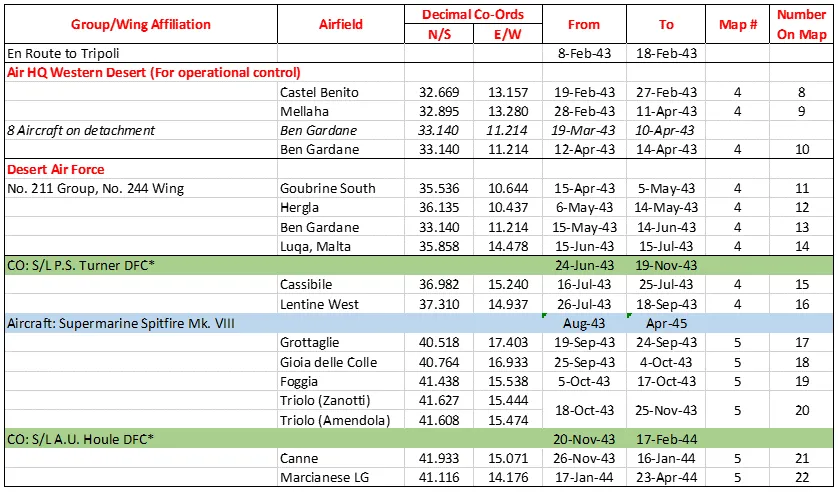
417 Squadron History Summary 1941-45 Page 3
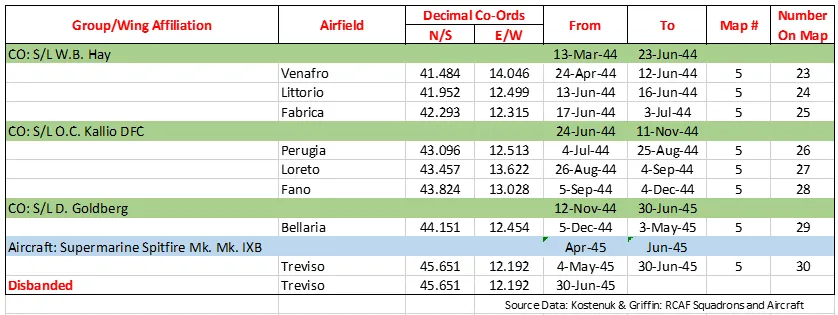
History of the Squadron Post-WWII (Aircraft: Mustang IV, Harvard II, Starfighter, Expeditor, Silver Star, Dragonfly, Huey, Iroquois, Griffon)
417 Squadron was reformed and disbanded twice since its original period of activity. The Squadron was reactivated on June 1, 1947 as a Fighter Reconnaissance Squadron at RCAF Station, Rivers, Manitoba , where it flew North American Mustangs and Harvards in the close air support role until August 1, 1948, when it was disbanded.
Twenty-two years later, in 1970, 417 Squadron was again reformed, but from the No. 6 (Strike and Reconnaissance) Operational Training Unit (OTU) at CFB Cold Lake, Alberta , which had been training pilots on the CF104 Starfighter since 1961. 417 continued as the CF104 OTU until the Squadron was disbanded in April 1983, as a result of the phasing out of the Starfighter.
During one of 417 Squadron's periods of inactivity, Base Flight at Cold Lake was formed on 24 August 1954. Its original reason for being was to provide a communications link to Edmonton, then five hours away by road. The Flight performed this with their first Aircraft, a Beechcraft Expeditor. In the process of expanding its role, Base Flight amassed a wide variety and number of aircraft, making it one of the largest and most active flying units in Canada's post-war Air Force. The fleet included H-5 (Dragonfly) and H-34 (Horse) helicopters, de Havilland Otters and the Douglas C-47 Dakotas, three of which were modified with nose cones to efficiently train upcoming CF 104 pilots on air intercept radar systems. Base Flight also employed the T-33 Silver Star as utility transport, airborne target trainer and as an air combat adversary. On the helicopter side, the main roles were, and still are, to rescue downed aircrew and to provide Medical Evacuation services (MEDEVAC) to both military and civilian communities. To fulfil these and other diverse roles, Base Flight added to the two original above-mentioned helicopters by receiving three UH-1 Huey or Iroquois helicopters and later, two CH-135 Twin Huey Aircraft. On April 1, 1993, 417 Squadron was re-formed again, incorporating the Base Flight plus aircraft servicing and maintenance elements of the Wing Maintenance organization.
The mission is now to provide helicopter support to 4 Wing, Cold Lake, by providing a dedicated on base Search and Rescue Unit. The unit’s primary role is to conduct Base rescue for the fighter units on base. Its secondary role is to augment the National Search and Rescue capability.