Born Halifax, Nova Scotia, 30 December 1919. Home in Liverpool, Nova Scotia. Attended Acadia University for three years. Enlisted in Halifax, 21 June 1940 (possibly 21 January 1940). Trained at No.2 ITS, No.8 EFTS and No. 4 SFTS (graduated 28 January 1941; awarded wings that date). Posted overseas in February 1941; further trained at No.52 OTU, March and April 1941. Served with Nos.403 Squadron, 21 April 1941 to 12 September 1941; No.402 Squadron, 21 September 1941 to January 1942; No.175 Squadron, 6 February 1942 to 9 July 1942. Returned to No.403 Squadron as B Flight Commander, 19 July 1942; became Commanding Officer on 13 August 1942. Posted to Digby as Wing Commander (Flying), 19 April 1943. Killed in action, 4 June 1943 attacking enemy shipping off Dutch coast; with four pilots of No.402 Squadron attacked three E-boats and was shot down into sea. Credited with six enemy aircraft destroyed.
402 City of Winnipeg Squadron. W/C. Ford was an ace, he was credited with destroying six enemy aircraft and was killed when his Spitfire aircraft AA 980 was shot down in the sea off Holland. On a previous operation, W/C. Ford dropped a bomb, from his Hurricane aircraft, which went right down the funnel of a German destroyer.
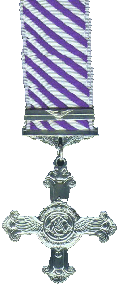
Addendum: - W/C Ford was 24 years old at time of death, not 22. FORD, FL Leslie Sydney (J3712) - Distinguished Flying Cross - No 175 Squadron - Award effective 9 June 1942 as per London Gazette dated 26 June 1942 and AFRO 1000-1001/42 dated 3 July 1942. The citation reads - " This officer has carried out many operational missions, having been engaged in fighter sweeps and in bombing attacks on land and sea targets. He has participated in two attacks when two mine sweepers and an enemy destroyer were sunk and two destroyers were damaged. He is a keen and zealous flight commander and leader." FORD, S/L, Leslie Sydney (J3712) - Bar to Distinguished Flying Cross - No.403 Squadron-Award effective 16 September 1942 as per London Gazette dated 2 October 1942 and AFRO 1653/42 dated 16 October 1942. The citation reads - "On August 19th, 1942, this officer led his squadron in support of the combined operations against Dieppe with great skill. Several enemy aircraft were destroyed, two of which were shot down by Squadron Leader Ford. Throughout, his inspiring example instilled great confidence in his fellow pilots." NOTE: Public Records Office Air 2/8769 has recommendation for a Croix de Guerre dated 20 January 1943 stating about the same as above. Although it went right through to Fighter Command Headquarters, it was not approved at Air Ministry level, either because the deed had already been covered by the Bar to the DFC or because of Ford's death in action. Several other pilots were recommended for the Croix de Guerre following the Dieppe Raid and ended up with Mentions in Despatches. Detail provided by H. Halliday, Orleans, Ontario.
Ford, Leslie Sydney (Wing Commander)
Killed in Action 1943-June-04
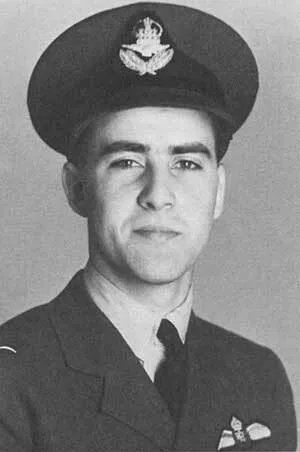

Birth Date: 1919
Born:
Parents: Son of Dr. Theodore Rupert Ford and Margaret Irene Ford, of Shelburne, Nova Scotia. B.A.
Spouse:
Home: Liverpool, Nova Scotia
Enlistment:
Enlistment Date: unkown date
Service
RCAF
Unit
402 Sqn- Squadron
We Stand on Guard
Base
Rank
Wing Commander
Position
Pilot
Service Numbers
J/3712
 Canadian Virtual War Memorial
 Library and Archives Canada Service Files (may not exist)
Spitfire serial: AA980
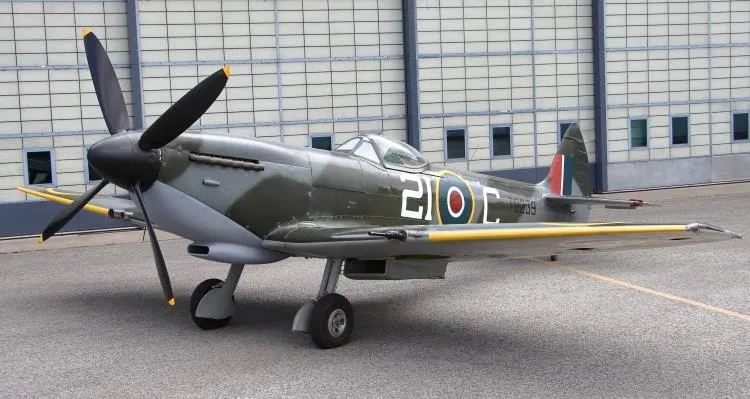
Supermarine Spitfire LF Mk. XVIe, Canadian Warplane Heritage Museum
The Supermarine Spitfire is a British single-seat fighter aircraft that was used by the Royal Air Force and other Allied countries before, during, and after World War II. Many variants of the Spitfire were built, using several wing configurations, and it was produced in greater numbers than any other British aircraft. It was also the only British fighter produced continuously throughout the war. The Spitfire continues to be popular among enthusiasts; around 70 remain airworthy, and many more are static exhibits in aviation museums throughout the world.
The Spitfire was designed as a short-range, high-performance interceptor aircraft by R. J. Mitchell, chief designer at Supermarine Aviation Works, which operated as a subsidiary of Vickers-Armstrong from 1928. Mitchell pushed the Spitfire's distinctive elliptical wing with cutting-edge sunken rivets (designed by Beverley Shenstone) to have the thinnest possible cross-section, helping give the aircraft a higher top speed than several contemporary fighters, including the Hawker Hurricane.
The Spitfire had detachable wing tips which were secured by two mounting points at the end of each main wing assembly. When the Spitfire took on a role as a high-altitude fighter (Marks VI and VII and some early Mk VIIIs), the standard wing tips were replaced by extended, "pointed" tips which increased the wingspan from 36 ft 10 in (11.23 m) to 40 ft 2 in (12.24 m). The other wing-tip variation, used by several Spitfire variants, was the "clipped" wing; the standard wing tips were replaced by wooden fairings which reduced the span by 3 ft 6 in (1.07 m). The wing tips used spruce formers for most of the internal structure with a light alloy skin attached using brass screws.
Due to a shortage of Brownings, which had been selected as the new standard rifle calibre machine gun for the RAF in 1934, early Spitfires were fitted with only four guns, with the other four fitted later. Early tests showed that, while the guns worked perfectly on the ground and at low altitudes, they tended to freeze at high altitude, especially the outer wing guns, because the RAF's Brownings had been modified to fire from an open bolt. While this prevented overheating of the cordite used in British ammunition, it allowed cold air to flow through the barrel unhindered. Supermarine did not fix the problem until October 1938, when they added hot air ducts from the rear of the wing-mounted radiators to the guns, and bulkheads around the gunbays to trap the hot air in the wing. Red fabric patches were doped over the gun ports to protect the guns from cold, dirt, and moisture until they were fired.
The first Rolls-Royce Griffon-engined Mk XII flew in August 1942, and first flew operationally with 41 Squadron in April 1943. This mark could nudge 400 mph (640 km/h) in level flight and climb to an altitude of 33,000 ft (10,000 m) in under nine minutes. As American fighters took over the long-range escorting of USAAF daylight bombing raids, the Griffon-engined Spitfires progressively took up the tactical air superiority role, and played a major role in intercepting V-1 flying bombs, while the Merlin-engined variants (mainly the Mk IX and the Packard-engined Mk XVI) were adapted to the fighter-bomber role. Although the later Griffon-engined marks lost some of the favourable handling characteristics of their Merlin-powered predecessors, they could still outmanoeuvre their main German foes and other, later American and British-designed fighters.Wikipedia
 Wikipedia Supermarine Spitfire
 Harold A Skaarup Web Page
 YouTube How the Spitfire Became an Aviation Masterpiece
 RCAF Supermarine Spitfire Serials - Kestrel Publications
Unit Desciption
402 Sqn We Stand on Guard ("City of Winnipeg")
History of the Squadron before and during World War II (Aircraft: DH-60 Moth, Lysander 1, Hurricane I, IIA, IIB, IIB(B), Spitfire V, VC, IX, IXB, XIVE, XVI)
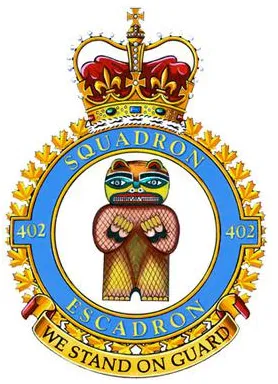
Note that the crest and motto were not granted until after WWII. During the war the squadron had no crest or motto
402 Squadron evolved from No 112 Army Co-operation Squadron (Auxiliary), which was formed at Winnipeg, MB in October 1932, although it did not begin flying training until September 1934, when it received de Havilland DH-60 Moth aircraft. It was renumbered as No 112 Squadron in November 1938. It was mobilized in September 1939 and was assigned to the Canadian Active Service Force for overseas duty and moved to Rockcliffe, ON in February of 1940, being equipped with Westland Lysander Mk. II aircraft with the squadron code XO. It embarked for Britain on 9 June 1940 to join RAF Army Co-operation Command, but the fighting in France was over before the squadron could become operational. On arrival to England, the squadron code was changed to AE. The unit remained with Army Co-operation Command until December 9, 1940, when it transferred to Digby, Lincolnshire, UK 
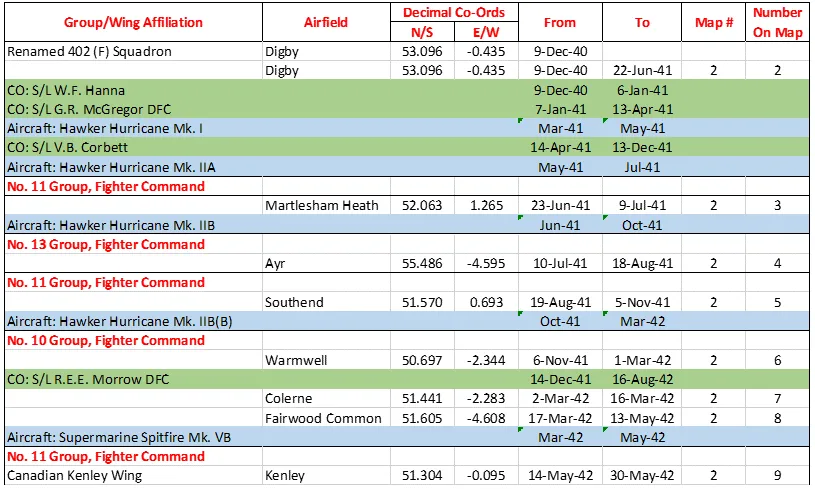
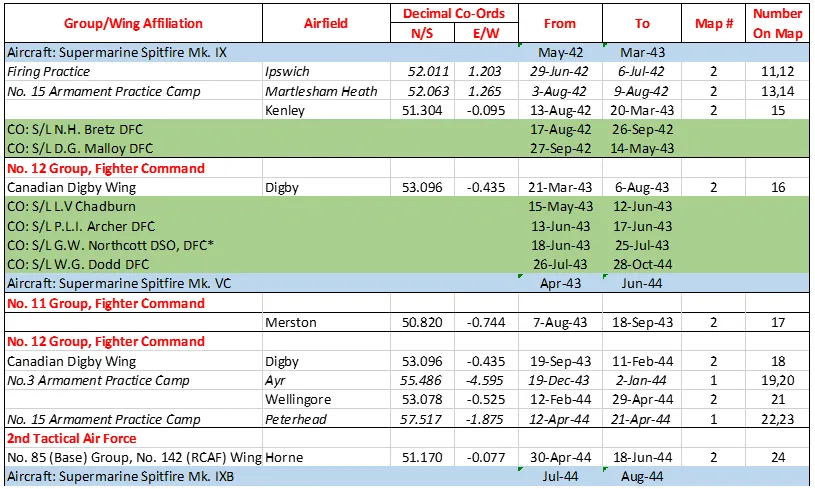
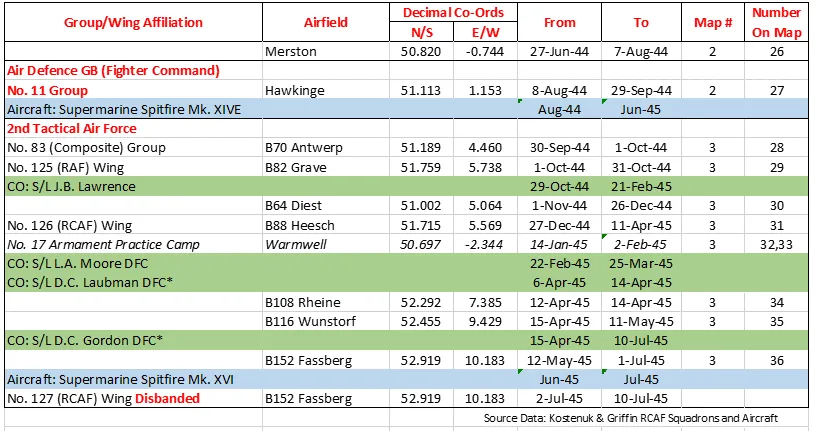
and was re-designated No 2 (Fighter) Squadron. On March 1, 1941, it was renumbered No 402 (Fighter) Squadron. The squadron was issued with Hawker Hurricane Mk I’s, but these were followed by Hurricane IIB and IIB(B) versions. The latter were the fighter-bomber versions of the aircraft ("Hurribombers"), and the squadron was the first RCAF unit to be equipped with them. The first bombing sortie was on November 1, 1941. The unit circulated between different Groups of Fighter Command in the course of 1941 and early 1942, being based at a number of airfields: Digby, Lincolnshire (12 Group), Martlesham Heath, Suffolk (11 Group), Ayr, Scotland (13 Group), Southend, Essex (11 Group) Warmwell, Dorset, Colerne, Wiltshire and Fairwood Common, S. Wales (10 Group), before joining the 11 Group Canadian Kenley Wing in May 1942. By now it was equipped with Supermarine Spitfire Mk Vb and later Mk IX. It remained at Kenley until March 1943, taking part in fighter sweep operations over France. In March 1943 it was back to Digby, where the squadron was trained for possible overseas postings involving aircraft carriers, although this came to nothing. In August the squadron spent a number of weeks back on the South Coast again flying RAMROD and RODEO operations. The squadron remained at Digby and Wellingore, Lincolnsire until the end of April 1944, when it joined No 142 (RCAF) Wing of No 85 Base Group of the 2nd Tactical Air Force (TAF) at Horne, Yorkshire and then Westhampnett and Merston, Sussex. The squadron provided low level beach cover and bomber escort operations after the D-Day landings in June 1944. In August, 1944 the squadron was equipped with Spitfire Mk XIVs and was focused on DIVER operations, the interception of German V-1 flying bomb missiles. From 30 September onwards, the squadron was again attached to 2nd TAF No 125 (RAF) Wing and subsequently No 126 (RCAF) Wing as they moved through Belgium and Germany. The Squadron was disbanded at Fassberg, Germany on July 10, 1945.
In the course of the war, the squadron flew 10,504 sorties for the loss of 47 pilots, of whom 36 were killed or missing. There were two aces among the squadron pilots, Squadron Leader G.W. Northcott, DSO, DFC and Bar, and Pilot Officer J.D. MIchner. The squadron was credited with 49 enemy aircraft destroyed and 37 damaged, and 5 V-1 flying bombs were destroyed. The squadron was awarded 4 DFCs and 1 Bar to DFC. Battle Honours were: Defence of Britain, 1941-1944; English Channel and North Sea, 1941-1944; Fortress Europe, 1941-1944; Dieppe; France and Germany, 1944-1945; Normandy, 1944; Arnhem; Rhine.Wikipedia, Rawlings, Kostenuk and Griffin
Maps for Movements of 402 Squadron 1940-45
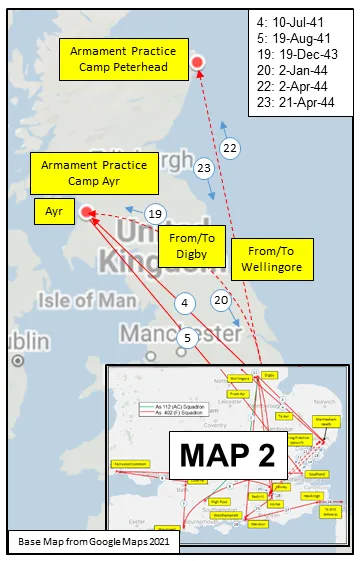
MAP 1: 402 Squadron Movements in UK 1940-44 (right-click on image to display enlarged new tab)
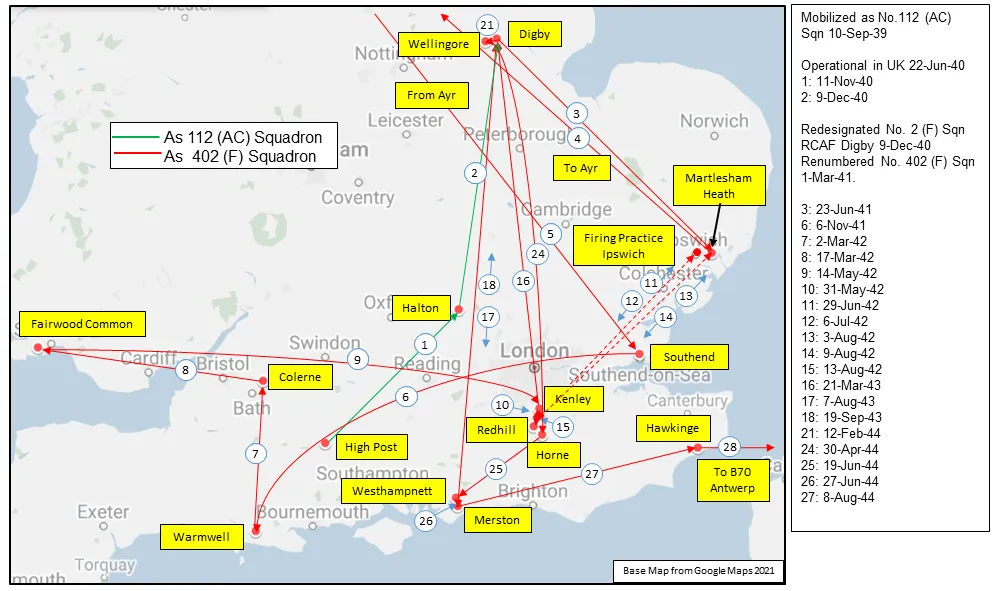
MAP 2: Detail from Map 1
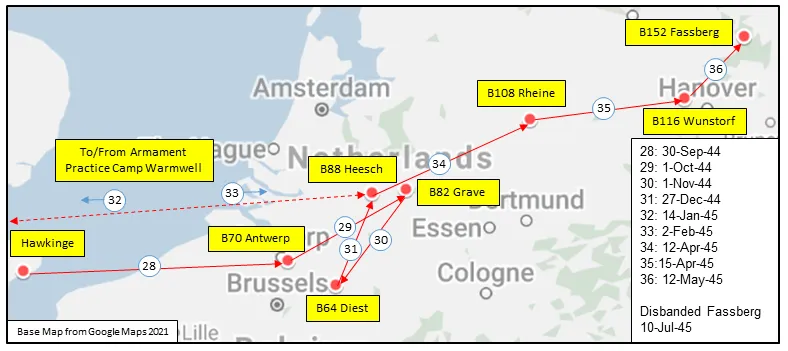
MAP 3: 402 Squadron Movements in Europe 1944-45
402 Squadron History Summary 1940-45
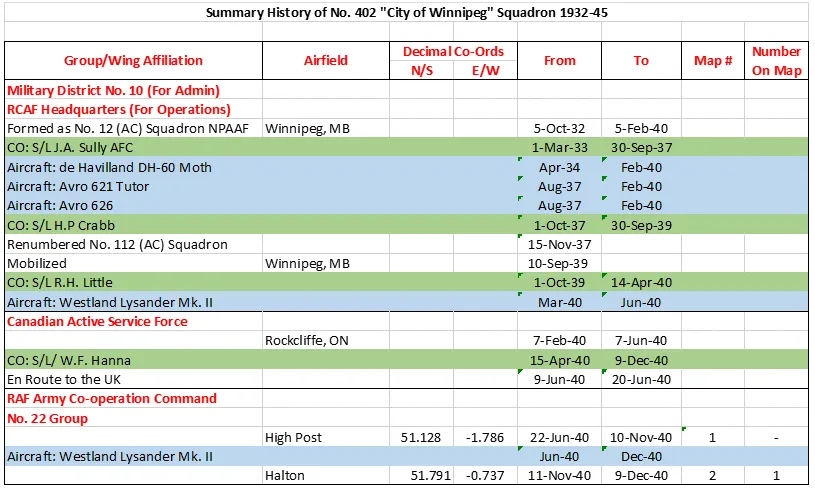
402 Squadron History Summary 1940-45 Page 2
402 Squadron History Summary 1940-45 Page 3
402 Squadron History Summary 1940-45 Page 4
History of the Squadron Post-WWII (Aircraft: Harvard II, Vampire III, Mustang IV, Expeditor, Otter, Dakota, Dash 8)
The squadron was re-formed as No 402 (FB) Sqn (Aux) in Winnipeg, Manotoba on 15 April 1946. It was re-designated No 402 (F) Sqn (Aux) on 1 March 1947. At that time it was flying North American Harvard Mk. II aircraft. It was re-designated No 402 (FB) Sqn (Aux) on 1 April 1949 by this time flying de Havilland Vampire III aircraft. These were later replaced by the North American Mustang IV (P-51D). It was retitled No 402 "City of Winnipeg" (FB) Sqn (Aux) on 10 November 1953. With a change of function to transport the squadron was redesignated No 402 "City of Winnipeg" (T) Sqn (Aux) on 25 January 1957, flying Beechcraft Expeditor and later de Havilland Otter aircraft. Although it had a Transport designation, it acted as a navigation school. It was further re-designated No 402 "City of Winnipeg" Sqn (Aux) on 1 April 1958. It was integrated into the CAF as No 402 "City of Winnipeg" Air Reserve Squadron on 1 February 1968. In 1975 the squadron replaced its Otters with Douglas CC-129 Dakotas as light transport and search and rescue aircraft. They were the last Canadian squadron to fly the Dakota.
In the late 1980s, the name changed to 402 "City of Winnipeg" Transport and Training Sqn. with the de Havilland Canada CC/CT-142 Dash 8 used to provide light transport and training for the Canadian Forces Air Navigation School (CFANS). In 2000, the two CC-142 Dash 8 light role.[8] By June 2009, and the changing demands of air forces worldwide, the training was adapted to include AESOPs (Airborne Electronic Sensor Operators) as well as Air Navigators now being called ACSOs (Air Combat Systems Officers). With the change in the trade name, CFANS became 1 Canadian Forces Flight Training School (1CFFTS). 402 Sqn and 1CFFTS continued to work together to provide ab-initio training. In 2014, 1CFFTS was amalgamated into 402 Sqn, who took over the full training syllabus alongside the aircraft maintenance and pilot employment. 402 Sqn. continues the long tradition of training Commonwealth partners from the United Kingdom, Australia and New Zealand, as well as NATO allies from Germany and Norway. The program has further expanded to include, among others, Singapore and South Korea.