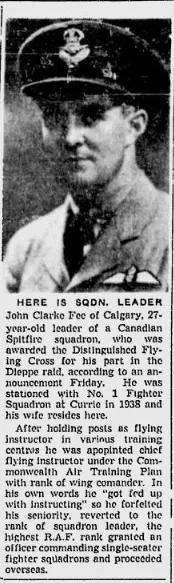
Born Toronto 1915. Home Calgary. Enlisted as P/P/O, 5 July 1937. Trained at Trenton and Camp Borden (wings on 20 May 1938 at Trenton). Promoted to F/O, 5 July 1938. To No.1 (F) Squadron, 22 August 1938. Later to No.115 Detachment. Flight Lieutenant on 15 January 1940, Squadron Leader I March 1941. Initially -overseas with No.41 Squadron (damaged a Bf. 109 near Le Havre on 4 May 1942; damaged an E-Boat and small flak ship, 21 May 1942). Took command of No.412 Squadron, Merston, 29 July 1941 On 19 August he led the squadron on three trips over Dieppe, twice engaging FW.I90s. Became W/C (Flying) of Kenley Wing, 27 November 1942. On 4 December he became detached from squadrons when hood frosted over. He ordered wing to re-assemble over Boulogne after they had been broken up by German fighters. While heading towards Boulogne he saw four FW-190s on tail of a Spitfire, chased them off and claimed one probably destroyed. Led wing on unproductive morning sweep, 17 January 1943. Killed in action 17 January 1943 while leading another sweep; bounced by FW-190s that shot down Fee and his wingman.
412 Falcon Squadron (Promtus Ad Vindictum). W/C. Fee was killed when his Spitfire aircraft BS 135 was shot down in the Bolbec area near Le Havre, France. This was the same action in which F/O(s) M.J. Sunstrom and A.M. Skinner were shot down. Four enemy aircraft were also shot down.
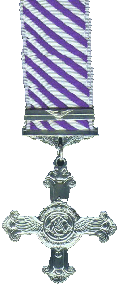
Addendum: - Distinguished Flying Cross - No.412 Squadron - Award effective 24 August 1942 as per London Gazette dated 11 September 1942 and AFRO 1653/42 dated 16 October 1942. The citation reads - "This officer is a fine pilot and skillful leader. By his outstanding ability he has been mainly responsible for the high standard of fighting efficiency of the squadron he commands. He has completed a large number of sorties including some during the combined operations at Dieppe. Squadron Leader Fee has at all times set a most inspiring example."
Addendum: FEE, W/C John Clarke (C773) - Bar to Distinguished Flying Cross - Canadian Fighter Wing - Award effective 25 January 1943 as per London Gazette dated 9 February 1943 and AFRO 373/43 dated 5 March 1943. The citation for his second D.F.C. (Bar) reads - "This officer; both as a squadron commander and a wing leader, has taken part in a large number of operational sorties. He has always shown exceptional enthusiasm to engage the enemy and remarkable coolness when under fire. Wing Commander Fee is a brilliant leader who has set a splendid example of courage and determination." Detail provided by H. Halliday, Orleans, Ontario.
Fee, John Clarke (Wing Commander)
Killed in Action 1943-January-17

Birth Date: 1915-May-23
Born: Toronto Ontario
Parents: Son of Thomas James Fee, and of Margery W. Fee, of St. Williams, Ontario, Canada; husband of Doreen Fee, of Calgary, Alberta, Canada.
Spouse: Husband of Doreen Fee, of Calgary, Alberta, Canada.
Home: St Williams, Ontario
Enlistment:
Enlistment Date: unkown date
Service
RCAF
Unit
412 Sqn- Squadron
Promptus Ad Vindictam Swift to Avenge
Base
Rank
Wing Commander
Position
Pilot
Service Numbers
C/773
 Canadian Virtual War Memorial
 Library and Archives Canada Service Files (may not exist)
Spitfire serial: BS135
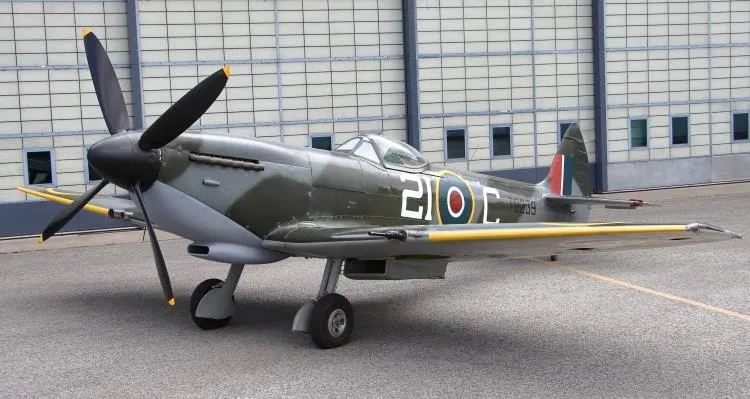
Supermarine Spitfire LF Mk. XVIe, Canadian Warplane Heritage Museum
The Supermarine Spitfire is a British single-seat fighter aircraft that was used by the Royal Air Force and other Allied countries before, during, and after World War II. Many variants of the Spitfire were built, using several wing configurations, and it was produced in greater numbers than any other British aircraft. It was also the only British fighter produced continuously throughout the war. The Spitfire continues to be popular among enthusiasts; around 70 remain airworthy, and many more are static exhibits in aviation museums throughout the world.
The Spitfire was designed as a short-range, high-performance interceptor aircraft by R. J. Mitchell, chief designer at Supermarine Aviation Works, which operated as a subsidiary of Vickers-Armstrong from 1928. Mitchell pushed the Spitfire's distinctive elliptical wing with cutting-edge sunken rivets (designed by Beverley Shenstone) to have the thinnest possible cross-section, helping give the aircraft a higher top speed than several contemporary fighters, including the Hawker Hurricane.
The Spitfire had detachable wing tips which were secured by two mounting points at the end of each main wing assembly. When the Spitfire took on a role as a high-altitude fighter (Marks VI and VII and some early Mk VIIIs), the standard wing tips were replaced by extended, "pointed" tips which increased the wingspan from 36 ft 10 in (11.23 m) to 40 ft 2 in (12.24 m). The other wing-tip variation, used by several Spitfire variants, was the "clipped" wing; the standard wing tips were replaced by wooden fairings which reduced the span by 3 ft 6 in (1.07 m). The wing tips used spruce formers for most of the internal structure with a light alloy skin attached using brass screws.
Due to a shortage of Brownings, which had been selected as the new standard rifle calibre machine gun for the RAF in 1934, early Spitfires were fitted with only four guns, with the other four fitted later. Early tests showed that, while the guns worked perfectly on the ground and at low altitudes, they tended to freeze at high altitude, especially the outer wing guns, because the RAF's Brownings had been modified to fire from an open bolt. While this prevented overheating of the cordite used in British ammunition, it allowed cold air to flow through the barrel unhindered. Supermarine did not fix the problem until October 1938, when they added hot air ducts from the rear of the wing-mounted radiators to the guns, and bulkheads around the gunbays to trap the hot air in the wing. Red fabric patches were doped over the gun ports to protect the guns from cold, dirt, and moisture until they were fired.
The first Rolls-Royce Griffon-engined Mk XII flew in August 1942, and first flew operationally with 41 Squadron in April 1943. This mark could nudge 400 mph (640 km/h) in level flight and climb to an altitude of 33,000 ft (10,000 m) in under nine minutes. As American fighters took over the long-range escorting of USAAF daylight bombing raids, the Griffon-engined Spitfires progressively took up the tactical air superiority role, and played a major role in intercepting V-1 flying bombs, while the Merlin-engined variants (mainly the Mk IX and the Packard-engined Mk XVI) were adapted to the fighter-bomber role. Although the later Griffon-engined marks lost some of the favourable handling characteristics of their Merlin-powered predecessors, they could still outmanoeuvre their main German foes and other, later American and British-designed fighters.Wikipedia
 Wikipedia Supermarine Spitfire
 Harold A Skaarup Web Page
 YouTube How the Spitfire Became an Aviation Masterpiece
 RCAF Supermarine Spitfire Serials - Kestrel Publications
Unit Desciption
412 Sqn Promptus Ad Vindictam ("Falcon")
History of the Squadron during World War II (Aircraft: Spitfire Mks. IIA, VB, IXB, IXE, XVI, XIV)
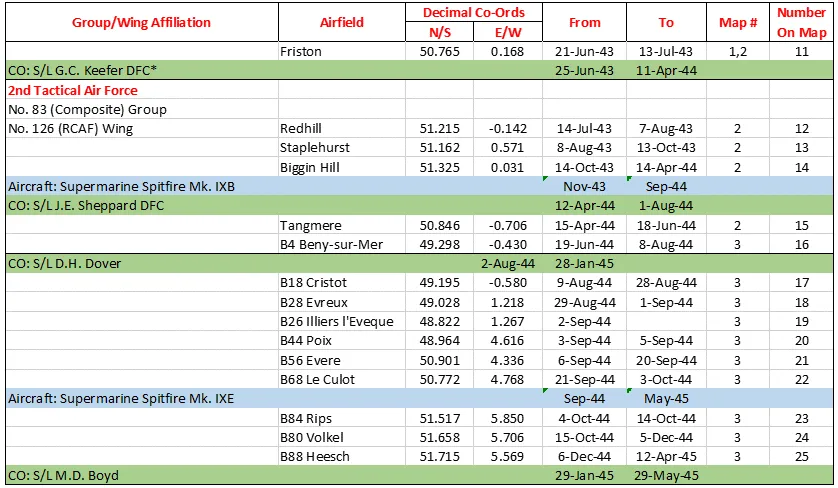
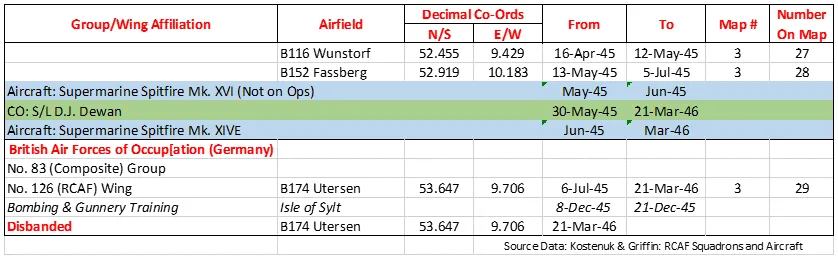
The squadron was the tenth of the RCAF's squadrons to be formed overseas in WWII. It was the seventh fighter squadron to be so formed. It was established at Digby, Lincolnshire, England  on June 30, 1941. John Gillespie Magee, the author of the famous aviation poem “High Flight” was serving with 412 Squadron when he was killed in a mid-air collision in his Spitfire in 1941. The squadron flew Spitfire aircraft in the defence of Great Britain, formed part of the Canadian Kenley Wing within No. 11 Group, Fighter Command. It was re-equipped with the Spitfire lXb in November 1943 and began operating over northern France in preparation for operation Overlord, the D-Day landings. It was during late 1943 that the ace George “Screwball” Beurling scored his last air victory while serving with the squadron. Shortly after D-Day, on June 19, 1944, the squadron moved to France in a fighter and ground support role. It then supported the Allied armies, moving through France, the Belgium, the Netherlands and Germany. It was one of four RCAF day fighter units retained in Germany as part of the British Air Forces of Occupation before being disbanded at Utersen, Germany on March 21, 1946.
In the course of hostilities, the squadron flew 12,761 sorties for the loss of 63 aircraft and 62 pilots, of whom 21 were killed, 14 presumed dead, 11 POW. The squadron claimed 106 enemy aircraft destroyed, 11 probably destroyed and 46 damaged. On the ground, they claimed 282 motor vehicles and 22 locomotives. The squadron had 5 aces (shot down 5 or more enemy aircraft): Flight Lieutenant D.C. Laubman DFC & Bar; Flight Lieutenant W.J. Banks,DFC & Bar; Flying Officer D.R.C. Jamieson DFC & Bar; Flying Officer P.M. Charron; Flight Lieutenant R.I.A. Smith DFC. Overall, the squadron was awarded 7 Bars to DFC, 16 DFCs and 4 MiD. Battle Honours were: Defence of Britain 1941-44, Wikipedia, Kostenuk and Griffin
Maps for Movements of 412 Squadron 1941-46
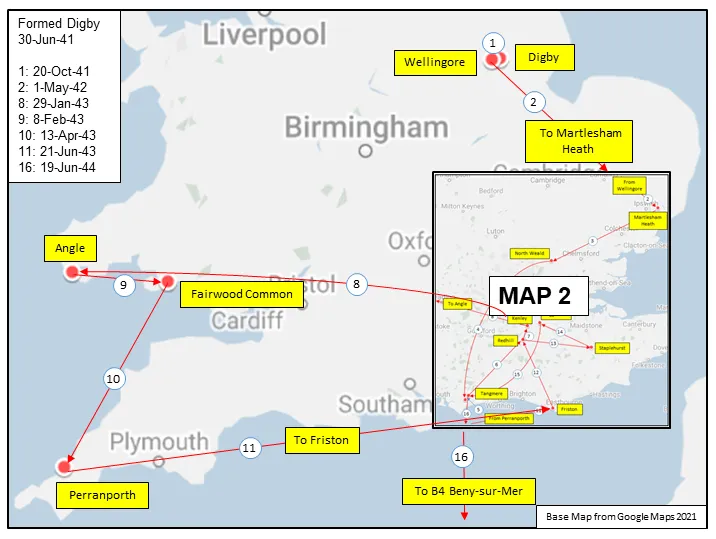
MAP 1: 412 Squadron Movements 1941-44 (right-click on image to display enlarged in new tab)
|
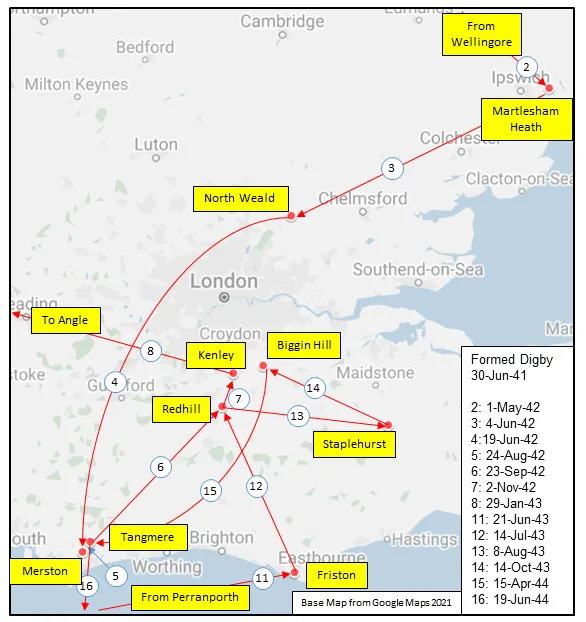
MAP 2: 412 Squadron Movements Detail of Map 1
|
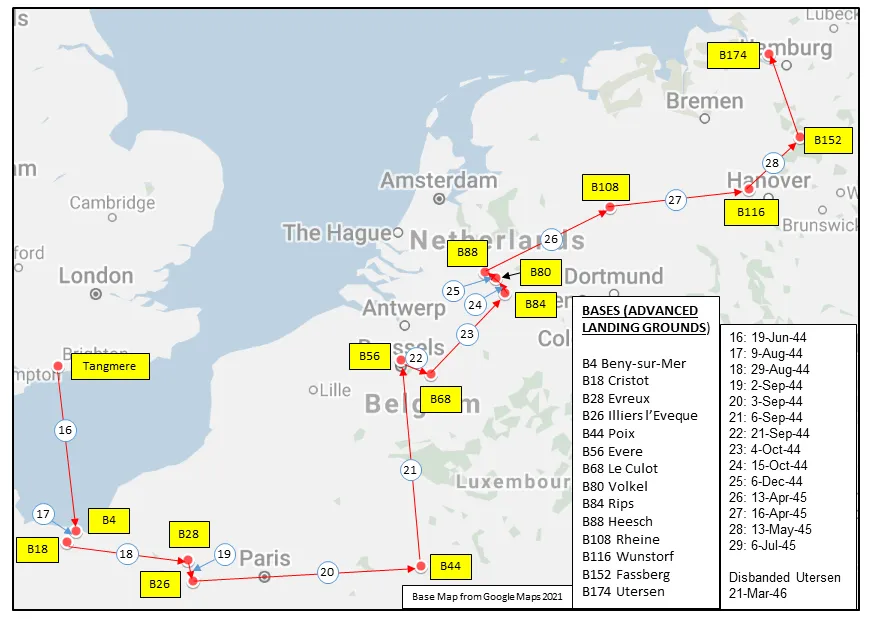
MAP 3: 412 Squadron Movements in Europe 1944-46
|
412 Squadron History Summary 1941-46
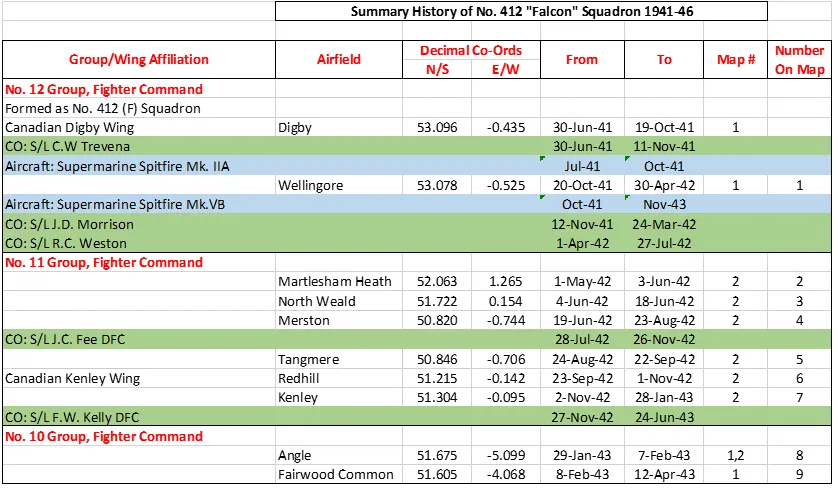
412 Squadron History Summary 1941-46 Page 2
412 Squadron History Summary 1941-46 Page 3
History of the Squadron Post-WWII (Aircraft: CC-117 Falcon, CC-144 Challenger and CC-109 Cosmopolitan)
After the Second World War, Number 12 Communications Flight was reassigned as 412 Squadron on 1 April 1947, and renamed 412 (Composite) Squadron based at Rockcliffe, Ontario . In 1955, the squadron moved to Uplands, Ontario. Upon unification in 1968, 412 Squadron became the VIP squadron for the Canadian Forces based at CFB Uplands -75.676, and flew the CC-117 Falcon, CC-144 Challenger and CC-109 Cosmopolitan. In the late 1970s a sub-unit was established at CFB Lahr in West Germany; this operation closed in 1993. In 1994, CFB Ottawa (Uplands) closed and 412's fleet was moved to a civilian hangar at Ottawa International Airport. All aircraft are maintained by Transport Canada on behalf of the Canadian Forces. Today, the Squadron performs the VIP and general transport duties with the CC-144 Challenger.