Dixon, Michael Ralph (Flight Sergeant)
Killed in Action 1943-April-11
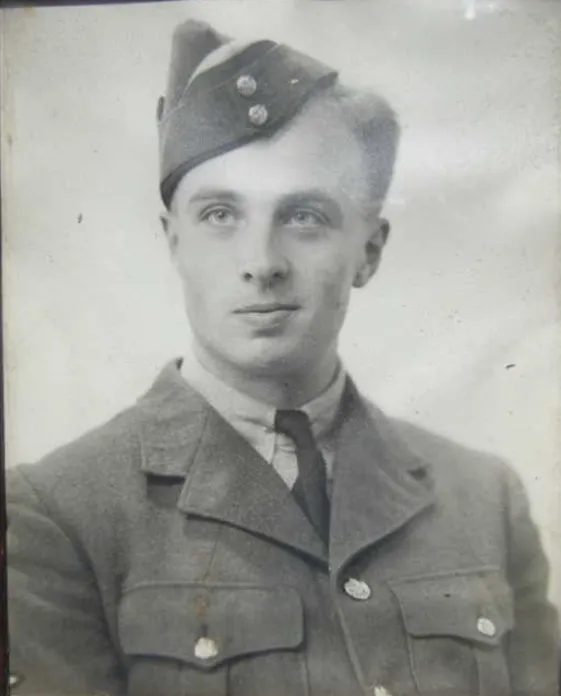

Birth Date: 1917-January-17
Born: Slingsby Yorkshire
Parents: Ralph C & Hilda M Dixon
Spouse:
Home: London, Ontario (parents)
Enlistment:
Enlistment Date: unkown date
Service
RCAF
Unit
166 (B) Sqn- Squadron (RAF)
Tenacity
Base
RAF Kirmington
Rank
Flight Sergeant
Position
Air Gunner
Service Numbers
R/99543
Target
 Frankfurt Germany
Temporary Burial
Darmstadt Forest Cemetery
Remains were later exhumed from this location and reburied
 Canadian Virtual War Memorial
 Commonwealth War Graves Commission
 Finadagrave.com
 Library and Archives Canada Service Files (may not exist)
Mission
Wellington Mk. III X3334
Bombing Frankfurt Germany 1943-April-11 to 1943-April-11
166 (B) Sqn (RAF) RAF Kirmington
On the night of Saturday 10th April 1943 Bomber Command operated a total of 513 sorties: 502 aircraft were assigned to attack Frankfurt, Seven aircraft to lay sea mines off the Frisian Islands and four O.T.U. aircraft from No.92 Group to carry nickel raids. Complete cloud cover obscured the target. The operation was classed as a failure and only a few bombs fell in the S of the River Main. From the night's operations a total of 23 (Identified) aircraft (4.48%) all from the attack on Frankfurt: a total of nine Wellington's six Short Stirling's, five Lancasters and three Halifaxes became non effective and struck off charge. From these aircraft a total of 128 (Identified) airmen became casualties: 102 airmen died, two were injured 14 became Prisoners of War and seven were interned in a neutral country. These 23 aircraft came from six Bomber Group and were serving on 19 Squadrons flying out of 18 airfields; there would be many empty chairs in the various Messes, as the Committee of Adjustment would be emptying the cupboards and lockers sorting out the personal effects and telegrams would soon be dispatched to the next of kin with many family lives being changed forever.
Wellington aircraft X 3334 was shot down in the Darmstadt Forest, Germany. Four RAF crew members were also killed.
Wellington serial: X3334
Source: Harold A Skaarup Web Page
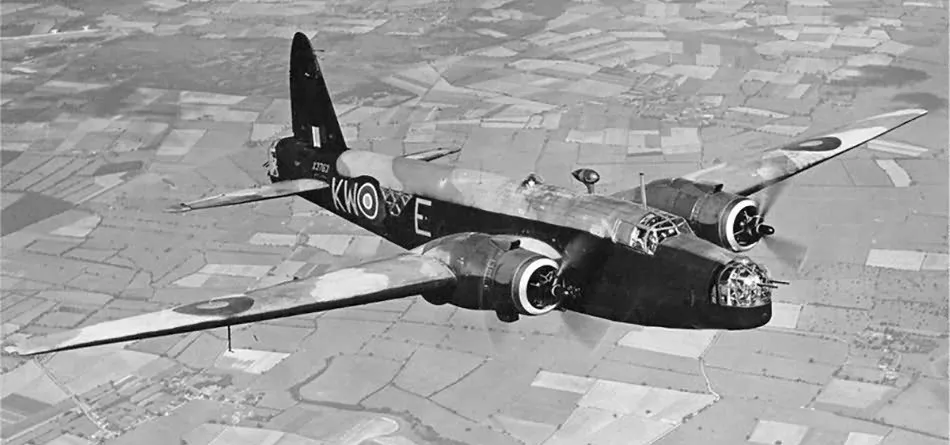
Vickers Wellington B. Mk. III (Serial No. X3763), coded KW-E, No. 425 'Alouette' (B) Squadron, RCAF, late summer of 1942
Vickers Wellington B. Mk. III (Serial No. X3763), coded KW-E, No. 425 'Alouette' (B) Squadron, RCAF, late summer of 1942
The Vickers Wellington was a British twin-engined, long-range medium bomber. It was designed during the mid-1930s at Brooklands in Weybridge, Surrey. Led by Vickers-Armstrongs' chief designer Rex Pierson, a key feature of the aircraft is its geodetic airframe fuselage structure, which was principally designed by Barnes Wallis. Development had been started in response to Air Ministry Specification B.9/32, issued in the middle of 1932, for a bomber for the Royal Air Force. This specification called for a twin-engined day bomber capable of delivering higher performance than any previous design.
The Wellington was used as a night bomber in the early years of the Second World War, performing as one of the principal bombers used by Bomber Command. During 1943, it started to be superseded as a bomber by the larger four-engined "heavies" such as the Avro Lancaster. The Wellington continued to serve throughout the war in other duties, particularly as an anti-submarine aircraft.
It holds the distinction of having been the only British bomber that was produced for the duration of the war, and of having been produced in a greater quantity than any other British-built bomber. The Wellington remained as first-line equipment when the war ended, although it had been increasingly relegated to secondary roles. The Wellington was one of two bombers named after Arthur Wellesley, 1st Duke of Wellington, the other being the Vickers Wellesley.
In August 1936, an initial order for 180 Wellington Mk I aircraft, powered by a pair of 1,050 hp (780 kW) Bristol Pegasus radial engines, was received by Vickers; it had been placed so rapidly that the order occurred prior to the first meeting intended to decide the details of the production aircraft. In October 1937, another order for a further 100 Wellington Mk Is, produced by the Gloster Aircraft Company, was issued; it was followed by an order for 100 Wellington Mk II aircraft with Rolls-Royce Merlin X V12 engines. Yet another order was placed for 64 Wellingtons produced by Armstrong Whitworth Aircraft. With this flurry of order and production having been assured by the end of 1937, Vickers set about simplifying the manufacturing process of the aircraft and announced a target of building one Wellington per day.
A total of 180 Wellington Mk I aircraft were built; 150 for the RAF and 30 for the Royal New Zealand Air Force (RNZAF) (which were transferred to the RAF on the outbreak of war and used by 75 Squadron). In October 1938, the Mk I entered service with 9 Squadron. The Wellington was initially outnumbered by the Handley Page Hampden (also ordered by the Ministry to B.9/32) and the Armstrong Whitworth Whitley (to B.34/3 for a 'night' bomber) but outlasted both rival aircraft in service. The Wellington went on to be built in 16 separate variants, in addition to two training conversions after the war. The number of Wellingtons built totalled 11,462 of all versions, a greater quantity produced than any other British bomber. On 13 October 1945, the last Wellington to be produced rolled out. Wikipedia
 Wikipedia Vickers Wellington
 RCAF - Vickers Wellington
 YouTube Vickers Wellington documentary
Unit Desciption
166 (B) Sqn Tenacity (Huddersfield's Own)
No 166 Squadron RAF was originally formed at Bircham Newton, Norfolk on June 13, 1918, designed as a heavy bomber unit, to fly the Handley Page V/1500 aircraft. The squadron was never fully mobilized because the Armistice intervened. The squadron was re-formed in November 1936 as a heavy bomber unit, flying Handley Page Heyfords, later equipping with Armstrong Whitworth Whitleys. It was based at Boscombe Down, Wiltshire from November 1936 to January 1937, when it moved to Leconfield, Yorkshire. The squadron became part of an air observer's school on June 7, 1938, and then became a 1 Group pool squadron in May 1939. From September 1939 it was based at Abingdon, Berkshire until April 1940. In that month the squadron merged with no. 97 Squadron to form No. 10 OTU.
In January 1943 the squadron was re-formed at Kirmington, Yorkshire (53.578,-0.344, now Humberside Airport), from flights of Nos. 150 and 170 squadrons, when parts of these squadrons were posted to the Middle East. It was again bomber squadron, flying Vickers Wellingtons in No. 1 Group of Bomber Command. It remained at Kirmington until the end of WWII, later re-equipping with Avro Lancasters. In the period 27/28 January 1943 and 25 April 1945, it dropped 27,287 tons of bombs and laid 333 tons of mines. The squadron won "at least" 2 DSOs, 2 CGMs, 117 DFCs and 108 DFMs in the course of WWII. The squadron was disbanded on November 18, 1945.
Wellington X3334 Mk. III - Bombing Frankfurt Germany - 1943-04-11 to 1943-04-11
Squadron: 166 (B) Sqn (RAF)
Start Date: 1943-04-11
Completion Date: 1943-04-11
Mission: Bombing
Operation: unspecified
Target City: Frankfurt Germany
Target Specific:
Base: RAF Kirmington
Take Off Time: 23.12
Squadron Code: AS W
Radio Code:
Return Base:
Return Time:
Crash City:
Crash Specifics:
Crash Latitude: 0.00000000
Crash Longitude: 0.00000000
Crash Reason:
Flak Battery:
Enemy Claim:
War Diary Unavailable
6 Group Unavailable
On the night of Saturday 10th April 1943 Bomber Command operated a total of 513 sorties: 502 aircraft were assigned to attack Frankfurt, Seven aircraft to lay sea mines off the Frisian Islands and four O.T.U. aircraft from No.92 Group to carry nickel raids. Complete cloud cover obscured the target. The operation was classed as a failure and only a few bombs fell in the S of the River Main. From the night's operations a total of 23 (Identified) aircraft (4.48%) all from the attack on Frankfurt: a total of nine Wellington's six Short Stirling's, five Lancasters and three Halifaxes became non effective and struck off charge. From these aircraft a total of 128 (Identified) airmen became casualties: 102 airmen died, two were injured 14 became Prisoners of War and seven were interned in a neutral country. These 23 aircraft came from six Bomber Group and were serving on 19 Squadrons flying out of 18 airfields; there would be many empty chairs in the various Messes, as the Committee of Adjustment would be emptying the cupboards and lockers sorting out the personal effects and telegrams would soon be dispatched to the next of kin with many family lives being changed forever.
Wellington aircraft X 3334 was shot down in the Darmstadt Forest, Germany. Four RAF crew members were also killed.
