 St Thomas, Ontario (parents)
3 Elementary Flying Training School, London, Ontario. Fleet Finch aircraft 4434 was engaged in flying sequences 1, 1A, 2, 3, and 4 when it hit the ground at a high speed four miles south of London. Sergeant D.A. Campbell was also killed.
Disbrowe, Walter Edward Cromwell 'Martin' (Leading Aircraftman)
Killed in Flying Accident 1941-October-30


Birth Date: 1921
Born:
Parents: George E Disbrowe & Edith P Disbrowe
Spouse:
Home: St Thomas, Ontario (parents)
Enlistment:
Enlistment Date: unkown date
Service
RCAF
Unit
3 EFTS- Elementary Flying Training School
Base
RCAF Stn. London, Ontario
Rank
Leading Aircraftman
Position
Pilot trainee
Service Numbers
R/116603
 Canadian Virtual War Memorial
 Commonwealth War Graves Commission
 Library and Archives Canada Service Files (may not exist)
Finch serial: 4434

Fleet Finch Mk. II
Canadian Warplane Heritage Museum
The Fleet Finch was the final version of a whole family of light biplane trainers, designed by Consolidated Aircraft of Buffalo, NY and intended for civilian use. Few of these aircraft were marketed under the Consolidated name, as most were sold through Fleet Aircraft Canada, under a range of model numbers. Only the RCAF gave any of these models names, calling the Model 7 the Fawn and the Model 16 the Finch. These aircraft were built from 1930 to 1941, all at Fort Erie, Ontario.
The Finch was developed to meet an RCAF requirement for a fully aerobatic, primary trainer. The RCAF ordered the first batch of aircraft in July 1939 and powered by a Kinner R5-2, 160 hp engine, they were designated the Fleet Finch Mk. I. Most of these aircraft were delivered to the RCAF Central Flying School at Trenton, Ontario by early 1940.
The RCAF placed a further order for primary trainers with Fleet in January 1940. The Fleet Finch Mk. II, powered by a Kinner B-5R, 130 hp engine, first flew from Fort Erie in March 1940. During the following year, over 400 Fleet Finch Mk. IIs were delivered to BCATP Elementary Flying Schools right across Canada.
The Fleet Finch was well liked by the RCAF as it was a rugged aircraft, was relatively easy to fly and withstood the abuse of novice pilots. Some Fleet Finches remained in service with the RCAF until 1947, but most were retired by October 1944. Their role as a primary trainer was taken over by Fairchild PT-26 Cornell. Canadian Warplane Heritage Museum
 Harold Skaarup Web Page
 Fleet Finch
Finch Finch II 4434
To No. 1 Training Command on 23 June 1940, for use by No. 3 Elementary Flying Training School at London, Ontario. Category C damage at 17:00 on 5 February 1941, at Galt, Ontario. Category C damage at 12:10 on 2 October 1941, at London aerodrome. Category A damage at 09:10 on 30 October 1941, 4 miles south of London. Aircraft struck ground at high speed and "nosed in". Instructor T/Sgt. D. Campbell seriously injured, student Leading Aircraftman M. Disbrowe killed.1940-05-06 Taken on Strength No. 12 Technical Detachment 2019-08-20
1941-October-02 Accident: 3 Elementary Flying Training School Loc: London City Airport Names: Mcguire
1941-October-20 Accident: 3 Elementary Flying Training School Loc: London Names: Campbell | Disbrowe
1942-01-29 Struck off Strength Struck off, reduced to spares and produce by No. 6 Repair Depot 2019-08-20
Unit Desciption
3 EFTS (3 Elementary Flying Training School)
An Elementary Flying Training School (EFTS) gave a trainee 50 hours of basic flying instruction on a simple trainer like the De Havilland Tiger Moth, Fleet Finch, or Fairchild Cornell over 8 weeks.Elementary schools were operated by civilian flying clubs under contract to the RCAF and most of the instructors were civilians. For example, No. 12 EFTS Goderich was run by the Kitchener-Waterloo Flying Club and the County of Huron Flying Club.The next step for a pilot was the Service Flying Training School.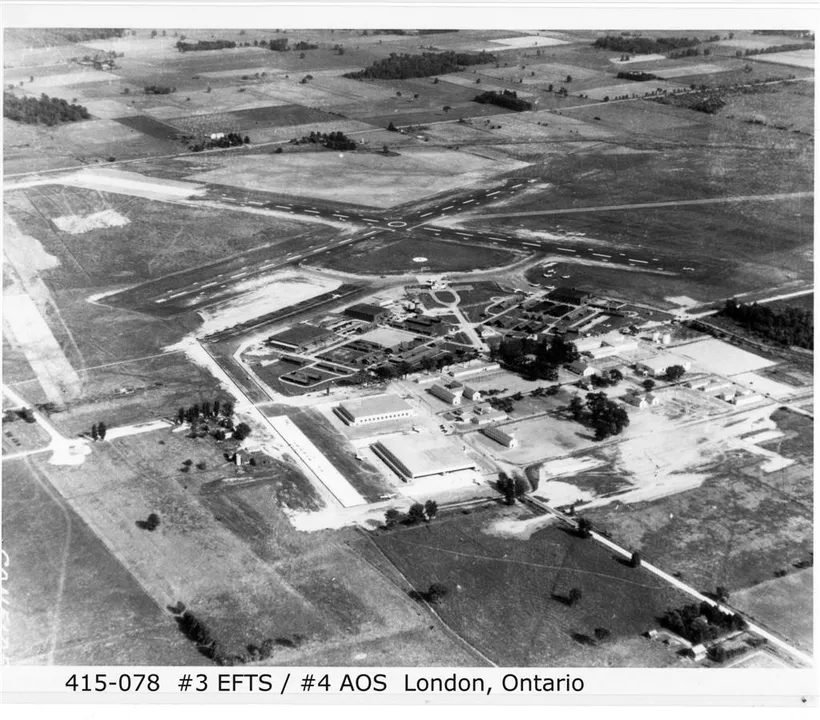
NO3 EFTS London 1942
The School was established at London, Ontario. The former school is now the London, Ontario International Airport.
More information on the RCAF Station at London can be found at Project 44 BCATP RCAF.Info - RCAF Station London ON