 Toronto, Ontario
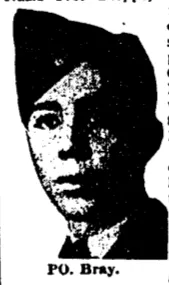
1435 Squadron (Vincere Est Vivere) RAF Luqa, Malta. Pilot Officer GP Bray (RCAF) was killed when his Spitfire Vc aircraft AR 560 was shot down by flak two miles north-east of the aerodrome at Corniso, Sicily.
Bray, Gordon Page (Pilot Officer)
Killed in Action 1943-June-29

Birth Date: 1922-November-18
Born: Toronto, Ontario
Parents: Son of William Ballentyne Bray and Mildred Irene Bray, of Toronto, Ontario.
Spouse:
Home: Toronto, Ontario
Enlistment: Toronto, Ontario
Enlistment Date: 1941-February-10
Service
RCAF
Unit
1435 (FB) Sqn- Squadron (RAF)
Defend the Right
Base
RAF Luqa, Malta
Rank
Pilot Officer
Position
Pilot
Service Numbers
J/17673
Prev: R/168889
 Canadian Virtual War Memorial
 Library and Archives Canada Service Files (may not exist)
Spitfire serial: AR560
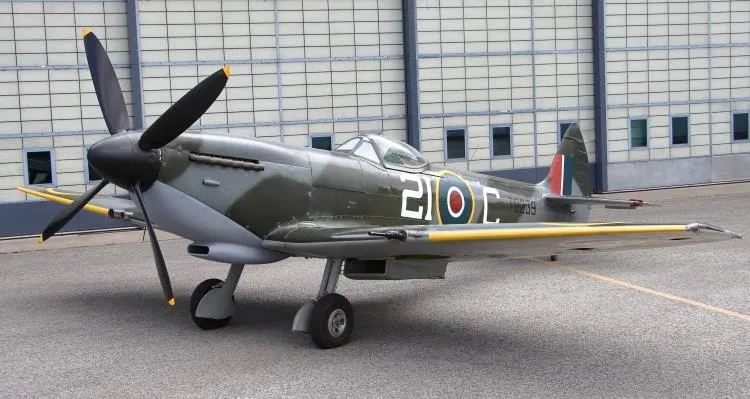
Supermarine Spitfire LF Mk. XVIe, Canadian Warplane Heritage Museum
The Supermarine Spitfire is a British single-seat fighter aircraft that was used by the Royal Air Force and other Allied countries before, during, and after World War II. Many variants of the Spitfire were built, using several wing configurations, and it was produced in greater numbers than any other British aircraft. It was also the only British fighter produced continuously throughout the war. The Spitfire continues to be popular among enthusiasts; around 70 remain airworthy, and many more are static exhibits in aviation museums throughout the world.
The Spitfire was designed as a short-range, high-performance interceptor aircraft by R. J. Mitchell, chief designer at Supermarine Aviation Works, which operated as a subsidiary of Vickers-Armstrong from 1928. Mitchell pushed the Spitfire's distinctive elliptical wing with cutting-edge sunken rivets (designed by Beverley Shenstone) to have the thinnest possible cross-section, helping give the aircraft a higher top speed than several contemporary fighters, including the Hawker Hurricane.
The Spitfire had detachable wing tips which were secured by two mounting points at the end of each main wing assembly. When the Spitfire took on a role as a high-altitude fighter (Marks VI and VII and some early Mk VIIIs), the standard wing tips were replaced by extended, "pointed" tips which increased the wingspan from 36 ft 10 in (11.23 m) to 40 ft 2 in (12.24 m). The other wing-tip variation, used by several Spitfire variants, was the "clipped" wing; the standard wing tips were replaced by wooden fairings which reduced the span by 3 ft 6 in (1.07 m). The wing tips used spruce formers for most of the internal structure with a light alloy skin attached using brass screws.
Due to a shortage of Brownings, which had been selected as the new standard rifle calibre machine gun for the RAF in 1934, early Spitfires were fitted with only four guns, with the other four fitted later. Early tests showed that, while the guns worked perfectly on the ground and at low altitudes, they tended to freeze at high altitude, especially the outer wing guns, because the RAF's Brownings had been modified to fire from an open bolt. While this prevented overheating of the cordite used in British ammunition, it allowed cold air to flow through the barrel unhindered. Supermarine did not fix the problem until October 1938, when they added hot air ducts from the rear of the wing-mounted radiators to the guns, and bulkheads around the gunbays to trap the hot air in the wing. Red fabric patches were doped over the gun ports to protect the guns from cold, dirt, and moisture until they were fired.
The first Rolls-Royce Griffon-engined Mk XII flew in August 1942, and first flew operationally with 41 Squadron in April 1943. This mark could nudge 400 mph (640 km/h) in level flight and climb to an altitude of 33,000 ft (10,000 m) in under nine minutes. As American fighters took over the long-range escorting of USAAF daylight bombing raids, the Griffon-engined Spitfires progressively took up the tactical air superiority role, and played a major role in intercepting V-1 flying bombs, while the Merlin-engined variants (mainly the Mk IX and the Packard-engined Mk XVI) were adapted to the fighter-bomber role. Although the later Griffon-engined marks lost some of the favourable handling characteristics of their Merlin-powered predecessors, they could still outmanoeuvre their main German foes and other, later American and British-designed fighters.Wikipedia
 Wikipedia Supermarine Spitfire
 Harold A Skaarup Web Page
 YouTube How the Spitfire Became an Aviation Masterpiece
 RCAF Supermarine Spitfire Serials - Kestrel Publications
Unit Desciption
1435 (FB) Sqn Defend the Right (Malta)
No.1435 Squadron was formed as a defensive fighter squadron on Malta, before becoming a fighter-bomber squadron operating over Italy and the Balkans.
The squadron's unusual designation was originally an unofficial one. A night fighter flight had been operating on Malta as No.1435 Flight. Soon after this was disbanded a new day fighter Spitfire flight began operations (23 July 1942), using pilots and aircraft from No.603 Squadron. The flight soon expanded to squadron size, and was unofficially given the title No.1435 Squadron. Rather unusually this unofficial designation was later approved by the Air Ministry and was used for the rest of the squadron's existence.
During 1942 the squadron served as a defensive fighter squadron helping protect Malta. During this period the squadron was helped by parties from the army, including the 2nd Bn Royal Irish Fusiliers until 3 December 1942 and the 4th Bn the Buffs after that date.
In January 1943 it became a fighter-bomber squadron, and went onto the offensive, flying sweeps across Sicily.
In October 1943 the squadron moved to the mainland of Italy and joined the Balkan Air Force. The squadron was based in southern Italy and helped provide local air defence as well as flying ground attack missions in Albania and Yugoslavia, supporting local partisans. In September 1944 a detachment even moved onto the island of Vis in the Adriatic, remaining there until April 1945.
In February 1945 the main part of the squadron moved north to Falconara to remain within range of the front line in Italy, and from then until late April took part in the final battles of the Italian campaign. It was withdrawn in April 1945 and disbanded on 9 May 1945.
Aircraft
- August 1942-November 1943: Supermarine Spitfire VB and VC
- March 1943-April 1945: Supermarine Spitfire IX
- May-September 1944: Supermarine Spitfire VB
Location
- August 1942-October 1943: Luqa
- October-November 1943: Grottaglie
- November 1943-May 1944: Brindisi
- May-June 1944: Grottaglie
- June-July 1944: Brindisi
- July 1944-February 1945: Grottaglie
- February-April 1945: Falconara
- April-May 1945: Gragnano
Squadron Codes: V