Footprints on the Sands of Time, RAF Bomber Command Prisoners of War in Germany 1939-45 by Oliver Clutton-Brock page 365
Moore, Theodore Bruce (Flight Lieutenant)
Prisoner of War 1943-June-12


Birth Date: unkown date
Born:
Parents:
Spouse:
Home: Flin Flon, Manitoba
Enlistment:
Enlistment Date: unkown date
Service
RCAF
Unit
408 (B) Sqn- Squadron
For Freedom
Base
Leeming
Rank
Flight Lieutenant
Position
Navigator
Service Numbers
J/11804
PoW: 1504
Crew or Other Personnel
Halifax JB972

Mission
Halifax B/GR.Mk.II JB972
Bombing Dusseldorf Germany 1943-June-11 to 1943-June-12
408 (B) Sqn (RCAF) RAF Leeming
408 Goose Squadron (For Freedom) RAF Leeming. Halifax II aircraft JB 972 EQ-Q was shot down by night fighter pilot Major Werner Streib of the Stab I/NJG 1, flying He 219 V9 G9+FB from Venlo airfield, Netherlands during operations against targets in Dusseldorf, Germany, but this loss was also claimed by heavy Flak units. The Halifax exploded and crashed in the target area southwest of Rheinberg, Nordrhein-Westfalen, Germany
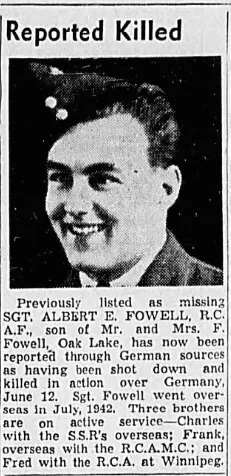
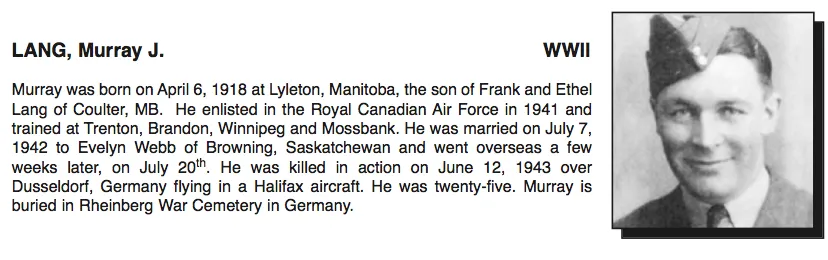
Pilot Officer AG Grant (RCAF), Warrant Officer Class 2 AE Fowell (RCAF) and FS JM Lang (RCAF) were all killed in action
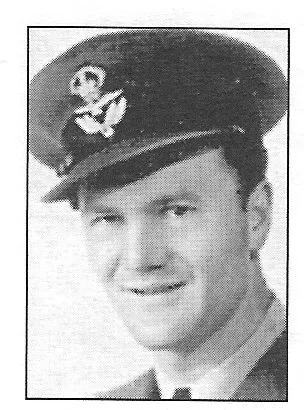
Pilot Officer RE Carter (RCAF), Flight Lieutenant TB Moore (RCAF), Sergeant MR Laloge (RCAF) and Sergeant KR Stentiford (RAFVR) survived were taken as Prisoners of War
Flight Lieutenant Bruce Moore was the navigator during the operation and later a resident of Flin Flon, Manitoba provided the following information, "We were hit by flak and the bomb aimer jettisoned the bombs, we were hit again and the Halifax blew up almost immediately. When I came to, the ground was getting very close so I pulled the ripcord. I landed OK, but was taken Prisoner of War. The next day I had to help bury my three Manitoba friends and was then taken to POW camp Stalag Luft IV where I helped in the Great Escape, Sergeant Laloge also survived the war
Footprints on the Sands of Time, RAF Bomber Command Prisoners of War in Germany 1939-45 by Oliver Clutton-Brock page 262,339,365,410 Daily Operations 6 Bomber Group RAF Bomber Command
Halifax II JB972 [Royal Air Force Serial and Image Database]...
Unit Desciption
408 (B) Sqn For Freedom ("Goose")
History of the Squadron during World War II (Aircraft: Hampden I, Halifax II & V, Lancaster II, Halifax III & VII, Lancaster X)
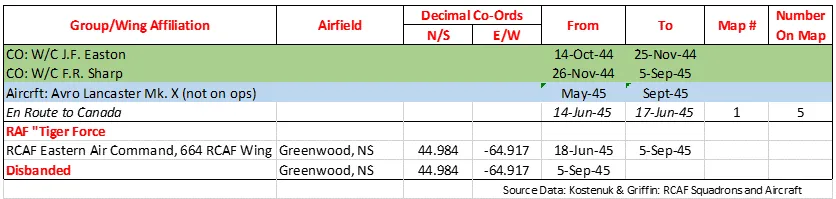
The squadron was the second Canadian bomber squadron to be formed in WWII. It was formed at Lindholme, Yorkshire, UK  in June of 1941 as part of Bomber Command No 5 Group, flying Handley Page Hampden Mk I bombers from Syerston, Nottinghamshire, Balderton, Newark and North Luffenham, Rutland. Its squadron code letters were EQ. In September 1942 the squadron was moved to No 4 Group, re-equipping with Halifax Mk II aircraft and flying from Leeming, Yorkshire. On January 1, 1943, by this time equipped with Lancaster Mk II bombers, the squadron joined No. 6 Group (RCAF) and flew from Linton-on-Ouse, Yorkshire from August 27 1943 to the end of WWII. In September 1944 it converted to Halifax Mk III and VII aircraft and flew these for the remainder of hostilities. It was slated to be part of the "Tiger Force" to attack Japan and had re-equipped with Lancaster Mk X aircraft, but the Japanese surrender ended all plans for the Tiger Force and the squadron was disbanded in September 1945 at Greenwood, Nova Scotia .
Altogether, the squadron logged 4610 operational sorties with 25,500 operational hours, in the course of which 11,430 tons of bombs were dropped. 146 aircraft were lost in the course of these operations. Awards included 161 DFC's and 6 bars to DFC, 32 DFM's, 1 MBE and 10 MiD's. Battle Honours were: English Channel and North Sea 1941-43, Baltic 1941-43, Fortress Europe 1941-44, France and Germany 1944-45, Biscay Ports 1941-44, Ruhr 1941-45, Berlin 1943-44, German Ports 1941-45, Normandy 1944, Rhine, Biscay 1942-43. Wikipedia, Moyes, Kostenuk and Griffin
Squadron History (Bomber Command Museum PDF)
Maps for Movements of 408 Squadron 1941-45
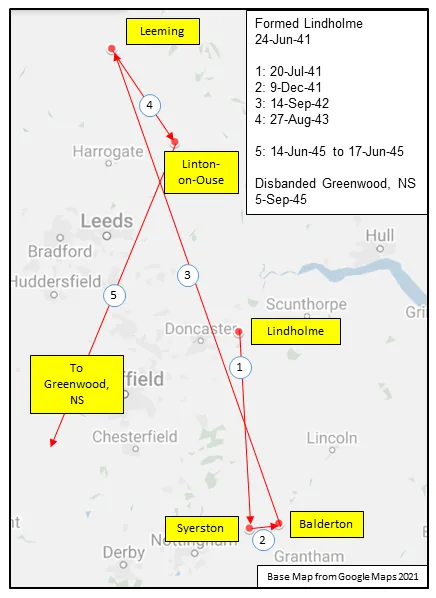
MAP 1: 408 Squadron Movements 1941-45 (right-click on image to display enlarged in new tab)
|
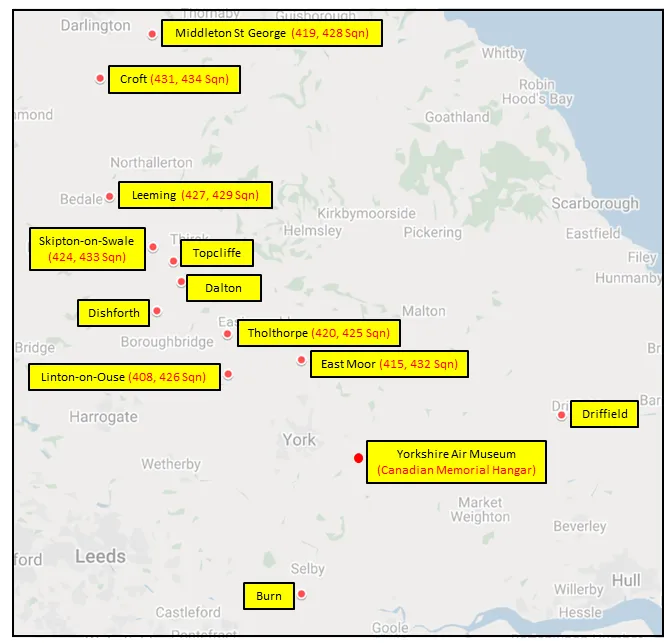
MAP 2: 6 Group Bomber Bases in Durham and Yorkshire 1943-45
|
408 Squadron History Summary
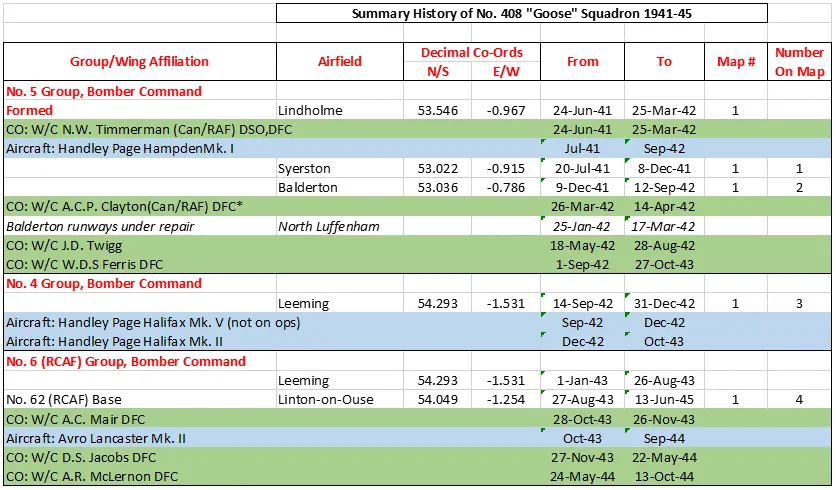
408 Squadron History Summary Page 2
History of the Squadron Post-WWII (Aircraft: Lancaster X, Canso A, Norseman VI, Otter, Dakota III & IV, Boxcar, Silver Star, Hercules, Griffon, Chinook)
On 10 January 1949, the squadron was reformed as 408 (Photographic) Squadron at RCAF Station Rockcliffe, Ontario . Equipped with eight Lancaster Mark X photographic aircraft equipped with SHORAN, a short-range navigational device. It was tasked with the mapping of Canada, specifically the far North. It also flew Canso, Norseman, Otter and Dakota aircraft on this mission, for photography and to maintain the SHORAN stations. Once the task was complete, the squadron was re-designated 408 (Reconnaissance) Squadron and flew Lancasters on Arctic surveillance patrols. In 1964, equipped with the Fairchild C-119G Flying Boxcar, it was again re-designated 408 (Transport Support and Aerial Reconnaissance) Squadron and moved to Rivers, Manitoba. In 1964, the squadron formed a flight of Canadair CT-133 Silver Star aircraft. In 1965, the Boxcars were replaced by CC-130 Hercules aircraft.
On January 1, 1971, 408 Squadron was once again re-activated at Namao in Edmonton, Alberta , as a tactical helicopter squadron (THS) and equipped with CH-135 Twin Huey and CH-136 Kiowa helicopters. Its primary tasking is to provide tactical aviation to the army. The mission includes air mobile assault, air ambulance, air observation, reconnaissance insertions, troop movement, airborne command and control platform and dropping paratroopers. In September 1996, the squadron was re-equipped with CH-146 Griffon helicopters. Personnel from 408 Squadron deployed to Afghanistan nearly continually from 2006 until 2011. Initially forming a Tactical Unmanned Aerial Vehicle (TUAV) detachment using the CU-161 Sperwer. From 2008, 408 members were deployed to Kandahar airfield operating the CH-146 Griffon and CH-147D helicopters as part of the Joint Task Force Afghanistan Air Wing. The primary role of the JTF-A Air Wing was to provide transportation, reconnaissance, armed escort, and fire support to the International Security Assistance Force (ISAF). In July of 2018, 408 THS deployed to Mali as part of Task Force Mali on Operation Presence. In Mali, 408 THS operated the CH-146 Griffon in the armed escort role, providing support to MEDEVAC and utility missions. 408 THS completed its tour in Mali in January of 2019, having participated in 7 medical evacuation missions. It is now co-located with 1 Canadian Mechanized Brigade Group at the 3rd Canadian Division Support Base, Edmonton, Alberta.
link,general,https://www.forfreedom.ca,408 “Goose†Squadron Association
Halifax JB972 B/GR.Mk.II - Bombing Dusseldorf Germany - 1943-06-11 to 1943-06-12
Squadron: 408 (B) Sqn (RCAF)
Start Date: 1943-06-11
Completion Date: 1943-06-12
Mission: Bombing
Operation: unspecified
Target City: Dusseldorf Germany
Target Specific:
Base: RAF Leeming
Take Off Time: 22:51
Squadron Code: EQ-Q
Radio Code:
Return Base:
Return Time:
Crash City: Germany
Crash Specifics: southwest of Rheinberg, Nordrhein-Westfalen
Crash Latitude: 0.00000000
Crash Longitude: 0.00000000
Crash Reason:
Flak Battery: unspecified
Enemy Claim: Major Werner Streib of the Stab I/NJG 1
War Diary Unavailable
6 Bomber Group June 11/12, 1943
51 Halifaxes from 408, 419, and 427 Squadrons were joined by 63 Wellingtons from 426, 428, 429, 431, and 432 Squadrons on an attack at Dusseldorf. The crews were over the target at between 12,000 and 15,000 feet, releasing 145,000 lbs of high explosives and 275,000 lbs of incendiaries. According to reports, severe damage was caused to this target. Richard Koval (6bombergroup.ca)
408 Goose Squadron (For Freedom) RAF Leeming. Halifax II aircraft JB 972 EQ-Q was shot down by night fighter pilot Major Werner Streib of the Stab I/NJG 1, flying He 219 V9 G9+FB from Venlo airfield, Netherlands during operations against targets in Dusseldorf, Germany, but this loss was also claimed by heavy Flak units. The Halifax exploded and crashed in the target area southwest of Rheinberg, Nordrhein-Westfalen, Germany
Pilot Officer AG Grant (RCAF), Warrant Officer Class 2 AE Fowell (RCAF) and FS JM Lang (RCAF) were all killed in action
Pilot Officer RE Carter (RCAF), Flight Lieutenant TB Moore (RCAF), Sergeant MR Laloge (RCAF) and Sergeant KR Stentiford (RAFVR) survived were taken as Prisoners of War
Flight Lieutenant Bruce Moore was the navigator during the operation and later a resident of Flin Flon, Manitoba provided the following information, "We were hit by flak and the bomb aimer jettisoned the bombs, we were hit again and the Halifax blew up almost immediately. When I came to, the ground was getting very close so I pulled the ripcord. I landed OK, but was taken Prisoner of War. The next day I had to help bury my three Manitoba friends and was then taken to POW camp Stalag Luft IV where I helped in the Great Escape, Sergeant Laloge also survived the war
Footprints on the Sands of Time, RAF Bomber Command Prisoners of War in Germany 1939-45 by Oliver Clutton-Brock page 262,339,365,410 Daily Operations 6 Bomber Group RAF Bomber Command
Halifax II JB972 [Royal Air Force Serial and Image Database]...