Casey, Brian Anthony (Flight Lieutenant)
Killed in Action 1943-May-05
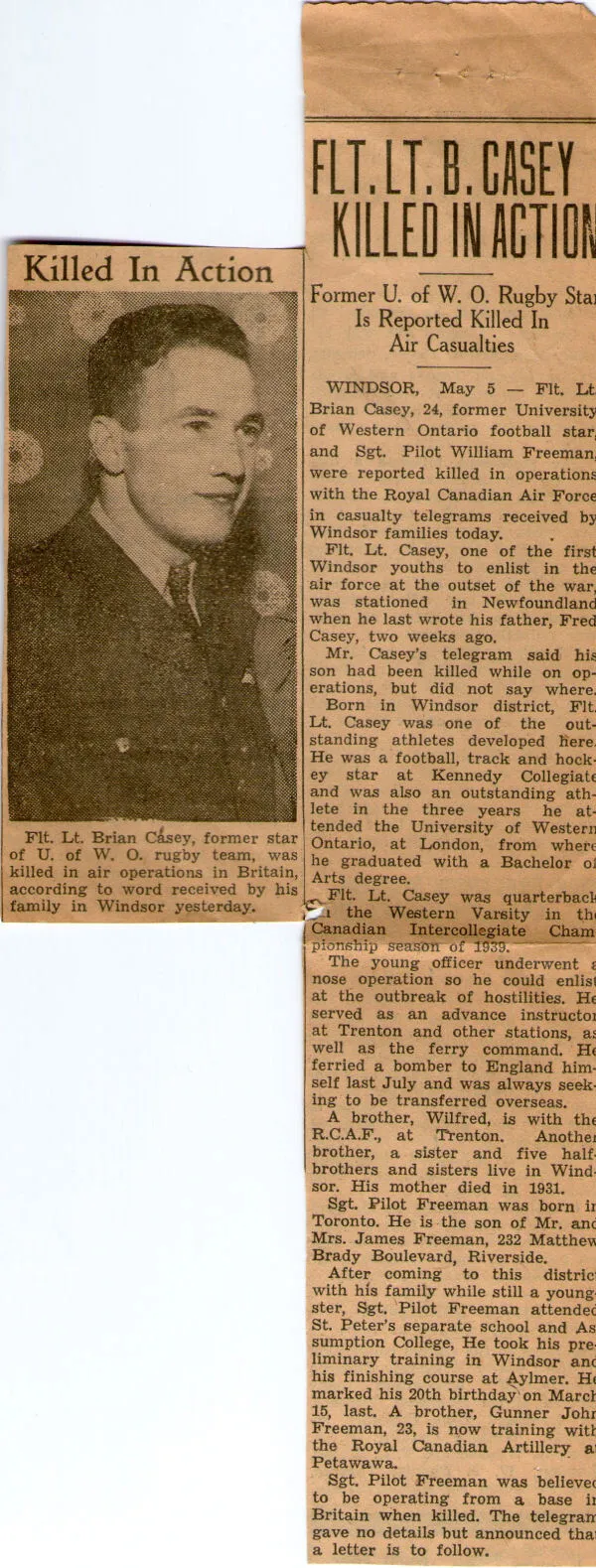

Birth Date: 1917-September-12
Born: Sandwich West, Windsor, Essex County, Ontario, Canada
Parents: Son of Fred Charles Casey & Ivy (nee Hobbs) Casey
Spouse:
Home: Sandwich West, Ontario
Enlistment:
Enlistment Date: 1939

Service
RCAF
Unit
5 (BR) Sqn- Squadron (RAF)
Frangas Non Flectas Thou mayest break but shall not bend me
Base
RCAF Station Gander, Newfoundland
Rank
Flight Lieutenant
Position
Pilot
Service Numbers
C/1061
 Sandwich West, Ontario
 Canadian Virtual War Memorial
 Commonwealth War Graves Commission
 Finadagrave.com
 Library and Archives Canada Service Files (may not exist)
Crew or Other Personnel
Canso 9807

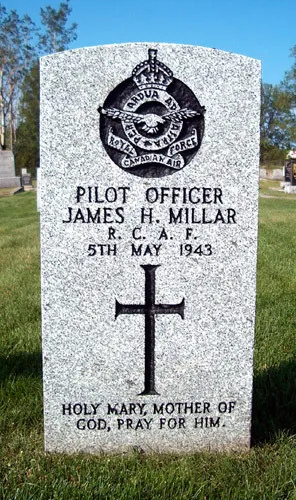
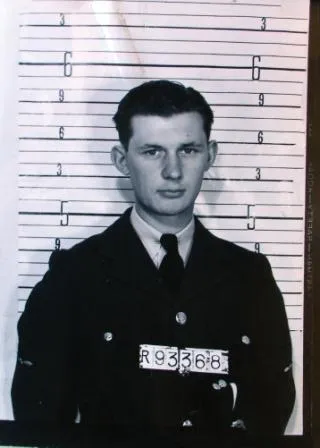
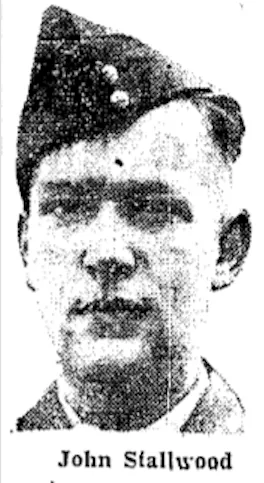
Accident Card - Consolidated Canso A serial:9807
This accident involved 1 aircraft on 1943-May-05. Cnso A s/n 9807.
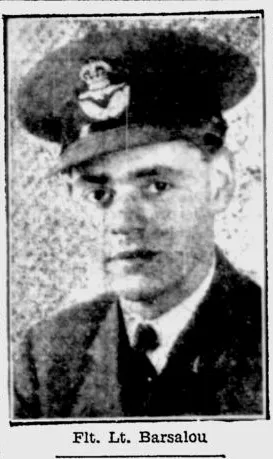
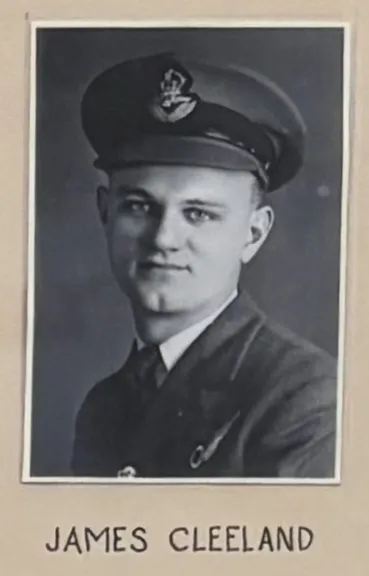
This accident involved 7 people. Cleeland JR, Millar JH, Casey BA, Barsalou JP, Morrice AF, Stallwood JB, Dube UEA
This accident had 6 fatalities. Pilot Officer James Herbert Millar RCAF Killed in Action service no:J/20859 Canso 9807, Warrant Officer 1 Alexander Frederick Morrice RCAF Killed in Action service no:R/93368 Canso 9807, Flight Lieutenant Jean Paul Barsalou RCAF Killed in Action service no:C/1237 Canso 9807, Flying Officer James Rayson Wallace Cleeland RCAF Killed in Action service no:J/11797 Canso 9807, Sergeant John Benjamin Stallwood RCAF Killed in Action service no:R/122657 Canso 9807, Flight Lieutenant Brian Anthony Casey RCAF Killed in Action service no:C/1061 Canso 9807
Mission
Canso A 9807
Reconnaissance 1943-May-05 to 1943-May-05
5 (BR) Sqn (RCAF) RCAF Station Gander, Newfoundland
5 (BR) Squadron, RCAF Station Gander, Newfoundland. Canso A 9807 F was outward-bound on an anti-submarine patrol when it crashed into bush immediately after take-off from Gander Newfoundland. The aircraft was completely demolished by the crash and the subsequent explosion of fuel and depth charges, killing six of the seven aircrew aboard
Flight Lieutenant Brian Anthony Casey MiD (RCAF), Flight Lieutenant Jean Paul Barsalou (RCAF), Flying Officer James Rayson Wallace Cleeland (RCAF), Pilot Officer James Herbert Millar (RCAF), Warrant Officer Class 2 Alexander Frederick Morrice (RCAF) and Sergeant John Benjamin Stallwood (RCAF) were all killed in action
Corporal Urbaine Edmond Antoine Dube (RCAF) survived the crash, seriously injured
The cause of the loss of this aircraft was not determined but a recommendation was made that a Canso should not be fully loaded at take-off if the wind conditions are too "rough" or strong
Quietus Last Flight, Accident Proneness in WWII, Wartime Aviation Stories on the Canadian Home Front by Anne Gafiuk, Chapter 6
RCAF Squadrons and Aircraft by Samuel Kostinuk and John Griffin, page 26
 RCAF Canso 9807 (DfAp-07) - Plane Crash Girl.ca
Canadian Vickers PBV-1 Canso (OA-10 Canso) I Bureau of Aircraft Accidents...
Canso serial: 9807
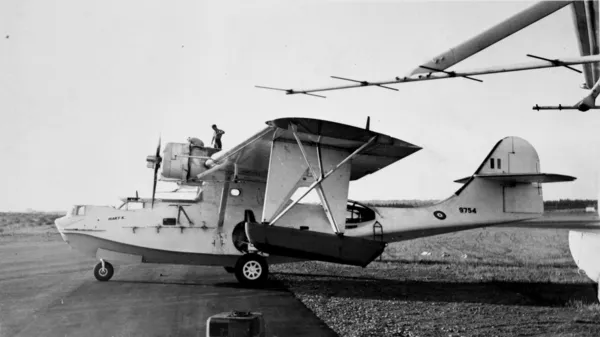
The Consolidated Catalina and Canso were close cousins. The Canso was the true amphibious version of the design and therefore included a conventional undercarriage to allow for either water or land use. The Canso provided more than two decades of valuable service to the RCAF. The Catalina variant came first and was produced beginning in 1935 for the United States Navy. The amphibious version, designated PBY-5A, came in service early in 1941 and the RCAF began using the aircraft on anti-submarine patrols that same year. After the Second World War, the RCAF used Cansos for search and rescue, Arctic survey missions and various transport operations. RCAF
 Canso PBY
 Wikipedia Canso PBY
Aircraft Images
Canso 9807
Canso A 9807
Served with No. 5 (BR) Squadron in Nova Scotia, Newfoundland, or Quebec, coded "F". Crashed near Gander in early 1943 (or 1944?). To No. 19 Sub Repair Depot at RCAF Station Gander, Newfoundland on 6 May 1943. Wreckage still on site in 2012.{{link,canadaprimary,https://heritage.canadiana.ca/view/oocihm.lac_reel_c5933/2006,RCAF - Accident Investigation File}}
1943-02-12 Taken on Strength Eastern Air Command 2019-08-20
1943-May-05 Accident: 5 Squadron Loc: Aerodrome Names: Barsalou | Casey | Cleeland | Dube | Millar | Morrice | Stallwood
1944-03-20 Struck off Strength Struck off, reduced to spares and produce 2019-08-20
Unit Desciption
5 (BR) Sqn Frangas Non Flectas ( x)
History of the Squadron during WWII (Aircraft: Audax, Mohawk IV, Hurricane IIc, IId, Thunderbolt I & II)
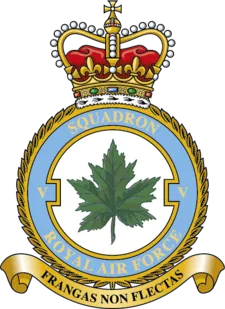
The Maple leaf in the badge reflects the squadron's close association with the Canadian Corps during WWI.
At the outbreak of war in September 1939, No. 5 Squadron were based in the North-West Frontier of India at Fort Sandeman (now Zhob, Pakistan), equipped with the Westland Wapiti biplane. The squadron became a light bomber unit when it converted to the Hawker Hart in June 1940. It became a fighter unit, equipped with obsolete Hawker Audaxes, in February 1941. In December 1941, the squadron relocated to RAF Dum Dum, Calcutta, and began to receive their first monoplane – the American-built Curtiss Mohawk Mk.IV. After the outbreak of hostilities with Japan, the squadron moved to RAF Dinjan, Assam, in May 1942, and was tasked with escorting Bristol Blenheim bombers over north west Burma (now Myanmar). Its first operational fighter sortie was flown in July 1942. In January 1943, the squadron began flying RHUBARB operations, on targets on the Imphal and Chindwin rivers, and these became an important part of the squadron’s activities. In June 1943 while the squadron was based at RAF Kharagpur, the Mohawks were replaced by Hawker Hurricane Mk.IId’s for ground attack missions, although they did not use them on vehicles until the following January. Later the squadron converted to Hurricane IIc’s and returned to more normal bomber escort and interdiction duties. In June of 1944, the squadron re-equipped with North American Thunderbolts, returning to operations in December. Duties were a mixture of escorts to Dakotas dropping supplies, RHUBARBS and dive bombing with wing-mounted 500 lb (227 kg) bombs. The last operations were bombing in support of the invasion of Rangoon. At the end of the hostilities, the squadron returned to India where it converted to Tempests and was disbanded in August 1947.
Maps for Movements of No. 5 Squadron 1941-45
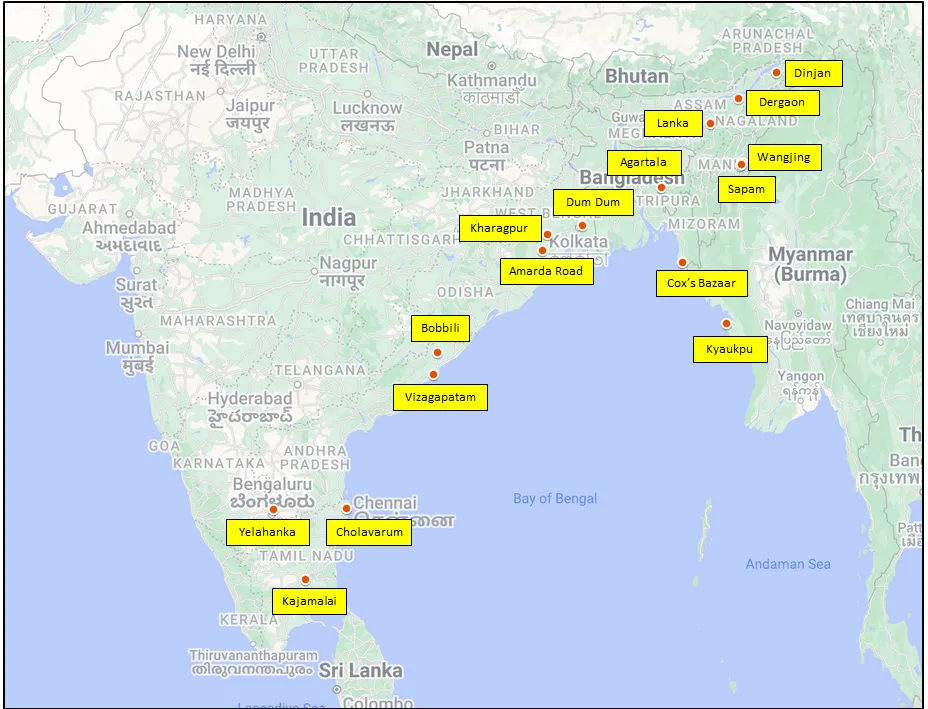
MAP 1 Bases used by 5 Sqn RAF 1941-45 (right-click on image to display enlarged in new tab)
|
Canso 9807 A - Reconnaissance - 1943-05-05 to 1943-05-05
War Diary Unavailable
6 Bomber Group May 5, 1943
3 Wellingtons from 426 and 429 Squadrons were ordered out on a sea search. All crews returned safely, but unsuccessful. Richard Koval (6bombergroup.ca)
5 (BR) Squadron, RCAF Station Gander, Newfoundland. Canso A 9807 F was outward-bound on an anti-submarine patrol when it crashed into bush immediately after take-off from Gander Newfoundland. The aircraft was completely demolished by the crash and the subsequent explosion of fuel and depth charges, killing six of the seven aircrew aboard
Flight Lieutenant Brian Anthony Casey MiD (RCAF), Flight Lieutenant Jean Paul Barsalou (RCAF), Flying Officer James Rayson Wallace Cleeland (RCAF), Pilot Officer James Herbert Millar (RCAF), Warrant Officer Class 2 Alexander Frederick Morrice (RCAF) and Sergeant John Benjamin Stallwood (RCAF) were all killed in action
Corporal Urbaine Edmond Antoine Dube (RCAF) survived the crash, seriously injured
The cause of the loss of this aircraft was not determined but a recommendation was made that a Canso should not be fully loaded at take-off if the wind conditions are too "rough" or strong
Quietus Last Flight, Accident Proneness in WWII, Wartime Aviation Stories on the Canadian Home Front by Anne Gafiuk, Chapter 6
RCAF Squadrons and Aircraft by Samuel Kostinuk and John Griffin, page 26
RCAF Canso 9807 (DfAp-07) - Plane Crash Girl.ca
Canadian Vickers PBV-1 Canso (OA-10 Canso) I Bureau of Aircraft Accidents...
