Fox Moth (Total: 3, Canadian: 3, Group 0)
de Havilland Fox Moth

Canadian Aviation and Space Museum
The Fox Moth was designed in England in 1932 as a light, economic transport, and was built using as many Tiger Moth components as possible. Fox Moths were produced in Canada after the Second World War mainly to keep the plant in production, but also to satisfy the increasing need for new bush aircraft. All the Canadian modifications made to the Tiger Moth were also applied to the Fox Moth. Of the 53 produced, 39 remained in Canada, most of which were operated in float/ski configuration, and gave years of satisfactory service.
The Fox Moth, though efficient, was a bit of an anachronism. For example, a modern, moulded- plexiglas sliding cockpit-hood was attached to what was essentially a 1932 aircraft. Communication between the passenger cabin in the fuselage and the cockpit to the rear was through a hole in the instrument panel. De Havilland designed a special stretcher for the Fox Moth, in order that it could operate as an air ambulance. Canadian Aviation and Space Museum
 Fox Moth
 Wikipedia Fox Moth
 Harold Skaarup Web Page
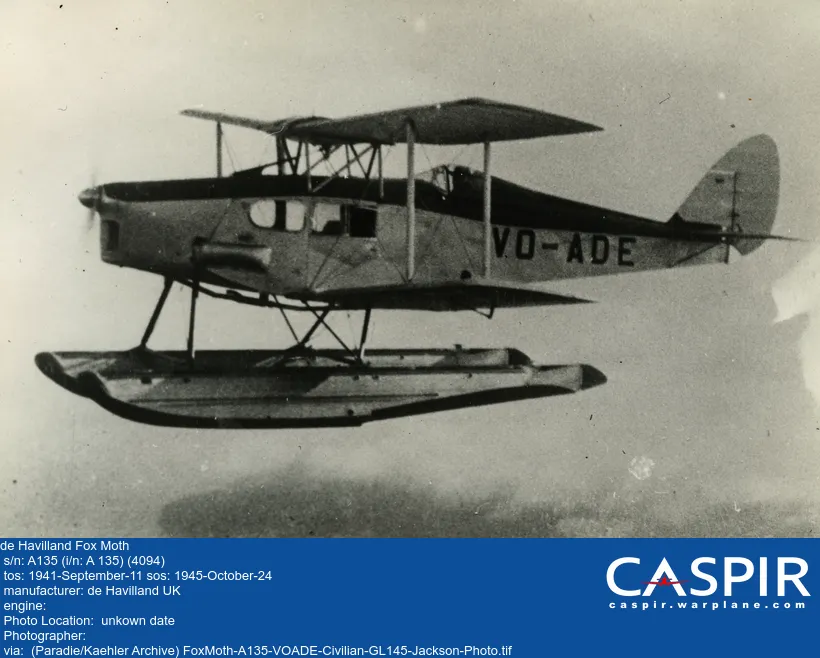
Fox Moth serial A135
s/n A135
c/n 4094
inst/n A 135
de Havilland
A 135
Known Units:
Received from UK Air Ministry. Had been on Newfoundland register as VO-ADE from 1934. Had been operated by Imperial Airways on behalf of the Newfoundland Government Air Service, was the first aircraft to land at the present location of Gander airport on 11 January 1938. Returned to flying status with Eastern Air Command on 31 July 1942. Operated by Station Flight at RCAF Station Gander, Newfoundland in civil markings, 1941 to 1945. Loaned to RAF Ferry Command on 1 August 1942, operated by No. 45 Group. Damaged beyond repair at Gander Bay on 22 February 1944.last update: 2026-August-19

1941-September-11 Classified Instructional CA A 135 2020-06-16
1945-October-24 Struck off Strength Struck off strength transferred to Government of Newfoundland 2019-08-20
Fox Moth DH.83 serial C-FYPM
s/n CFYPM
m/d DH.83
c/n 4033
C-FYPM
Known Units:
de Havilland DH 83 Fox Moth, construction number 4033, built at Stag Lane, England and registered G-ACAJ in November 1932 for the Prince of Wales. It later flew in the Belgian Congo, New Zealand (airline and crop-spraying service; crashed on the Franz Josef glacier in 1943 and rebuilt) and Fiji, was derelict by 1960, and was restored in New Zealand from 1993. The museum's page gives no registration; the registration C-FYPM comes from a third-party list and is the less certain part. The museum says nothing of RCAF service and CASPIR has no record of any. Added 2026-11-04 because it is in Vintage Wings of Canada and its type was used by the Canadian military (CASPIR includes aircraft in Canadian museums if the type was used by the Canadian military: about/dataarchive). last update: 2026-November-04Fox Moth DH.83C serial CF-DJB
s/n CFDJB
m/d DH.83
c/n FM-28/2
CF-DJB
Known Units:
Fox Moth built by de Havilland Aircraft of Canada at Downsview, Ontario, in 1947 and owned by several operators before Max Ward (founder of Wardair) bought it in the 1980s, repainted it in the markings of his first bush plane, restored it and presented it to the museum in 1989 (artifact 1989.0335). Shown in the Early Travel and Transport exhibition. Added 2026-11-04 because it is in the museum and its type was used by the Canadian military (CASPIR includes aircraft in Canadian museums if the type was used by the Canadian military: about/dataarchive). Source: the museum's own collection highlight page and the Ingenium collection record. last update: 2026-November-04